Foundation Repair in Schaumburg, Illinois
Schaumburg went up in three decades on flat prairie clay, and it cracks in patterns: block split-levels bowing under saturated ground, poured colonials settling into former farmland, townhouse rows moving together. When one house on a street cracks, its siblings usually follow, so a diagnosis here often arrives half proven.
- Structural warranty: 25-year transferable
- Published pricing: injection from $450, piers from $1,600
- Free structural inspection within 48 hours
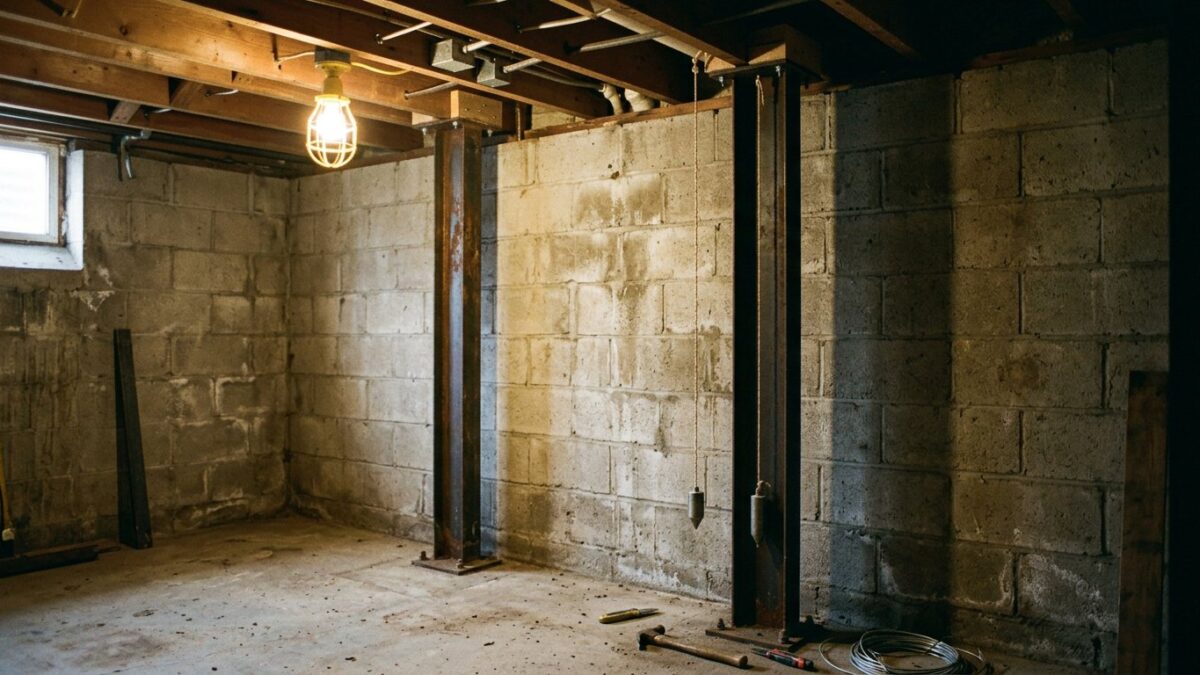 Measured first, 25-year transferable warranty after
Who does foundation repair in Schaumburg?
ProSeal Basement Waterproofing repairs Schaumburg foundations from a base in the Joliet and New Lenox corridor, covering crack injection at $450 to $900, bowing-wall reinforcement at $600 to $1,800 per strap, beam or anchor, and settlement piers at $1,600 to $3,000 each. The prices are published before an estimator sees your wall, and structural work carries a 25-year transferable warranty.
The useful thing about a planned village is that its houses fail in cohorts. A 1971 split-level on the Wise Road side shares its block, its backfill and its drainage details with hundreds of near twins, so the crack you found this spring has usually been measured, repaired and warrantied somewhere nearby already. We treat that pattern as evidence, then verify it against your wall's own numbers before anything is quoted.
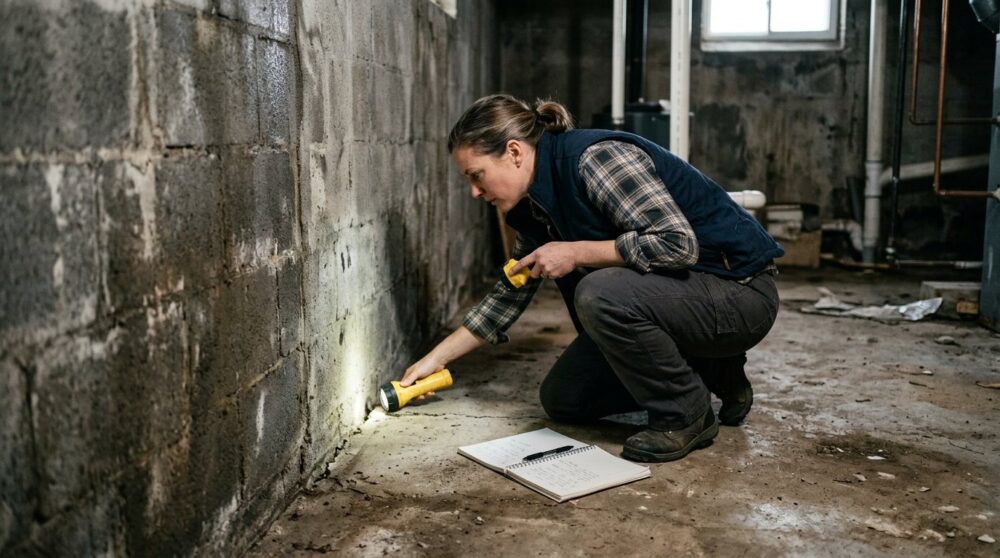 Numbers before steel: deflection and elevation mapped at the free inspection.
What does foundation repair in Schaumburg include?
Six structural tools cover what three decades of Schaumburg construction can break, and the written plan always argues for the cheapest fix that fully solves the problem. Reasoning comes with the quote, not after it.
 Urethane crack injection
Settling cracks in the 1980s and 90s poured walls, sealed full depth in a morning.
Learn more
Urethane crack injection
Settling cracks in the 1980s and 90s poured walls, sealed full depth in a morning.
Learn more
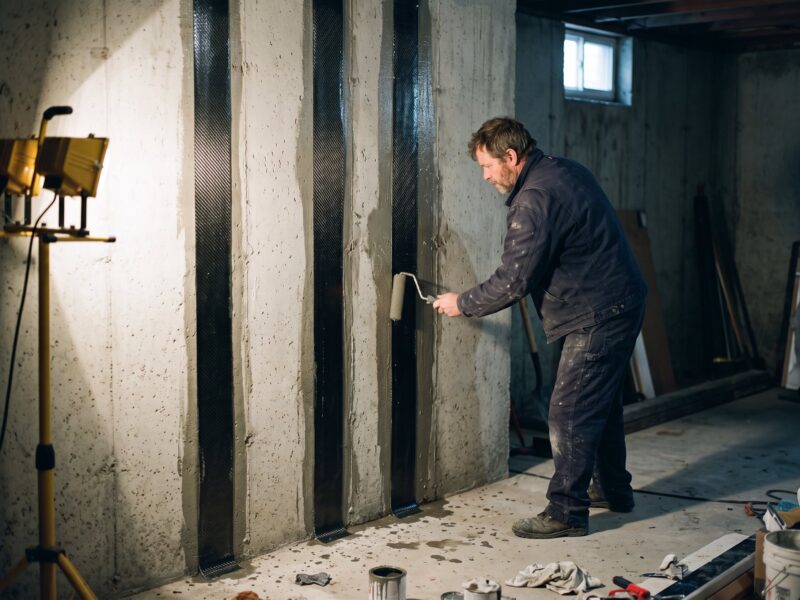 Carbon fiber straps
For block-era walls caught while the bow is still under two inches.
Learn more
Carbon fiber straps
For block-era walls caught while the bow is still under two inches.
Learn more
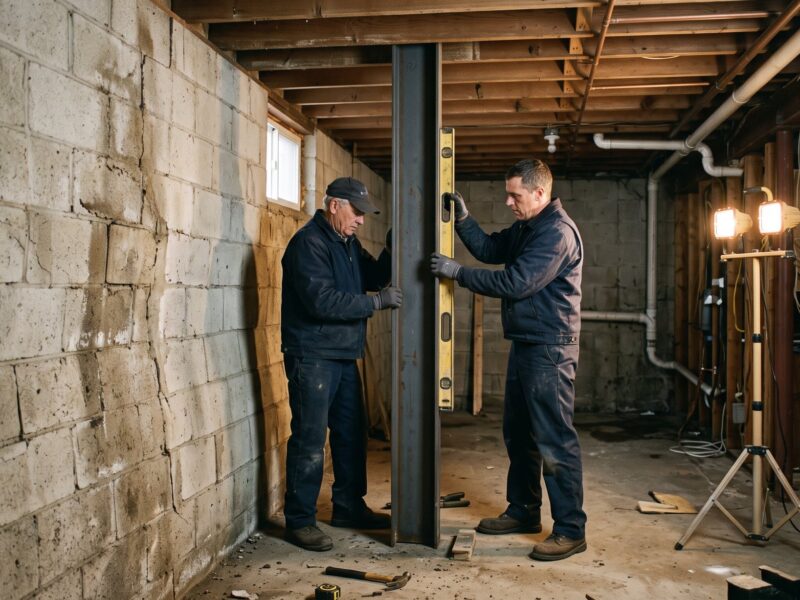 Steel I-beams & wall anchors
For split-level block that waited too long for carbon fiber.
Learn more
Steel I-beams & wall anchors
For split-level block that waited too long for carbon fiber.
Learn more
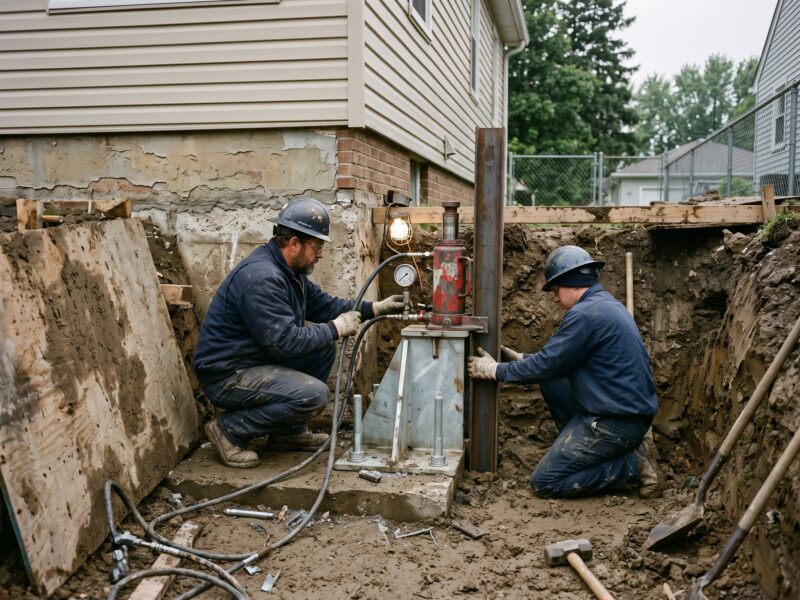 Push & helical piers
For settlement where subdivisions sit on graded prairie fill.
Learn more
Push & helical piers
For settlement where subdivisions sit on graded prairie fill.
Learn more
 House leveling
Beams, columns and footings under sagging mid-span floors.
Learn more
House leveling
Beams, columns and footings under sagging mid-span floors.
Learn more
 Not sure what you have?
A plain-language guide to what Schaumburg walls and floors are trying to report.
Learn more
Not sure what you have?
A plain-language guide to what Schaumburg walls and floors are trying to report.
Learn more
Why do Schaumburg foundations crack and settle?
Schaumburg foundations crack because flat clay holds water against them far longer than sloped ground would, and because a village built in a few big pushes repeats every marginal detail hundreds of times. The era of your house predicts the failure better than almost anything else.

Block walls of the first phases
The 1960s and 70s split-levels and ranches stand on block that has now spent decades against clay that stays saturated because the water cannot run off. Mid-height horizontal cracks and corner stair-steps are that pressure keeping score, and age has removed the walls' margin.
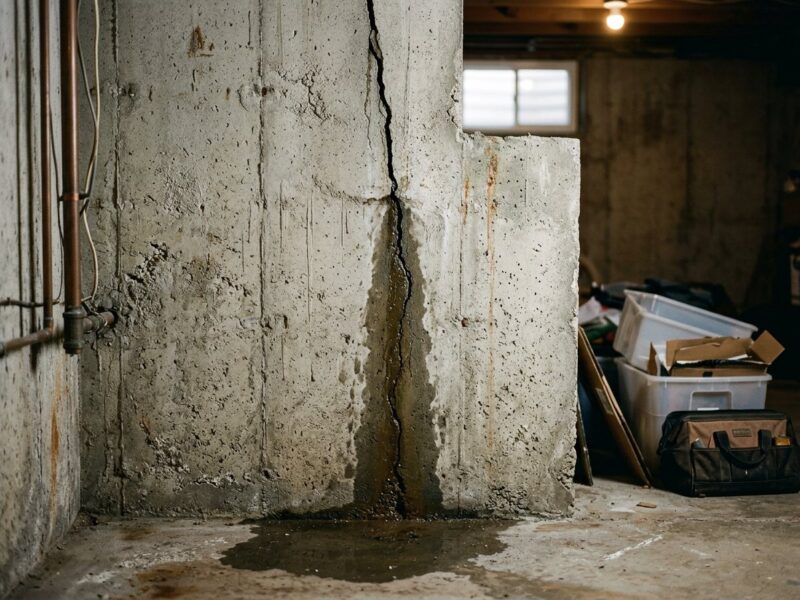
Poured walls of the later phases
The 1980s and 90s colonials cured, shrank and settled into graded farmland, and their vertical and diagonal cracks are mostly stories about that first decade. The job is telling the finished movement from the active kind, which is a measurement, not an opinion.

The townhouse rows
Attached homes ride their shared foundations together, so movement telegraphs along the row: a crack at one party wall, doors sticking two units down. Repairs here get sequenced for the structure as a whole, which is where the systemic pattern actually helps.
What does flat prairie clay do to Schaumburg foundations?
Flat prairie clay works on a Schaumburg foundation from both directions of the moisture cycle, and the flatness makes both worse. In wet seasons, water that has no fall to escape by stands in the soil and swells it, loading basement walls for weeks at a time; Poplar Creek and the Salt Creek headwaters carry it away, but slowly. In drought, the same clay shrinks hard and evenly, and footings follow it down.
That is why drainage and structure are one conversation in this village. A yard that ponds is not just a lawn problem; it is a wall being loaded every storm, and the cheapest structural repair in Schaumburg is often the grading and French drain work that stops the cycle upstream. Where subdivisions sit on filled and graded farm ground, corners and additions can settle on their own schedule, and there the answer is piers carried down to soil that has stopped negotiating.
 Regrading as structural medicine: unloading a wall by rerouting its water.
Signs you need foundation repair in Schaumburg
Six symptoms produce most Schaumburg structural calls, and because the housing repeats, most of them arrive with precedent three doors away. None of them get cheaper by waiting a season.
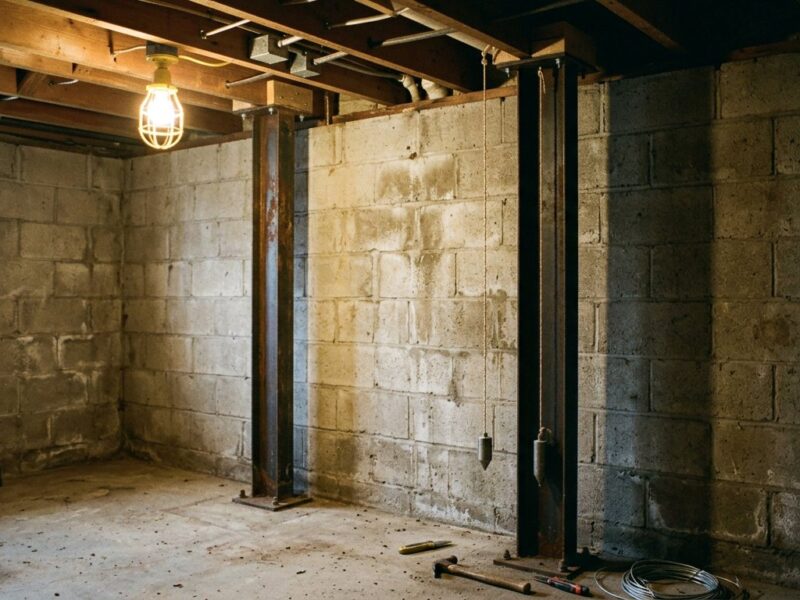
A horizontal crack at mid-height
The block-era warning that matters most: saturated clay actively bowing the wall inward. Caught early it is carbon fiber money; ignored through a few more wet springs it becomes steel and anchor money.
Stair-step cracks at the corners
Mortar joints tracing how one part of the foundation moved against the rest. Width, direction and change over time tell the story, which is why we measure instead of eyeball.

Doors out of square, floors off level
When latches quit catching upstairs, something moved downstairs. In split-levels it is often a beam or column at the level change, which costs far less than a foundation, so the diagnosis pays.
A crack that leaks during storms
Poured-wall cracks that pass water are usually stable shrinkage paths, sealed for $450 to $900. The inspection confirms the crack is finished moving before anyone quotes past an injection.

A bouncy or sagging mid-span floor
Long spans of the colonial era sag at midlife, and the honest fix is framing: sistered joists, a beam, a column with a real footing. Structural, warrantied and cheaper than what people fear.

The same crack as the neighbors
On streets of near-identical homes, matching cracks in matching walls are a pattern worth reporting. It sharpens the diagnosis and often means the proven local fix is already known.
Same crack as the house next door? In a village built in cohorts, that is data. Get yours measured against it, free.
How does foundation repair work in Schaumburg?
A Schaumburg repair runs four steps from call to warranty, planned around the honest fact that the village sits at the top of our map and gets served in scheduled blocks.
Measure the movement
Crack widths, wall deflection and floor elevations get mapped in numbers, and we note the house's era and phase, because a 1972 block wall and a 1991 poured wall fail differently on the same street. Free, within 48 hours.
Day 0Check the cohort
Where we have measured or repaired the same era nearby, that history informs the plan, and the plan says so. The method still has to earn its place against your wall's own numbers.
Day 0, same visitInstall and verify in one block
Because the drive north is real, jobs are staged so the crew arrives once with everything: straps, steel, piers or injection, installed, torqued and re-measured against day-zero figures before leaving.
Days 1 to 3Warranty registered to the address
Structural repairs carry the 25-year transferable warranty and injections the 10-year coverage, both registered to the house so they survive a sale.
On completionReinforce or rebuild: what do Schaumburg walls need?
Reinforcing in place is the right call for nearly every failing Schaumburg wall, because the village's stock is young enough that walls are almost always intact when the first crack appears, and the systemic pattern means problems get spotted early, while the cheap options are still on the table.
| Reinforce in place | Excavate and rebuild | |
|---|---|---|
| Best for | Bowing block and settling poured walls still structurally sound, which is nearly all of them here | Walls sheared, collapsing or beyond reinforcement, rare in stock this young |
| On saturated flat clay | Interior work is indifferent to the wet ground outside | Deep excavation in slow-draining clay means pumping, shoring and mud |
| In townhouse rows | Installs inside one unit without disturbing the neighbors' foundations | Excavating against a shared foundation involves everyone attached to it |
| Paired with drainage | Straps or piers plus yard drainage remove both the symptom and the cause | Rebuilding a wall while the clay stays wet invites a repeat performance |
| Cost | $450 injections to $3,000 piers, from published ranges | Tens of thousands per wall before the landscaping bill |
| Time | One to three days, grouped into a scheduled Schaumburg block | Weeks of machines, spoil and an open trench beside the house |
A rebuild quote that arrives without deflection numbers deserves a second opinion. Ours is free, and it comes with the measurements attached.
When do Schaumburg foundations move?
Schaumburg foundation movement follows the moisture calendar of clay that drains slowly in every season, and each quarter of the year has its own cheapest moment to act.
Spring: the loading season
Melt and rain stand in flat yards and swell the clay against block walls for weeks. Horizontal cracks widen and bows advance measurably, which makes spring the season readings are most revealing.
March to MaySummer: the shrink season
A dry July pulls moisture out of the prairie clay and lets footings drop with it. Cracks open over windows and doors in the poured-wall phases, and settled corners announce themselves.
June to AugustFall: the repair season
Calm soil, workable ground and open scheduling make fall the easiest time to strap a wall, drive piers or fix the grading that loads the wall in the first place, all before frost.
September to NovemberWinter: the indoor season
Injection, carbon fiber, bracing and beam-and-column work all happen inside at full speed while the ground is locked. Winter blocks are the quickest to book on the north end of our map.
December to FebruaryHow much does foundation repair cost in Schaumburg?
Foundation repair in Schaumburg costs $450 to $900 per injected crack, $600 to $1,800 per strap, beam or anchor on a bowing wall, and $1,600 to $3,000 per pier for settlement, the identical published ranges we hold across the map, with nothing added for the drive. Where wet ground is the root cause, the quote may pair a small drainage line item with the structural fix, because repairing the wall without unloading it is half a job.
| Work | Range | What moves the number |
|---|---|---|
| Urethane crack injectionper crack | $450–$900 | Crack length and width, access to the full height |
| Carbon fiber strapsper strap | $600–$1,000 | Wall height, spacing the deflection requires |
| Steel I-beam wall bracingper beam | $900–$1,500 | Ceiling height, footing condition at the base |
| Push or helical piersper pier | $1,600–$3,000 | Depth to load-bearing strata, access for equipment |
The full structural table lives on the pricing page; your written Schaumburg quote lands inside it.
Where we repair foundations in Schaumburg
Across 60193, 60194 and 60195 the structural calls sort by construction phase. The Wise Road area and the Schaumburg Road corridor, where the earliest split-levels and ranches stand, send bowing block, horizontal cracks and level-change beam questions. The Roselle Road and Golf Road corridors send the later poured stock's settling cracks and the occasional low corner on graded fill, plus townhouse rows where movement travels the party walls. Lots draining toward Poplar Creek and the Salt Creek headwaters near Busse Woods pair their structural calls with wet ground more often than anywhere else in the village.
On monitoring, honesty about geography: Schaumburg is the northern boundary of our service area, an hour and a quarter to an hour and a half out, so when a wall deserves watching rather than steel we schedule the re-measure into our next northern block and put the date in writing, instead of pretending we pass by daily.
 The early start a northern-edge job gets: staged the night before, on the road at dawn.
Schaumburg foundation repair questions, answered straight
Is Schaumburg really inside your service area?
It is the northern edge of it, and we say that plainly. The drive from our base runs an hour and a quarter to an hour and a half, there is no travel charge, and we group Schaumburg work into scheduled blocks so the logistics stay realistic. If we cannot make a date work, you hear that on the phone, not after a week of silence.
My 1970s split-level has a horizontal crack in the block. How serious is it?
Serious enough to measure this season. Horizontal at mid-height means the clay is actively pushing the wall in, and block of that age has little reserve left. Under two inches of bow it is usually carbon fiber at $600 to $1,000 per strap; past that it graduates to steel beams or anchors. The gap between those prices is the cost of waiting.
The ground here is completely flat. Why would a foundation settle at all?
Because flat is about the surface, not what is under it. Schaumburg subdivisions sit on farmland that was cut, filled and graded before building, and filled ground compresses on its own schedule, especially under corners, stoops and additions. Add clay that swells wet and shrinks dry, and a perfectly level lot can still move a footing. Elevations tell us whether yours has.
How much does foundation repair cost in Schaumburg?
The published ranges apply unchanged: $450 to $900 per injected crack, $600 to $1,000 per carbon strap, $900 to $1,500 per steel beam, $1,000 to $1,800 for wall anchors, and $1,600 to $3,000 per pier. Support columns run $1,500 to $3,200. Your written quote is built from those numbers and nothing invented on the driveway.
Several houses on my street have the same repair. Should mine be identical?
Probably similar, and that is worth money, but it still has to be verified. Identical houses on identical clay tend to fail identically, so the street's repair history is a genuinely useful prior. We measure your wall anyway, because backfill, downspouts and decades of small choices differ house to house, and the warranty goes on what your wall needs.
Does homeowners insurance cover foundation repair in Schaumburg?
Usually not. Standard Illinois policies exclude damage from soil movement and hydrostatic pressure, which is precisely what moves foundations on this clay. That exclusion is the financial argument for early repair: a strap-stage fix costs hundreds per strap, and the stage after it costs multiples of that, with insurance absent both times.
Will a documented repair hurt when I sell my Schaumburg house?
In our experience the opposite. Buyers walk away from mystery cracks, not from engineered repairs with paperwork. Our jobs close with measurements, photos, the scope and a 25-year transferable warranty registered to the address, which your agent hands to the buyer's inspector as an answer instead of an apology.
If my wall only needs monitoring, will you really come back this far north?
Yes, on a schedule we commit to in writing. Monitoring visits ride along with our next Schaumburg block, typically aligned with the spring and fall movement seasons when readings change most. What you will not get is a fake urgency upgrade to steel just because the drive is long; the numbers decide, both visits.
Is the cracked wall also a wet one?
On flat clay the two trades share a root cause: the standing water that never leaves the yard is the load on the wall that cracked. If the block that bowed also seeps at the cove joint every spring, one Schaumburg visit assesses both, and the fixes get sequenced so the drainage stops feeding the structural problem.
Basement Waterproofing in Schaumburg
Foundation repair near Schaumburg

Get the Schaumburg wall measured while the fix is still small
A free structural inspection within 48 hours, a method matched to your house's era and its street's history, and a 25-year transferable warranty that transfers with the deed.
Or talk to a human right now
(630) 335-1128
Request your free estimate
Tell us what you're seeing. We'll call back fast and be out within 48 hours.