Foundation Repair in St. Charles, Illinois
St. Charles keeps three generations of foundations standing at once: stone quarried before 1900 in the river core, post-war block in the middle rings, and young poured walls out west. We repair each with the method its era demands, measured before and after, under a 25-year transferable warranty.
- Structural warranty: 25-year transferable
- Published pricing: injection from $450, piers from $1,600
- Free structural inspection within 48 hours
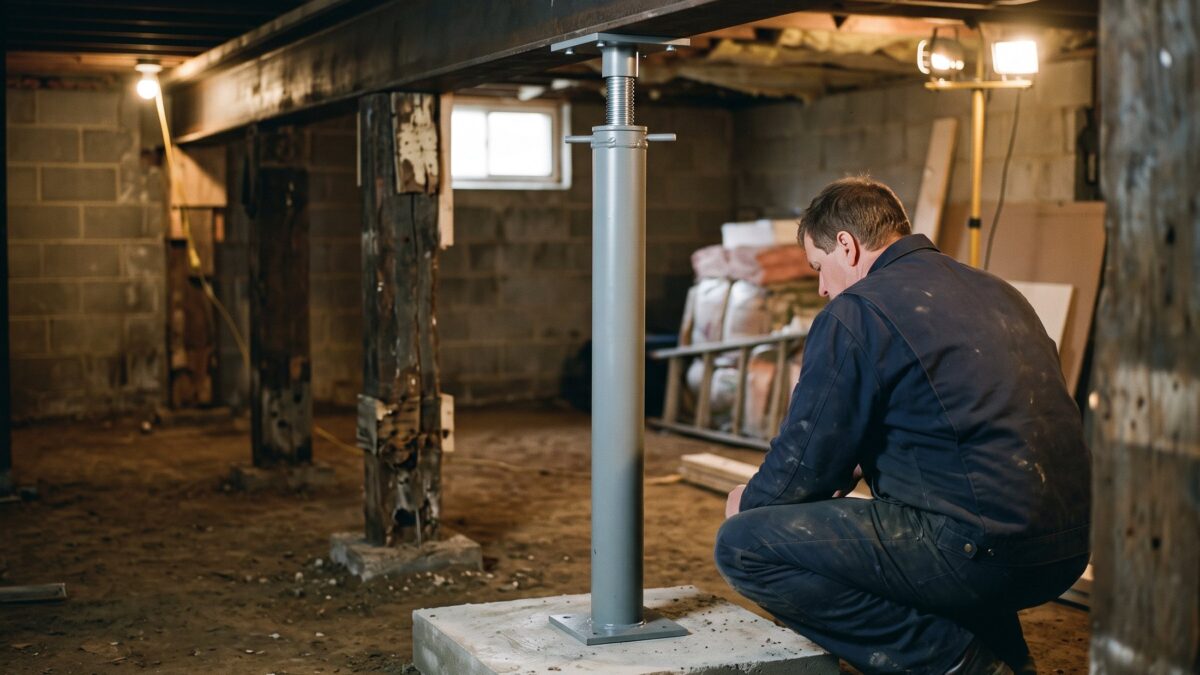 25-year transferable structural warranty
Who does foundation repair in St. Charles?
ProSeal Basement Waterproofing repairs foundations across St. Charles from a base in the Joliet and New Lenox corridor, with crack injection at $450 to $900, bowing-wall reinforcement at $600 to $1,800 per strap, beam or anchor, and settlement piers at $1,600 to $3,000 each, every number published before an estimator sees your wall. Structural work carries a 25-year transferable warranty.
The historic core is why St. Charles deserves a careful contractor. A rubble or limestone wall built from local stone holds itself up by weight, breathes through lime mortar, and has survived a century by moving a little instead of cracking a lot. Treat it like modern concrete, with hard mortar or aggressive excavation, and you damage it. The newer block and poured stock needs the standard playbook; the old stock needs judgment.
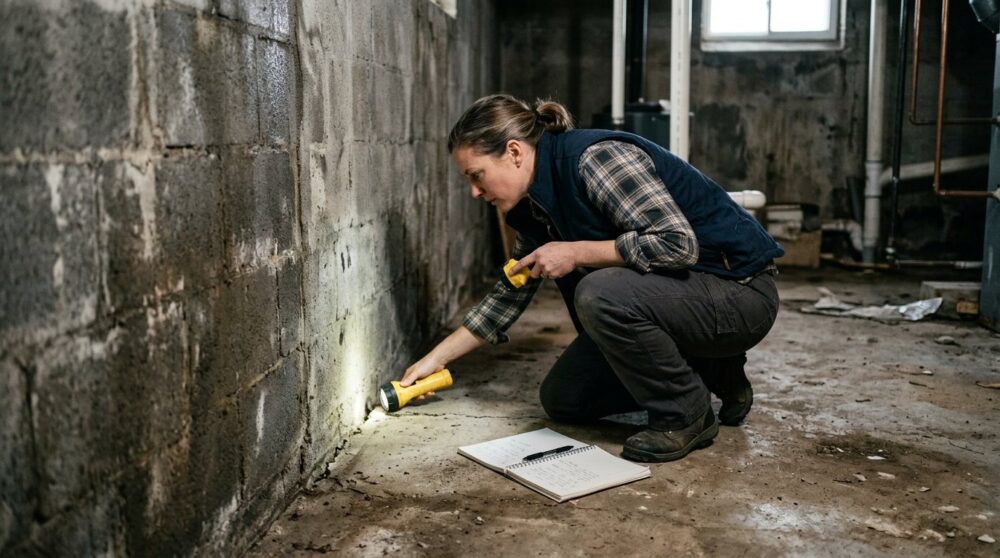 The measurement comes first: era, deflection, movement, then a method.
What does foundation repair in St. Charles include?
Six structural tools cover what three eras of St. Charles housing actually break, and the cheapest adequate fix always leads the written plan.
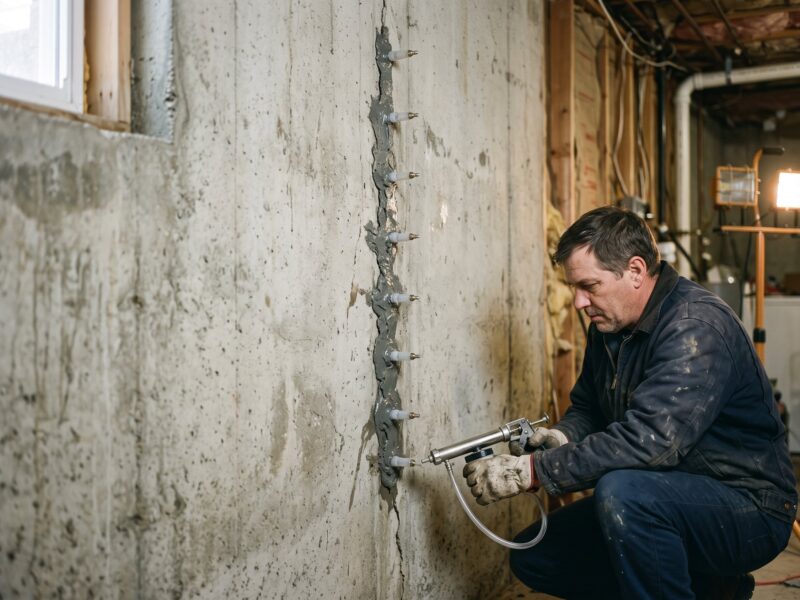 Urethane crack injection
Leaking poured-wall cracks in the western subdivisions, sealed full depth.
Learn more
Urethane crack injection
Leaking poured-wall cracks in the western subdivisions, sealed full depth.
Learn more
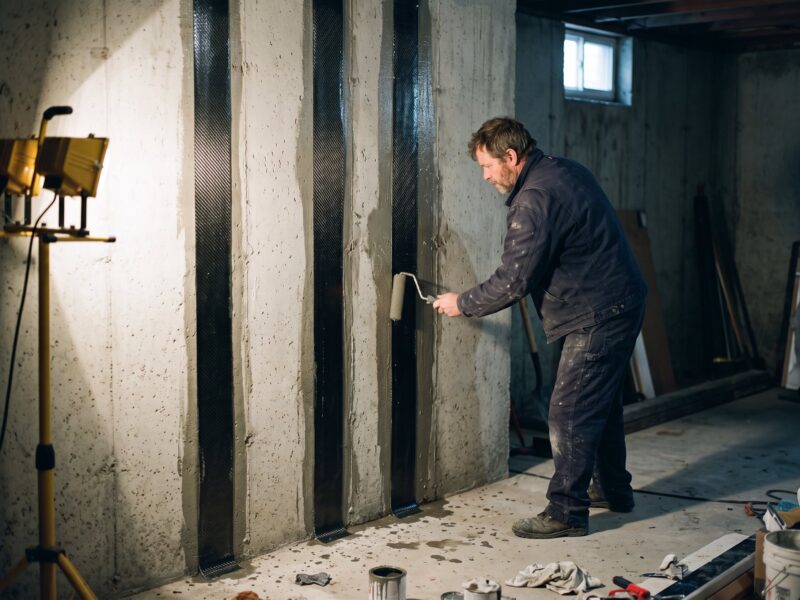 Carbon fiber straps
For post-war block caught while the bow is still under two inches.
Learn more
Carbon fiber straps
For post-war block caught while the bow is still under two inches.
Learn more
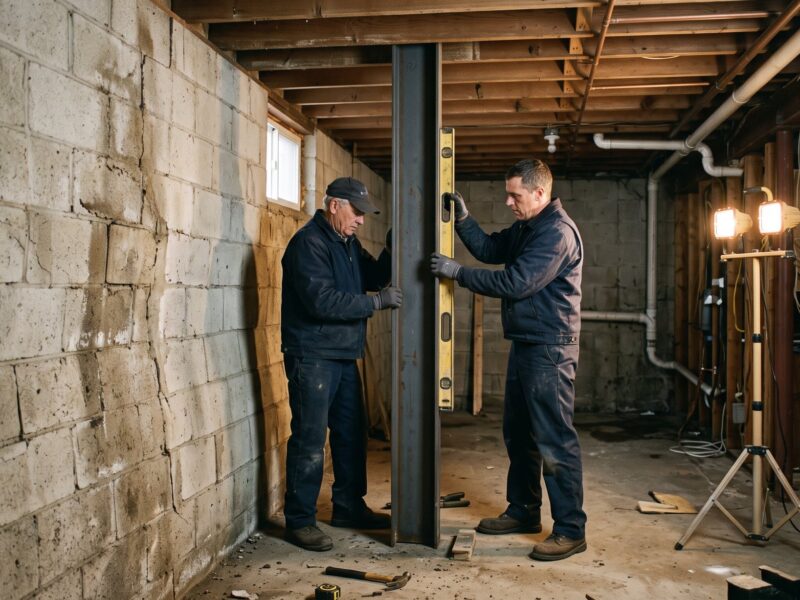 Steel I-beams & wall anchors
For block walls past the carbon fiber window.
Learn more
Steel I-beams & wall anchors
For block walls past the carbon fiber window.
Learn more
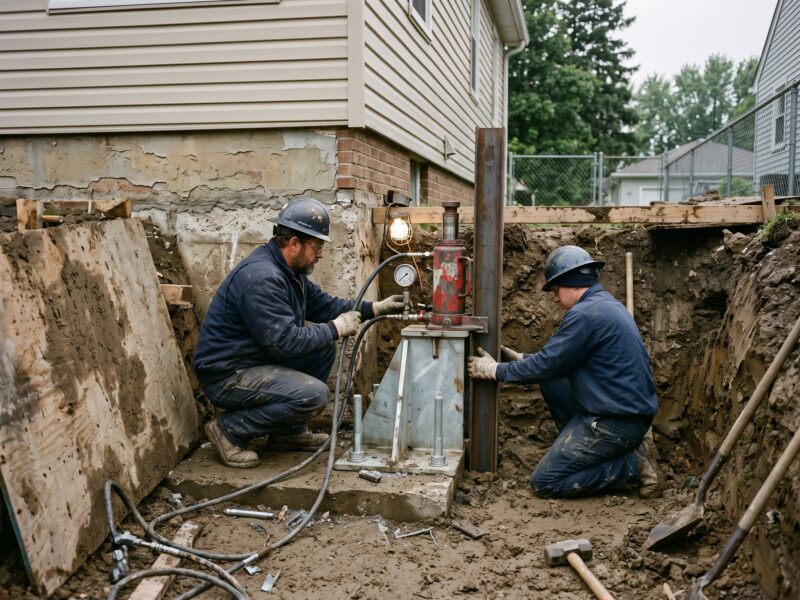 Push & helical piers
For settlement in the graded ground west of the old town.
Learn more
Push & helical piers
For settlement in the graded ground west of the old town.
Learn more
 House leveling
Columns, beams and sistered joists under the historic core's sagging floors.
Learn more
House leveling
Columns, beams and sistered joists under the historic core's sagging floors.
Learn more
 Not sure what you have?
A field guide to what a river town's walls and floors do when something below is moving.
Learn more
Not sure what you have?
A field guide to what a river town's walls and floors do when something below is moving.
Learn more
Why do St. Charles foundations crack and settle?
Each era of St. Charles construction fails in its own dialect: stone loses mortar, block bows under clay, and young poured walls ride settling ground. Reading the dialect correctly is most of the diagnosis.

Stone walls of the river core
The pre-1900 stock stands on quarried and rubble stone bound with lime mortar. It fails softly: joints wash out, faces bulge, floors above dip. It wants repointing in kind, moisture relief and patience, never hard modern mortar or a jackhammer.

The post-war rings
Block foundations from the mid-century decades take clay pressure on the flat of the wall. Horizontal cracks at mid-height and stair-steps at corners are the tells, and the price of the fix depends entirely on how early you measure.

The western growth
The 1990s and 2000s subdivisions toward Randall Road sit on poured walls over graded ground that is still finding its final shape. Cracks over windows, a low corner, a garage seam opening: settlement questions that elevations answer.
What is under a St. Charles foundation?
Under St. Charles sits river-valley ground that changes character block by block. Near the Fox River the water table is shallow and the soil stays wet, which matters structurally because lime-mortar stone walls cycle moisture constantly; the wetting and drying is what slowly rinses mortar from the joints. Away from the river the Fox Valley clay does what clay does everywhere: swells against walls in wet years and shrinks away from footings in droughts, moving foundations a little each season.
The western third of town adds one more variable: ground that was graded for subdivisions within the last few decades and is still consolidating under the houses placed on it. That is where our settlement calls concentrate, and where elevation surveys and piers do their best work. Three soils, three eras, one rule: measure before you prescribe.
 Graded ground west of the old town: young soil still settling under young houses.
Signs you need foundation repair in St. Charles
Six symptoms bring St. Charles structural calls, ranging from a masonry craft problem on a stone wall to a pier question on a new lot. None of them gets better on its own.

A horizontal crack at mid-height
The serious one in the post-war block: clay pressure actively bowing the wall inward. Early, this is carbon fiber money; late, it is steel and anchor money.

Stair-step cracks in block or brick
Mortar joints mapping differential settlement, one part of the foundation moving relative to the rest. Width and direction tell the story; we measure both.

Mortar washing out of stone joints
On the river core's stone walls, sandy dust and hollow joints mean the lime mortar is rinsing away. Repointing in kind, plus drainage relief, before stones shift.

Doors sticking, frames out of square
When upstairs doors stop latching, something below moved. In the old stock it is often a beam or column, which costs far less than foundation work.
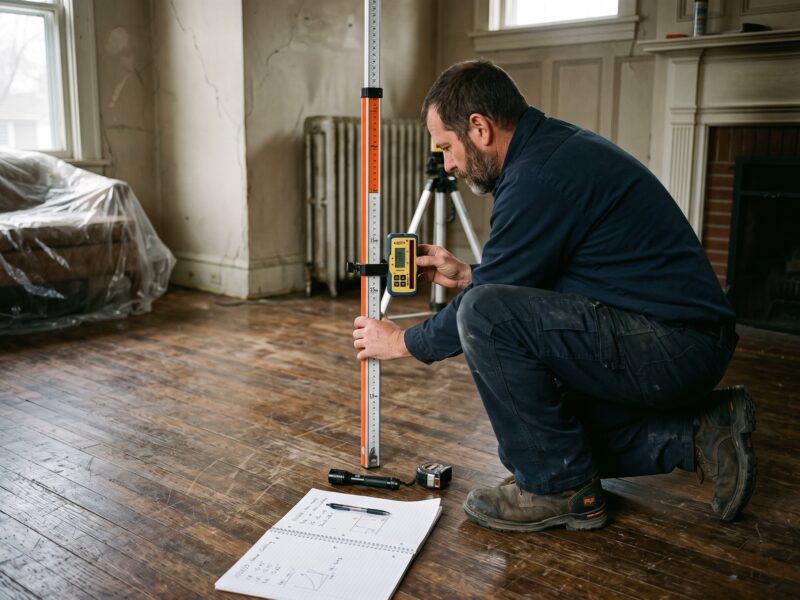
Floors sloping toward the middle
Century-old houses commonly sag toward tired center beams. Columns, footings and leveling from $1,500 fix the frame without touching the perimeter walls.
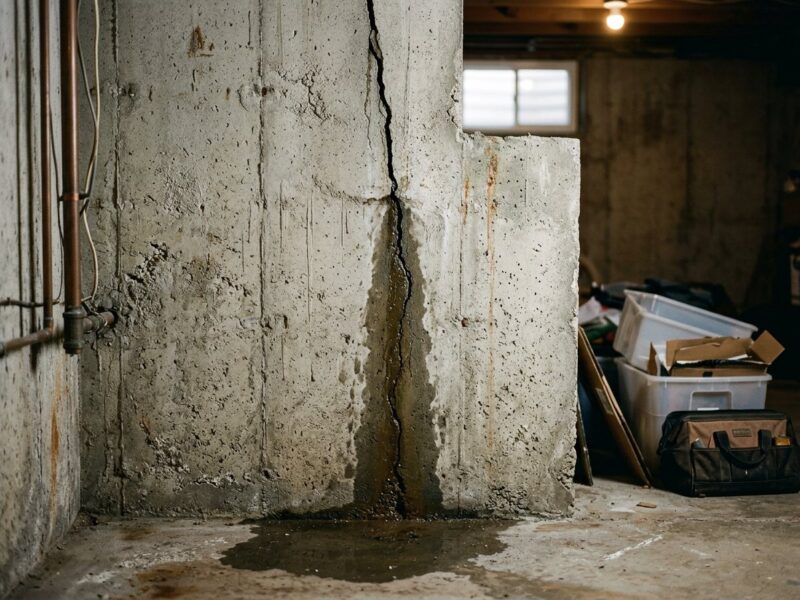
A poured-wall crack that also leaks
Common in the western subdivisions. If the crack is stable, a $450 to $900 injection seals it; if it is moving, the inspection says so before anyone sells more.
Joints in the stone wall turning to sand? Get it measured before another wet season works on the mortar. The inspection is free.
How does foundation repair work in St. Charles?
A St. Charles structural repair runs four steps: date the wall, measure the movement, match the method, verify the result. Most repairs finish in one to three days on site.
Date the wall, measure the movement
Stone, block or poured decides the playbook, so the inspection establishes the era first, then records crack widths, deflection and floor elevations in numbers. Free, within 48 hours.
Day 0Match the method
Lime-mortar repointing and relief for the river core's stone, carbon or steel for block, injection or piers for poured: the written plan pairs fix to failure at published prices.
Day 0, same visitInstall and verify
St. Charles jobs are scheduled as complete visits, so the crew arrives with the full scope loaded, installs, torques to spec and re-measures against the day-zero numbers before driving home.
Days 1 to 3Warranty to the address
The 25-year transferable warranty registers to the house and transfers at closing, with the measurement record attached for the next buyer's inspector.
On completionReinforce or rebuild: what does a St. Charles wall need?
Almost every failing wall in St. Charles can be reinforced or repointed in place for a fraction of rebuild money, and on the historic stock the case is even stronger: a stone wall that has stood since the 1890s usually needs help, not replacement.
| Reinforce in place | Excavate and rebuild | |
|---|---|---|
| Best for | Bowing, cracked or settling walls still structurally intact, which is most of them | Walls sheared or collapsing, a small minority |
| On lime-mortar stone | Repointing in kind and moisture relief preserve how the wall works | Digging out a gravity wall risks collapsing what you meant to save |
| Near the river | Interior methods ignore the shallow water table entirely | Deep excavation close to the Fox River fights groundwater the whole way |
| Historic-district lots | Works from inside; mature trees and tight side yards stay untouched | Needs machine access most core lots simply do not have |
| Cost | $450 injections to $3,000 piers, per published ranges | Tens of thousands per wall, plus excavation and restoration |
| Warranty | 25-year transferable, registered to the house | Varies by scope; get it in writing before signing anything |
If an estimator prescribes a rebuild for a stone wall without measuring it, or quotes Portland mortar for lime joints, get a second opinion. Ours is free and arrives with instruments.
When do St. Charles foundations move?
Foundation movement in St. Charles keeps the clay's schedule, and every season has a cheapest moment to act on it.
Spring: push season
Saturated Fox Valley clay swells and loads the post-war block walls, while the high river keeps the core's stone wet and working on its mortar. Movement is most visible now, which makes spring the best measuring season.
March to MaySummer: shrink season
Drought pulls the clay away from footings and the western subdivisions do most of their settling. Cracks open over windows and doors start catching; elevations taken now show exactly how much.
June to AugustFall: repair season
Calm soil, dry ground and open scheduling make fall the unhurried time to brace a wall, drive piers or repoint stone before frost closes the exterior window.
September to NovemberWinter: interior season
Injection, carbon fiber, steel bracing, columns and beam work all happen indoors at full speed. Batched winter routes to the Fox Valley book fastest of the year.
December to FebruaryHow much does foundation repair cost in St. Charles?
Foundation repair in St. Charles costs $450 to $900 for crack injection, $600 to $1,800 per strap, beam or anchor for a bowing wall, and $1,600 to $3,000 per pier for settlement, the same published ranges we hold in every town regardless of the drive. Stone repointing is masonry craft priced by the wall, scoped in writing at the free inspection.
| Work | Range | What moves the number |
|---|---|---|
| Urethane crack injectionper crack | $450–$900 | Crack length and width, access to the full height |
| Carbon fiber strapsper strap | $600–$1,000 | Wall height, spacing the deflection requires |
| Steel I-beam wall bracingper beam | $900–$1,500 | Ceiling height, footing condition at the base |
| Push or helical piersper pier | $1,600–$3,000 | Depth to load-bearing strata, access for equipment |
The full structural table lives on the pricing page; your written St. Charles quote lands inside it.
Where we repair foundations in St. Charles
The structural map of St. Charles follows its construction history outward from the river. The historic downtown and Century Corners send stone-wall calls: washed joints, bulging faces, sagging center beams. Pottawatomie Park and the Main Street corridor send post-war block with horizontal cracks and stair-steps. The Randall Road and Route 31 corridors send settlement surveys on 1990s and 2000s poured walls. Both ZIPs, 60174 and 60175, are on the route.
The drive is real and we plan for it: an hour to an hour and fifteen from our base in the Joliet and New Lenox corridor, batched with other Fox Valley stops so scheduling stays predictable. Inspections land within 48 hours, and when a wall deserves monitoring rather than steel, re-measurement visits ride the same batched routes.
 Old masonry streets: the era of the wall decides the method of the repair.
St. Charles foundation repair questions, answered straight
Who repairs stone foundations in St. Charles?
We do, and the river core keeps that skill sharp. Rubble and quarried-limestone walls need repointing with compatible mortar, moisture relief and structural judgment rather than the poured-wall playbook. If a contractor quotes your 1890s wall the same fix as a subdivision basement, get a second opinion; ours is free.
Should an old stone wall be repointed with lime mortar or modern mortar?
Lime, or a mortar matched to the original. Hard Portland mortar in a lime-built wall traps moisture in the stone and concentrates stress on it, so the wall starts breaking at its faces instead of breathing through its joints. Matching the mortar to the wall is not nostalgia; it is how these walls last another century.
Is a horizontal crack in my post-war block wall serious?
Yes. Horizontal at mid-height means clay pressure is actively bowing the wall, and block of that age has little reserve. Caught early it is carbon fiber at $600 to $1,000 per strap; left alone it graduates to steel beams, wall anchors or worse. The measurement is free and settles the question with numbers.
My newer house near Randall Road has cracks over the windows. Is it settling?
Likely, and the real question is whether it has finished. Subdivisions built on recently graded ground often move through their first decades. We shoot floor elevations and measure the cracks: active movement is pier territory at $1,600 to $3,000 each, while old stable movement may need nothing but sealed cracks.
How much does foundation repair cost in St. Charles?
Published ranges, identical in every town we serve: $450 to $900 per injected crack, $600 to $1,000 per carbon strap, $900 to $1,500 per steel beam, $1,000 to $1,800 for wall anchors, $1,600 to $3,000 per pier. Stone masonry is scoped per wall at the free inspection because no two rubble walls match.
Does homeowners insurance cover foundation repair in Illinois?
Usually not. Standard Illinois policies exclude damage from soil movement and hydrostatic pressure, which describes most foundation failures including mortar loss in old stone. That exclusion is the practical argument for fixing a wall at the hundreds-per-strap stage instead of the five-figure stage.
Will foundation repair hurt the resale of a historic St. Charles house?
Documented repair usually helps it. Buyers of century-old houses expect foundation history; what scares them is an unexplained bulge with no paperwork. Our work leaves a packet of measurements, photos, scope and a 25-year transferable warranty registered to the address, which your listing agent hands to the buyer's inspector.
You are an hour away. Can you actually monitor a wall that just needs watching?
Yes, because monitoring is scheduled, not spontaneous. When a wall deserves observation instead of immediate steel, we set measurement benchmarks on day one and fold re-checks into our batched Fox Valley routes. You get numbers over time instead of a hard sell on the first visit.
Is the moving wall also wet?
On a St. Charles stone wall the two problems are the same problem: river moisture cycling through the joints is what carries the lime mortar away. If the wall that bulges also weeps every spring, drainage relief belongs in the structural plan, and one inspection scopes both trades in a single visit.
Basement Waterproofing in St. Charles
Foundation repair near St. Charles

Get the wall measured, whichever century built it
A free structural inspection within 48 hours, a method matched to stone, block or poured, and a 25-year transferable warranty that transfers with the house.
Or talk to a human right now
(630) 335-1128
Request your free estimate
Tell us what you're seeing. We'll call back fast and be out within 48 hours.