Foundation Repair in Elgin, Illinois
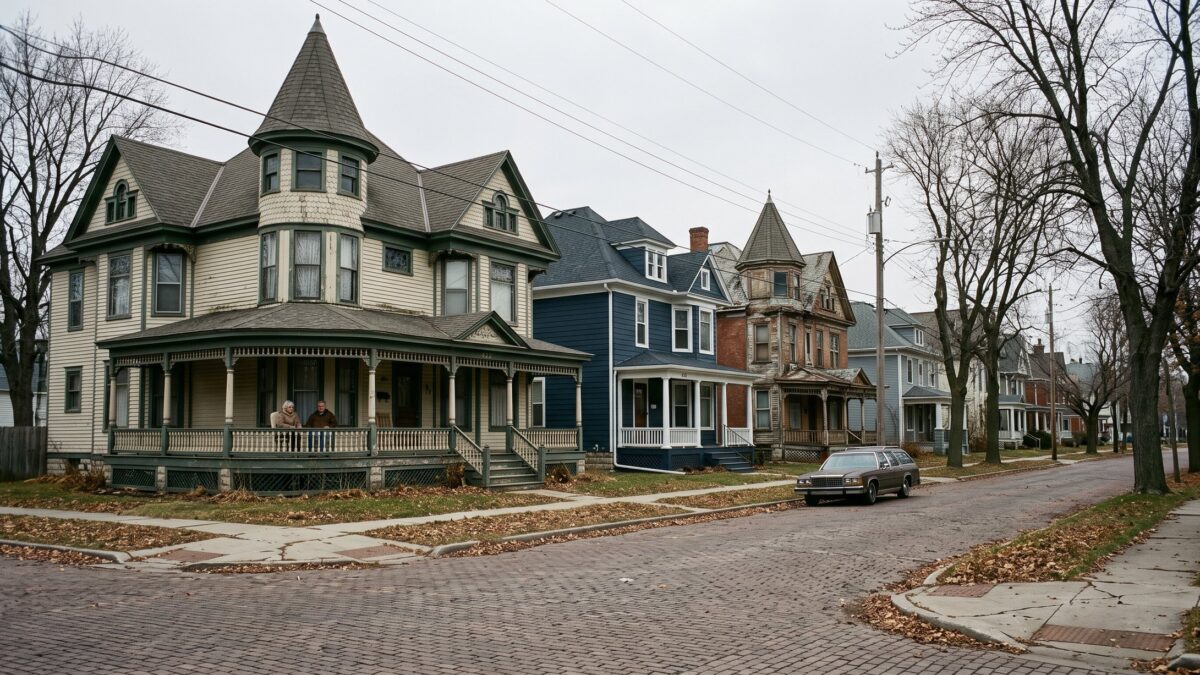
Elgin holds one of the biggest pre-1930 housing inventories anywhere in the region, and those foundations carry a century of recorded movement. Most of it stopped long ago. The skill is knowing which cracks are history and which are happening, and we bring the measurements to prove it either way.
- 25-year transferable warranty on structural work
- Injection from $450, piers from $1,600, all published
- Free structural inspection within 48 hours
 25-year transferable warranty
Who does foundation repair in Elgin?
ProSeal Basement Waterproofing repairs foundations across Elgin, from stone and brick under the historic districts to poured walls out the Randall Road corridor. Crack injection is $450 to $900, bowing-wall reinforcement $600 to $1,800 per strap, beam or anchor, settlement piers $1,600 to $3,000 each, every number published before an estimator sees the house, every repair carrying a 25-year transferable warranty.
The defining question on an Elgin inspection is age versus activity. A Victorian on a stone foundation has been settling, shrugging and re-settling since before anyone alive saw it built, so cracks are simply part of its record. Treating that record as an emergency is how homeowners here get oversold, and reading it correctly is the discipline we bring: measure first, and let the numbers say whether anything is still moving.
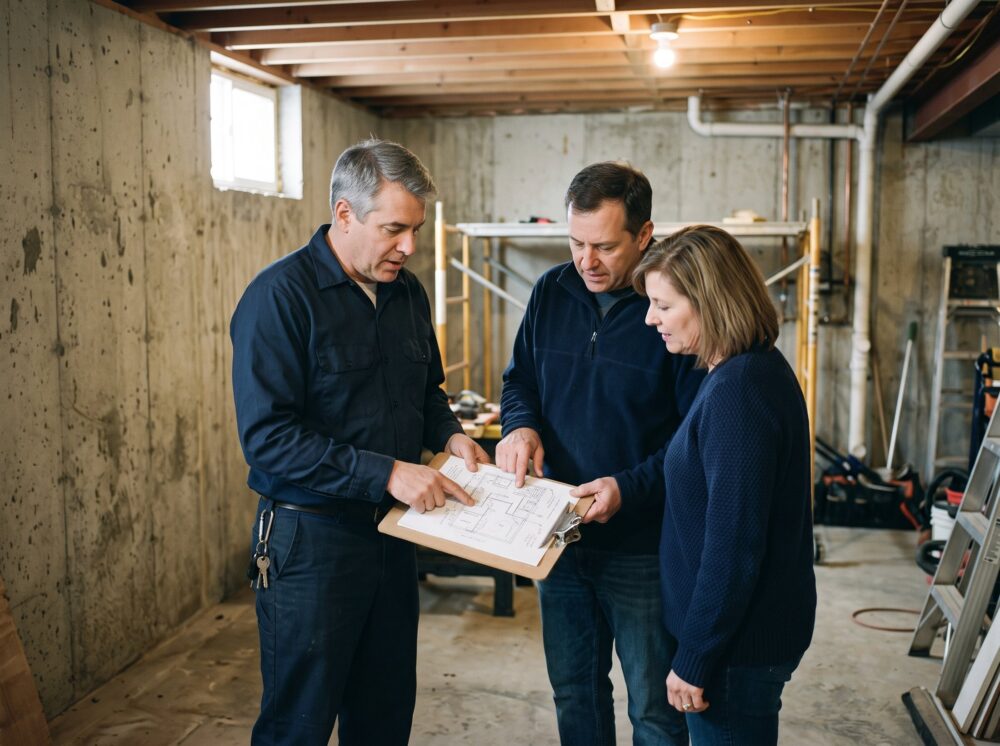
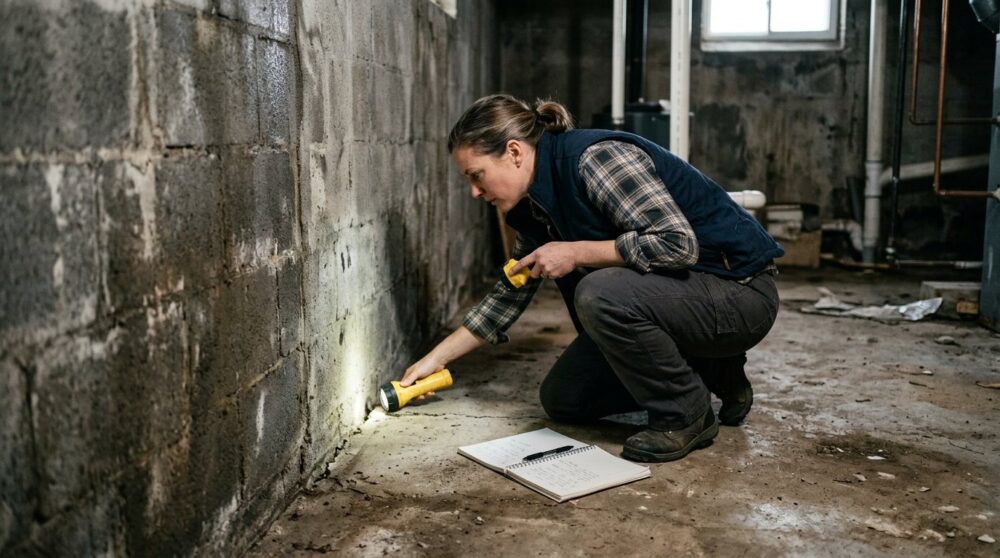 The Elgin inspection: dating the cracks before deciding anything.
What does foundation repair in Elgin include?
Six structural tools handle everything Elgin's three building eras can break, and the plan always starts from the cheapest fix the measurements justify. Nobody here is paid to find steel where a $450 injection will do.
 Urethane crack injection
Full-depth sealing for the west side's poured-wall cracks.
Learn more
Urethane crack injection
Full-depth sealing for the west side's poured-wall cracks.
Learn more
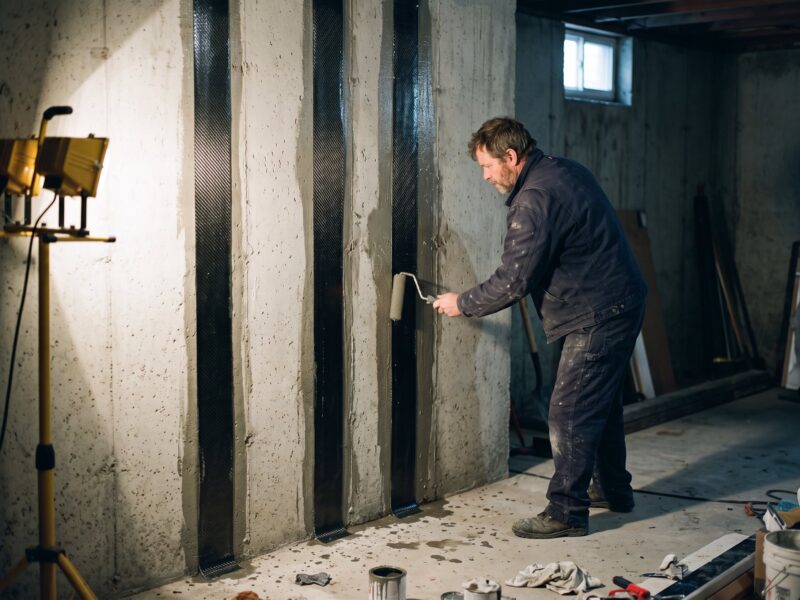 Carbon fiber straps
Holds a bowing wall flat when the deflection is caught early.
Learn more
Carbon fiber straps
Holds a bowing wall flat when the deflection is caught early.
Learn more
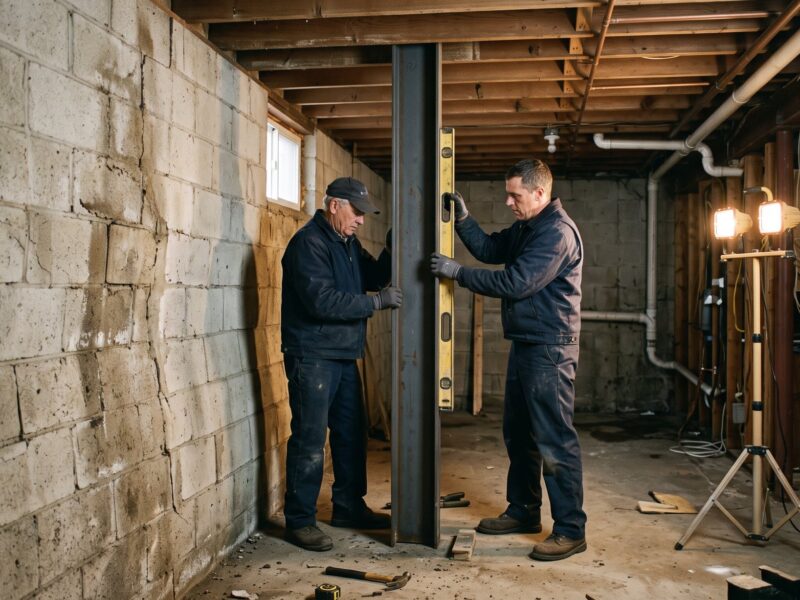 Steel I-beams & wall anchors
For walls the hillside has pushed past the strap stage.
Learn more
Steel I-beams & wall anchors
For walls the hillside has pushed past the strap stage.
Learn more
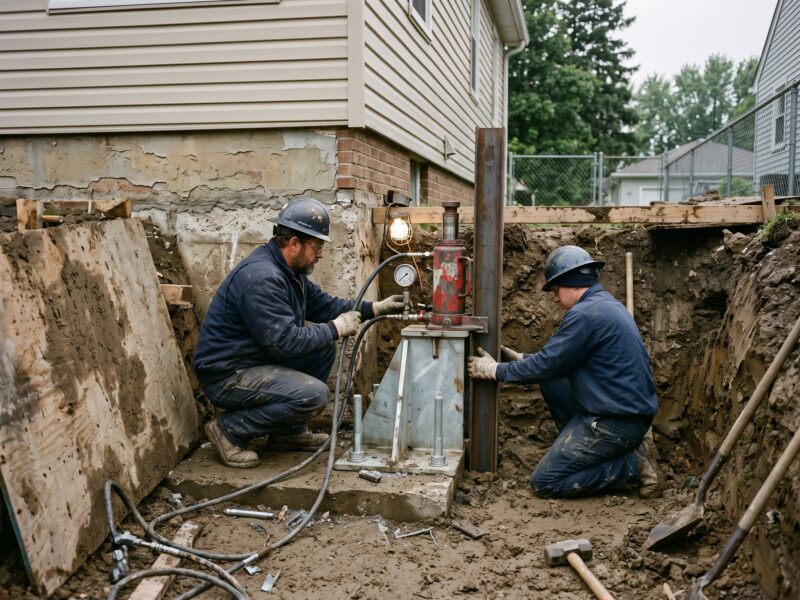 Push & helical piers
For settlement the elevation survey proves is still active.
Learn more
Push & helical piers
For settlement the elevation survey proves is still active.
Learn more
 House leveling
New columns, footings and beams under sagging Victorian floors.
Learn more
House leveling
New columns, footings and beams under sagging Victorian floors.
Learn more
 Not sure what you have?
A plain-language guide to what an old wall's symptoms actually mean.
Learn more
Not sure what you have?
A plain-language guide to what an old wall's symptoms actually mean.
Learn more
Why do Elgin foundations crack and move?
Elgin foundations span three structural generations, and each fails in its own dialect: stone and brick that age through mortar, early poured walls in restless clay, and young west-side foundations still finding their grade.

Stone under the Victorians
The pre-1900 stock stands on stone laid without rebar or footing drains, often retaining a bluff grade on one side. These walls fail slowly, through mortar loss and moisture cycling, and they reward patient repointing over aggressive intervention.
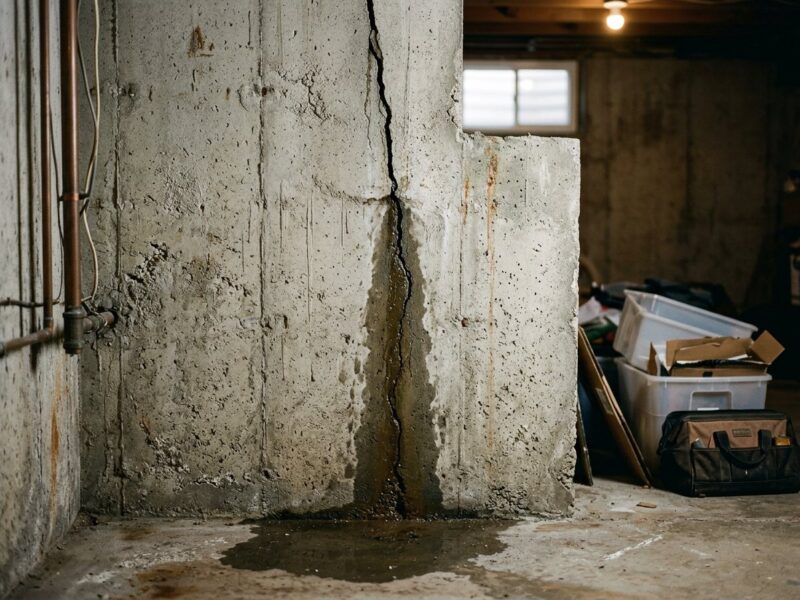
Brick and early poured, 1900 to 1930
The workers' cottages and substantial old-town homes sit on foundations that have already done a century of moving. Most of their cracks are closed history; the few that are widening or leaking are the ones worth money.

The far west side
From the 1990s out the Randall Road corridor, poured walls on graded ground occasionally settle at a corner or crack over an opening. Young movement is the easiest kind to measure and, when active, the cleanest to stop with piers.
What makes Elgin ground move?
Elgin ground moves because the city is built on a slope-and-clay combination few towns share. The older neighborhoods climb bluffs on both sides of the Fox River, so foundations on those streets carry lateral load from the hillside as well as the house above, and wet years add water weight to the push. The clay between the high streets and the river swells and shrinks seasonally, working on footings that were laid before anyone calculated for it.
Here is the reassuring part the sales industry rarely mentions: on a hundred-year-old foundation, most of the visible damage is finished business. Settlement that happened in 1940 left cracks that will never move again, and they need paint, not piers. Our inspections mark, measure and date the cracking so a season of your own evidence separates the archive from the activity, and money only chases the second category.
 Laser elevations: a century of movement, reduced to numbers.
Signs you need foundation repair in Elgin
Six symptoms drive Elgin's structural calls, and in this housing stock each one comes with the same first question: is it old or is it ongoing? Measurement answers it; guessing never does.

A horizontal crack at mid-height
The one that outranks the rest. Lateral pressure, on a bluff lot often literal hillside load, is flexing the wall inward. Early it is strap money; ignored it becomes steel and anchors.

Stair-stepping through brick or block
Cracks tracking the mortar joints map differential settlement. If the crack has clean, sharp edges and no paint inside it, it is young enough to take seriously.

Doors out of square, floors off level
In a Victorian, some slope is simply biography. New sticking doors, fresh drywall cracks upstairs or a slope that measurably worsens is a different story, and the laser tells them apart.
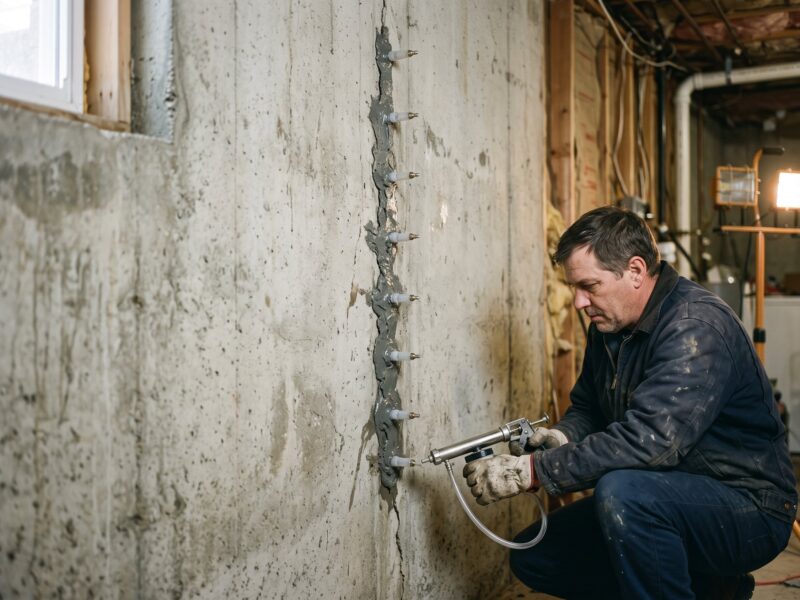
A crack wider than a quarter inch
Width is the first triage line. Hairlines flush on both faces are usually archive; anything a pencil fits into, or where one face sits proud of the other, earns gauges and a return measurement.

A bouncy or sagging main floor
Under many older Elgin houses the foundation is fine and a tired beam or crushed post is the whole problem. Columns and sistered joists cost a fraction of what homeowners fear the symptom means.

Mortar turning to sand
Stone and brick foundations age through their joints. Dust trails, soft mortar and stones standing proud of the wall face are the maintenance calls that, answered early, prevent the structural ones.
Staring at a crack and wondering if it moved? Stop wondering. We measure it, gauge it and tell you in writing whether it is history or active.
How does foundation repair work in Elgin?
An Elgin repair runs four steps built around one principle: prove movement before spending against it. Most repairs, once justified, finish in one to three days.
Date the damage
The inspection reads the foundation's era, maps every crack, and looks for the tells that separate old movement from new: paint in the crack, edge weathering, displacement. Free, booked within 48 hours.
Day 0Measure and, when smart, wait
Stable-looking cracks get marked and gauged so the house itself testifies over a season. Because Elgin runs on scheduled blocks for us, re-measurement visits are planned, not promised vaguely.
Day 0, or a seasonRepair what the numbers convict
Repointing for stone, straps or steel for flexing walls, injection for leaking poured cracks, piers where elevations prove live settlement. Published ranges, cheapest adequate fix first.
Days 1 to 3Document and warranty
You get the before-and-after measurements, photos and a 25-year transferable warranty registered to the address, the packet that answers a future buyer's inspector on paper.
On completionReinforce or rebuild: what do Elgin foundations actually need?
Almost every Elgin foundation showing distress can be reinforced in place, and on this housing stock the case is stronger than usual: excavating beside a hundred-year-old stone wall that retains a bluff grade risks the very wall being rescued.
| Reinforce in place | Excavate and rebuild | |
|---|---|---|
| Best for | Walls that are cracked, weathered or flexing but structurally intact, the large majority | Walls sheared, collapsing or beyond their material's limit |
| On historic stone and brick | Repointing, relief and reinforcement preserve original fabric | Rebuilding erases the material a historic district exists to keep |
| On grade-retaining bluff walls | Interior work never disturbs the loaded side of the wall | Removing soil from a retaining wall is its most dangerous moment |
| Cost | $450 injections to $3,000 piers, from published ranges | Tens of thousands per wall before landscaping recovery |
| Time | One to three days for most repairs | Weeks of shoring, machines and an open excavation |
| Warranty | 25-year transferable, registered to the house | Depends entirely on the contract; read it before signing |
A rebuild quote unaccompanied by deflection numbers is a sales document, not an engineering one. Our second opinion is free and arrives with measurements.
When do Elgin foundations move?
What still moves in Elgin moves on the clay's schedule, which makes the calendar a diagnostic tool: when a crack changes tells you nearly as much as how much.
Spring: the hill leans in
Saturated bluff clay adds real load to uphill walls, and this is when flexing block and stone announce themselves. A crack that widens now and relaxes by July is confessing to lateral pressure.
March to MaySummer: the clay lets go
Drought shrinks the ground away from footings, and the far west side does most of its settling in dry Augusts. Cracks over windows and doors that open in late summer point to dropped support, not push.
June to AugustFall: the proving season
Calm ground and mild weather make fall the best time to compare against spring measurements and to book repairs that finish before frost. Gauge readings from both seasons make the diagnosis nearly argument-proof.
September to NovemberWinter: inside work continues
Injection, carbon fiber, steel bracing, columns and beam work all happen indoors at full pace while frost holds the ground. An Elgin block scheduled in January runs exactly like one in June.
December to FebruaryHow much does foundation repair cost in Elgin?
Foundation repair in Elgin costs $450 to $900 for crack injection, $600 to $1,800 per strap, beam or anchor to reinforce a bowing wall, and $1,600 to $3,000 per pier for active settlement, the identical published ranges we quote in every town we serve. Stone repointing is scoped by the masonry's condition at the free inspection, and the drive to Elgin never appears on an invoice.
| Work | Range | What moves the number |
|---|---|---|
| Urethane crack injectionper crack | $450–$900 | Crack length and width, access to the full height |
| Carbon fiber strapsper strap | $600–$1,000 | Wall height, spacing the deflection requires |
| Steel I-beam wall bracingper beam | $900–$1,500 | Ceiling height, footing condition at the base |
| Push or helical piersper pier | $1,600–$3,000 | Depth to load-bearing strata, access for equipment |
The full structural table lives on the pricing page; your written Elgin quote lands inside it.
Where we repair foundations in Elgin
Elgin's structural calls follow its building eras street by street. The Elgin Historic District and Gifford Park send stone and brick work: repointing, bulge checks and the old-versus-active question on walls that retain the bluff grade. The old-town blocks along the Fox River and Route 20 corridors send early poured and brick foundations with cracks that need dating more often than fixing. The Randall Road corridor sends young settlement, elevation surveys and the occasional pier job. All of 60120, 60123 and 60124 are covered.
Elgin sits toward the northern limit of our map, a real drive of an hour and ten to an hour and a half from the Joliet and New Lenox corridor, and we run it in scheduled blocks rather than pretending we are around the corner. What that costs in spontaneity it pays back in planning: inspections booked within 48 hours, gauge re-checks slotted into the next block, and no travel charge at any point.
 The verdict in writing: what moved, what did not, what it costs.
Elgin foundation repair questions, answered straight
My 1890s Elgin house has cracks everywhere. Which ones actually matter?
Triage on three things in order: width, displacement, movement. A hairline that is flush across both faces with old paint down inside it finished moving generations ago. A crack wider than roughly a quarter inch, or one where the two sides no longer sit in the same plane, deserves measurement. We mark and date the candidates so a season of your own readings settles the question with evidence.
Should I hire a structural engineer before repairing?
On a house of this age and value, sometimes yes, and we will tell you when we think so. An independent engineer's opinion costs a few hundred dollars and is cheap insurance before accepting anyone's five-figure proposal, including ours. We also give free second opinions on quotes you already have in hand.
Who repairs stone foundations in Elgin?
We do, and Elgin's historic districts give us plenty of practice. Stone wants repointing, moisture relief and restraint, not the poured-wall playbook applied by habit. If a bidder's proposal for your 1885 foundation reads like their subdivision template, that is your signal to keep interviewing.
How much does foundation repair cost in Elgin?
From the published list: $450 to $900 per injected crack, $600 to $1,000 per carbon fiber strap, $900 to $1,500 per steel beam, $1,000 to $1,800 for wall anchors and $1,600 to $3,000 per pier. Stone repointing is priced by condition at the free inspection because no two century-old walls have aged alike.
The wall holding back my sloped yard is bowing. Is that different from normal bowing?
It matters, because a grade-retaining basement wall on a bluff lot carries hillside load year-round, not just in wet springs. The reinforcement math accounts for that: straps if the deflection is small, steel or anchors with proper backing if the hill has been winning for years. The measurement, not the fear, picks the answer.
Do I need a permit for foundation repair in Elgin?
It varies by municipality and by the scope of work, and historic-district properties can carry extra review for exterior changes. Where a permit is required for our scope, we pull it as part of the job. The practical advice is simple: never let a contractor talk you into skipping paperwork the work legitimately needs.
Will old foundation repairs hurt the sale of my Elgin Victorian?
Documented repair helps a sale far more than an unexplained crack hurts one. Buyers of historic homes expect a foundation with a past; what they want is proof someone competent managed it. Our packet of measurements, photos, scope and a 25-year transferable warranty registered to the address gives their inspector the answer before the question.
Does insurance pay for foundation repair on an older home?
Rarely. Standard Illinois homeowner policies exclude earth movement and hydrostatic pressure, which between them describe nearly every foundation claim. Budget as though it is out of pocket, and let that be the argument for catching a flexing wall at strap prices rather than anchor prices.
Is the cracked wall also a wet one?
In Elgin the hillside works both trades at once: the lateral load flexing an uphill wall is delivered by the same wet clay that pushes water through it, and a stone joint losing mortar is usually losing it to moisture. If the wall you are watching also weeps in spring, one inspection scopes both and the fixes get sequenced in the right order.
Basement Waterproofing in Elgin
Foundation repair near Elgin

Find out what the old walls are really saying
A free structural inspection within 48 hours, measurements that separate history from movement, and a 25-year transferable warranty on whatever repair the numbers justify.
Or talk to a human right now
(630) 335-1128
Request your free estimate
Tell us what you're seeing. We'll call back fast and be out within 48 hours.