
Basement Waterproofing in Schaumburg, Illinois
Schaumburg sits on flat prairie clay with almost no fall to grade to, so storm water leaves through a pipe or it does not leave at all. We build the fall the land never had, with grading, French drains, catch basins and discharge that goes somewhere real, then back the basement up with systems warrantied for life.
- Yard drainage and grading fixes priced from $600
- Interior systems carry the lifetime, fully transferable warranty
- Free written inspection within 48 hours
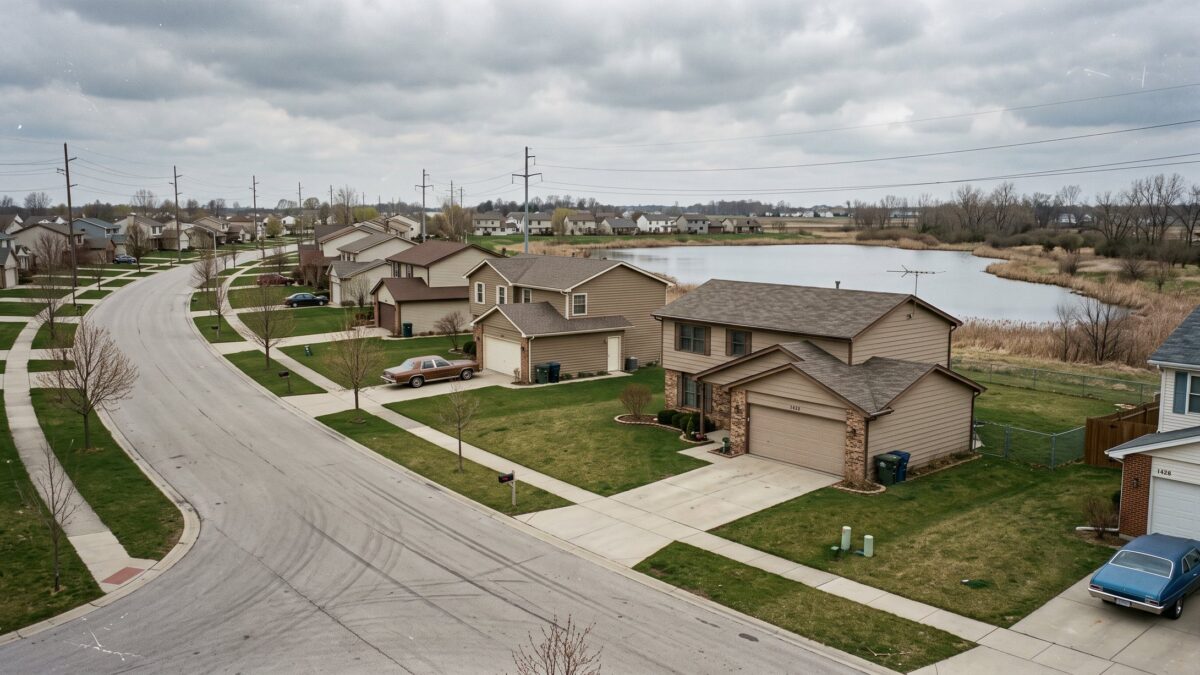 Northern edge of our map: a real drive, scheduled in blocks
Who does basement waterproofing in Schaumburg?
ProSeal Basement Waterproofing serves Schaumburg with yard drainage, French drains, sump pump systems and interior drain tile from a base in the Joliet and New Lenox corridor. Downspout extensions and regrading run $600 to $2,500, exterior French drains $45 to $90 per linear foot, interior drain tile $95 to $160 per linear foot, and every number is published before we make the drive north.
In Schaumburg the first question is never which interior system to buy. It is where the water can be made to go, because on ground this flat there is no downhill to send it. A contractor who starts the conversation in your basement has skipped the actual problem, which is usually sitting in your yard, your neighbor's swale, or a downspout that ends two feet from the wall.
 A catch basin taking over where flat prairie ground gave up.
What does basement waterproofing in Schaumburg include?
On flat clay the outside work comes first, so the Schaumburg toolkit starts in the yard and works inward. The free inspection prices only the pieces your lot and basement actually need, from the published ranges.
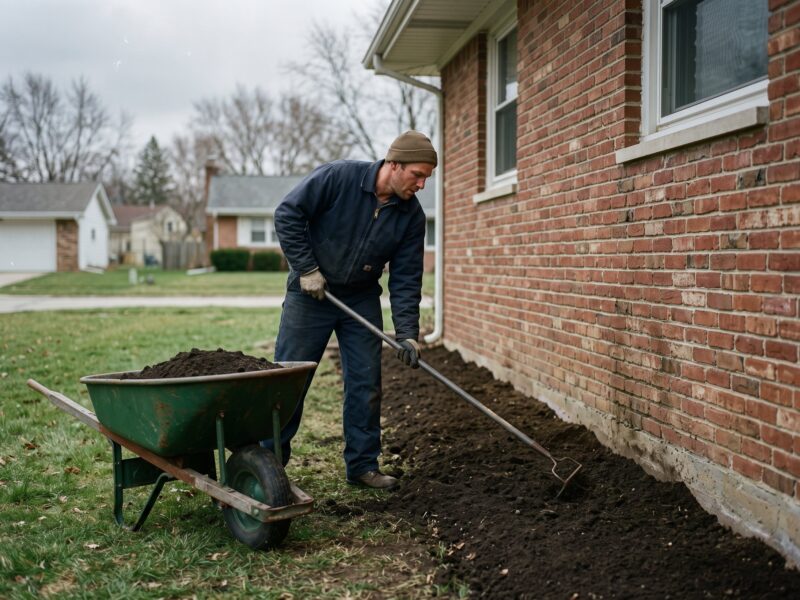 Yard drainage & regrading
The lead trade in Schaumburg: engineered pitch, swale repair and downspout routing on lots born flat.
Learn more
Yard drainage & regrading
The lead trade in Schaumburg: engineered pitch, swale repair and downspout routing on lots born flat.
Learn more
 French drains
Pitched pipe to a dry well, popup or street outfall, because the fall has to be built here.
Learn more
French drains
Pitched pipe to a dry well, popup or street outfall, because the fall has to be built here.
Learn more
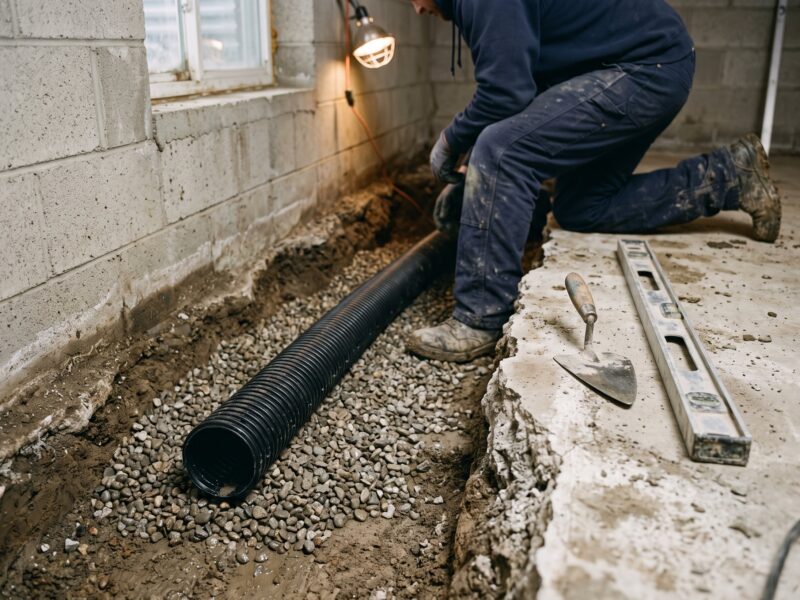 Interior drain tile
For groundwater the yard work cannot reach, footing to sump.
Learn more
Interior drain tile
For groundwater the yard work cannot reach, footing to sump.
Learn more
 Sump pumps & battery backup
Sized for slow-draining clay and the storms that take the power out.
Learn more
Sump pumps & battery backup
Sized for slow-draining clay and the storms that take the power out.
Learn more
 Crawl space encapsulation
Split-level lower sections and additions sealed against ground moisture.
Learn more
Crawl space encapsulation
Split-level lower sections and additions sealed against ground moisture.
Learn more
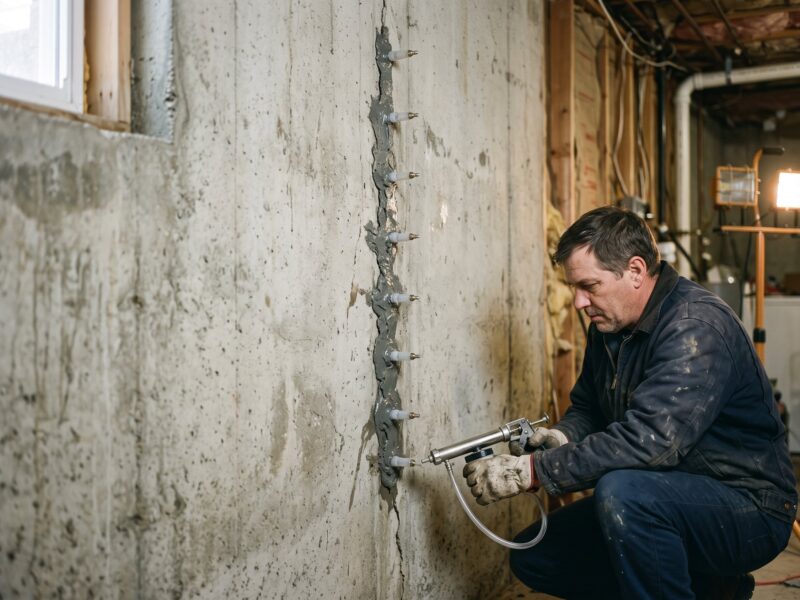 Leaking crack injection
Poured-wall cracks in the later subdivisions, sealed from $450.
Learn more
Leaking crack injection
Poured-wall cracks in the later subdivisions, sealed from $450.
Learn more
Why do Schaumburg basements leak?
Schaumburg basements leak because the village was built flat, on clay that barely absorbs water, in big cohorts that share the same drainage design. When that design is marginal, whole streets find out together, which at least means your neighbor's diagnosis is a head start on yours.

The 1960s and 70s split-levels and ranches
The earliest phases went up in block on the flattest ground, and sixty years of saturated clay against block shows at the cove joint and the mortar lines. Their original drainage details are now the oldest in the village, and it shows every spring.

The 1980s and 90s colonials
The later phases are poured walls that mostly hold dry until something outside gives: a settled swale, a buried downspout that quit, a sump discharging onto a lawn with nowhere to send it. Out here the fix is usually measured in hundreds, not thousands.

The townhouse rows
Townhouses share a drainage design the way they share walls. One marginal swale or overloaded downspout run can wet a whole row of lower levels, and the durable fix is designed for the row, not patched unit by unit.
Why does Schaumburg water sit instead of draining?
Schaumburg water sits because the village is exceptionally flat prairie over clay that lets almost nothing soak in, so every gallon has to leave through the storm system or wait in place. Poplar Creek and the Salt Creek headwaters drain the area slowly, and Busse Woods marks how low and gentle the fall is on the east side. There is no hill to send water toward, which is a fact of geography no gutter guard changes.
That single fact reorders the whole trade here. Elsewhere we find the fall; in Schaumburg we build it, with pitched French drain runs, dry wells sized to the roof area, catch basins piped to the street where the village allows a connection, and regrading that buys the wall a few crucial inches. Interior drain tile still earns its place, but only for the groundwater left over after the surface water finally has a route out.
 Days-old storm water on flat clay: nowhere to soak, nowhere to run.
Signs your Schaumburg basement needs waterproofing
Six symptoms fill the Schaumburg call log, and on flat ground most of them trace back outside before they trace back down. Sorting which is which is exactly what the free inspection is for.

Water at the floor-wall joint
Groundwater under pressure finding the cove joint, the classic call from the block-era split-levels and ranches. Drain tile handles it, but the yard gets checked first so you buy it once.

White mineral bloom on block
Efflorescence means the wall itself is passing water and leaving the minerals behind. On sixty-year-old block it is an early, honest warning that the clay outside stays wet too long.

A sump that cycles for days after rain
Slow-draining clay keeps feeding the pit long after the sky clears. Capacity and a battery backup help, but if the discharge just soaks back in, the pump is recycling its own work.

Musty lower level in a split-level
Half-buried lower levels breathe their moisture into the whole house. A persistent spring smell is seasonal ground moisture talking, and it has a fixable source, not a housekeeping one.
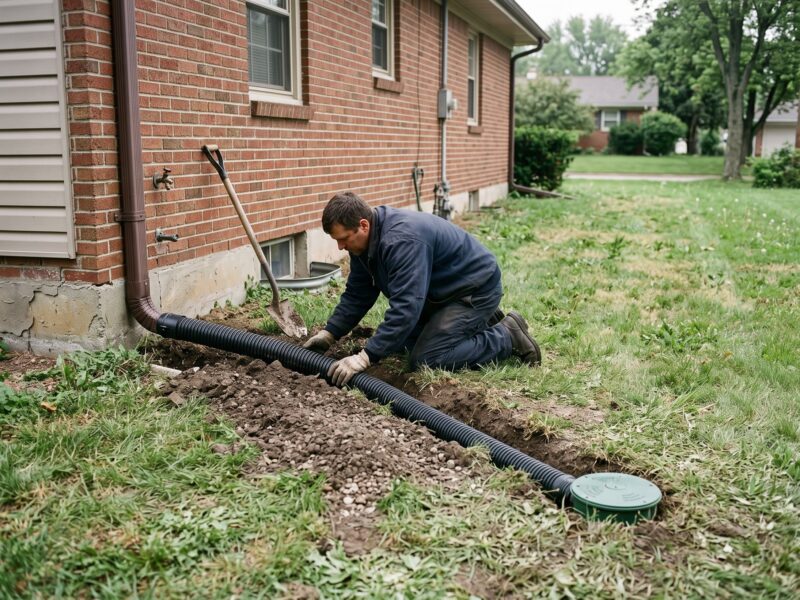
Downspouts flooding the foundation
On a lot with no pitch, a downspout ending at the wall delivers the whole roof to your footing. Burial to a popup or basin is some of the cheapest insurance sold in Schaumburg.
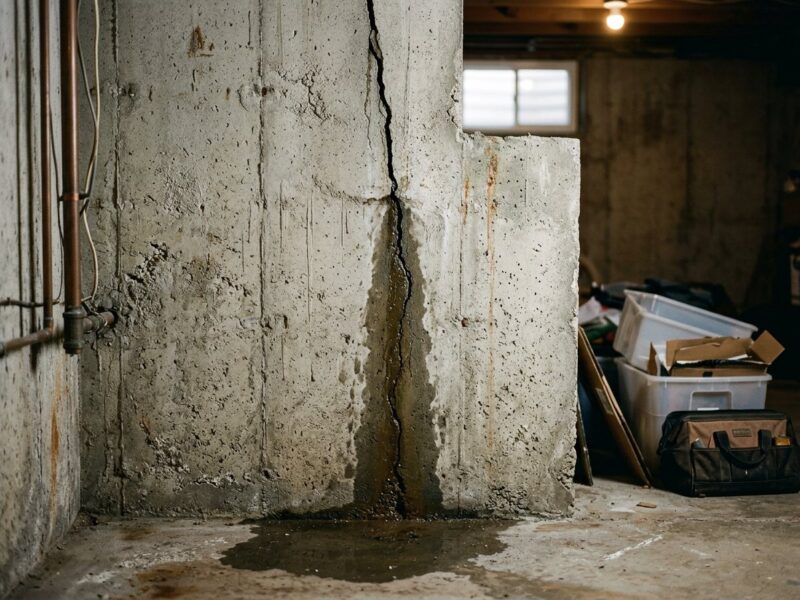
A poured-wall crack that runs in storms
The 1980s and 90s phases crack as they cure and settle, and a crack that has become a spout usually closes for good with a $450 to $900 injection.
Yard still wet three days after the rain stopped? That is flat clay doing what it does. Send the street and a photo; the fix gets designed, not guessed.
How does basement waterproofing work in Schaumburg?
A Schaumburg job runs four steps, and because the village sits at the north end of our map, the visits are grouped into scheduled blocks and we are upfront about that from the first call.
Walk the lot before the basement
In Schaumburg the inspection starts outside: grading, swales, downspouts and where a discharge could actually go. Then we trace the water indoors. Free, booked within 48 hours.
Day 0Design the outfall
Flat ground means the destination is a decision: daylight if any fall exists, a dry well sized to the volume, or a piped route to the street where the village allows it. The written plan names the destination and why.
Day 0, same visitInstall in a scheduled block
Crews come north with the job fully staged so the drive is spent once, not four times. Exterior runs, basins and any interior tile go in together, then a flow test you watch.
Days 1 to 4Register the warranties
Interior systems register the lifetime, fully transferable warranty to the address, drainage work carries its 5-year coverage, and both transfer if you sell.
On completionInterior or exterior waterproofing: what works in Schaumburg?
On flat Schaumburg clay the honest sequence is surface drainage first, then interior drain tile for whatever groundwater remains, with full exterior excavation reserved for walls that are actually failing on their outside face. Most homes here never need the third option.
| Interior drain tile | Exterior excavation | |
|---|---|---|
| Best for | Groundwater still reaching the cove joint after the yard is fixed | Walls deteriorating from the soil side, a small minority |
| After yard drainage | The right second move when grading and French drains have done their part | Rarely justified once surface water finally has a route out |
| On flat saturated clay | Unaffected; the trench lives inside, below the slab | Open excavations hold water on ground this slow to drain |
| Lot access | Needs none; townhouse rows and tight side yards qualify | Needs machine access and takes the landscaping with it |
| Cost | $95 to $160 per linear foot | Several times interior cost, priced per wall after inspection |
| Season | Installs all winter; frozen ground never matters | Weather-bound, and worst in a wet spring on this clay |
When $900 of grading is the real answer, that is the quote you get. On flat ground the cheapest adequate fix is usually outdoors, and we price it that way.
When do Schaumburg basements flood?
Schaumburg water keeps a schedule set by flat clay: it arrives with the melt, tests the pumps in summer, and gives one cheap window in fall to get ahead of all of it.
Spring: the standing-water season
Snowmelt plus rain lands on ground that cannot pass it along, yards pond for days, and saturated clay presses water toward cove joints across the block-era streets. Sumps run around the clock village-wide.
March to MaySummer: the cloudburst test
An inch of rain in an hour asks more of a flat storm system than it can give, and the same cells knock the power out. This season is the whole argument for battery backup on every pit we install.
June to AugustFall: the drainage window
Dry, workable ground makes fall the season for regrading, downspout burials and French drain runs, the $600 to $2,500 work that decides how spring goes. Book it before the ground closes for winter.
September to NovemberWinter: the inside season
Interior drain tile installs full speed with the ground frozen, and flat lawns mean discharge lines get sloped and freeze-protected deliberately, not by luck. Systems finished now meet the melt ready.
December to FebruaryHow much does basement waterproofing cost in Schaumburg?
Basement waterproofing in Schaumburg costs $95 to $160 per linear foot for interior drain tile, with a full perimeter system, sump and battery backup landing between $8,000 and $16,000, but a real share of Schaumburg calls close for far less: $600 to $2,500 of downspout and grading work, or a French drain at $45 to $90 per linear foot. The ranges are published, and the drive north adds nothing to them.
| Work | Range | What moves the number |
|---|---|---|
| Interior drain tileper linear foot | $95–$160 | Length of the run, slab thickness, what has to be moved off the walls |
| Sump pump with battery backupinstalled | $2,800–$4,500 | Pit condition, backup capacity, discharge routing |
| Exterior French drainper linear foot | $45–$90 | Trench depth, where the water can legally go |
| Downspout extensions and regradingtypical job | $600–$2,500 | Feet of grade to rebuild, soil hauling |
Every range lives on the pricing page, and your written Schaumburg quote lands inside it.
Where we waterproof in Schaumburg
We cover all three Schaumburg ZIPs, 60193, 60194 and 60195, and the calls map onto the village's corridors. The Wise Road area and the Schaumburg Road corridor, heavy with the earliest split-levels and ranches, send cove-joint seepage and tired block. The Golf Road and Roselle Road corridors mix later colonials and townhouse rows, where the calls are ponding yards, shared-swale disputes and sump discharge with nowhere to go. Streets draining toward Poplar Creek and the Salt Creek headwaters near Busse Woods send the slowest-drying lots in the village.
Straight about the map: Schaumburg is roughly the northern boundary of our service area, an hour and a quarter to an hour and a half from our base in the Joliet and New Lenox corridor. We make the drive, we group the visits into scheduled blocks so the logistics stay honest, there is no travel charge, and if a date cannot work we say so on the phone rather than string you along.
 A discharge line earning its keep on a lawn with no fall of its own.
Schaumburg basement waterproofing questions, answered straight
Water sits in my Schaumburg yard for days. What actually works on ground this flat?
You create the fall, because there is none to find. That means a French drain pitched properly to a real outfall, a dry well sized to the volume when there is nowhere to daylight, or a catch basin piped to the street where the village allows the connection. Regrading alone is not the answer here, because a regrade needs somewhere to send the water and a flat lot does not offer one.
Half my street has the same wet basement. Is that a design problem?
Very possibly, and it is worth knowing before you spend. Subdivisions built in one push share one drainage design, and when that design is marginal the whole block discovers it in the same wet spring. The upside is real: the fix that worked three doors down was probably the right prescription for your house too, which saves everyone diagnostic money.
My sump discharges onto the lawn and the water just comes back. What fixes that loop?
A destination. On flat clay a pump that dumps at the wall is refilling its own pit, sometimes within the hour. The fix is a buried discharge run pitched to a popup emitter, dry well or basin far enough out that the clay between you and it becomes the buffer instead of the return path. It is a small job that ends a very annoying cycle.
How much does basement waterproofing cost in Schaumburg?
The published ranges hold here: $95 to $160 per linear foot for interior drain tile, $8,000 to $16,000 for a full perimeter system with sump and battery backup, $45 to $90 per linear foot for exterior French drains, and $600 to $2,500 for downspout and grading work. On this ground the drainage numbers solve more problems than anywhere else we work.
How do I choose a waterproofing company in Schaumburg?
Ask where the water will go, in feet and inches, before you ask anything else. A company that quotes an interior system for a flat-lot house without naming an outfall has not solved your problem, just relocated it. Then check that pricing is published, the warranty transfers with the house, and the estimator will put the drainage-first reasoning in writing.
I am in a Schaumburg townhouse. Is the drainage mine to fix or the association's?
Usually both, split at the property line and the governing documents. Swales, common turf and shared downspout runs typically belong to the association; your foundation, window wells and unit discharge are typically yours. We put findings in writing in a form you can hand a board, because row-wide problems get fixed properly when the association acts once instead of eight owners patching separately.
When is the best time of year to fix yard drainage in Schaumburg?
Fall, without much competition. The clay is dry enough to trench cleanly, the lawn recovers before winter, and the work is finished before the melt asks its annual question. Spring diagnoses well because the problem is visible, but the digging is miserable on saturated ground; fall installs what spring revealed.
Do I need a permit to run drainage water to the street in Schaumburg?
Permit requirements vary by municipality and by scope, and connections to public storm structures generally involve village review. We keep it directional until the inspection defines the work: where a permit is required for the route your lot needs, we pull it as part of the job rather than leaving that homework with you.
Is the wet basement wall also cracked or bowing?
The clay that keeps a Schaumburg yard wet is also leaning on the basement walls, saturated and heavy, season after season. If the wall that seeps has a horizontal crack, a stair-step line or a measurable bow, book one inspection: both trades get assessed in the same visit, which matters when the visit involves this much driving.
Foundation Repair in Schaumburg
Basement waterproofing near Schaumburg

Give the water somewhere to go
A free inspection within 48 hours, an outfall designed for a lot with no natural fall, and interior systems backed by the lifetime, fully transferable warranty. 20+ years of this work, 1,500+ homes dried.
Or talk to a human right now
(630) 335-1128
Request your free estimate
Tell us what you're seeing. We'll call back fast and be out within 48 hours.