Foundation Repair in Palos Heights, Illinois
Foundations on a hill carry loads flat-lot foundations never meet: clay shoving the uphill wall, footings stepped down a grade, walkout walls standing tall on the downhill side. We measure what the slope is doing to your house and repair it with published pricing and a 25-year transferable warranty.
- Structural warranty: 25-year transferable
- Published pricing: injection from $450, piers from $1,600
- Free structural inspection within 48 hours
 25-year transferable warranty on structural work
Who does foundation repair in Palos Heights?
ProSeal Basement Waterproofing repairs foundations across Palos Heights from our base in the Joliet and New Lenox corridor. Crack injection runs $450 to $900, carbon fiber straps $600 to $1,000, steel beams $900 to $1,500, wall anchors $1,000 to $1,800 and settlement piers $1,600 to $3,000 each, every number published before an estimator sees your wall, every repair carrying a 25-year transferable warranty.
Sloped lots ask harder structural questions than flat ones, and this village is mostly sloped lots. The uphill wall of a house cut into a grade carries lateral clay load its builder may never have fully accounted for, footings step down hillsides, and walkout rear walls stand nearly full height with less soil bracing them. An estimator who has only ever measured flat-subdivision basements will misread all three. Ours reads the slope first.
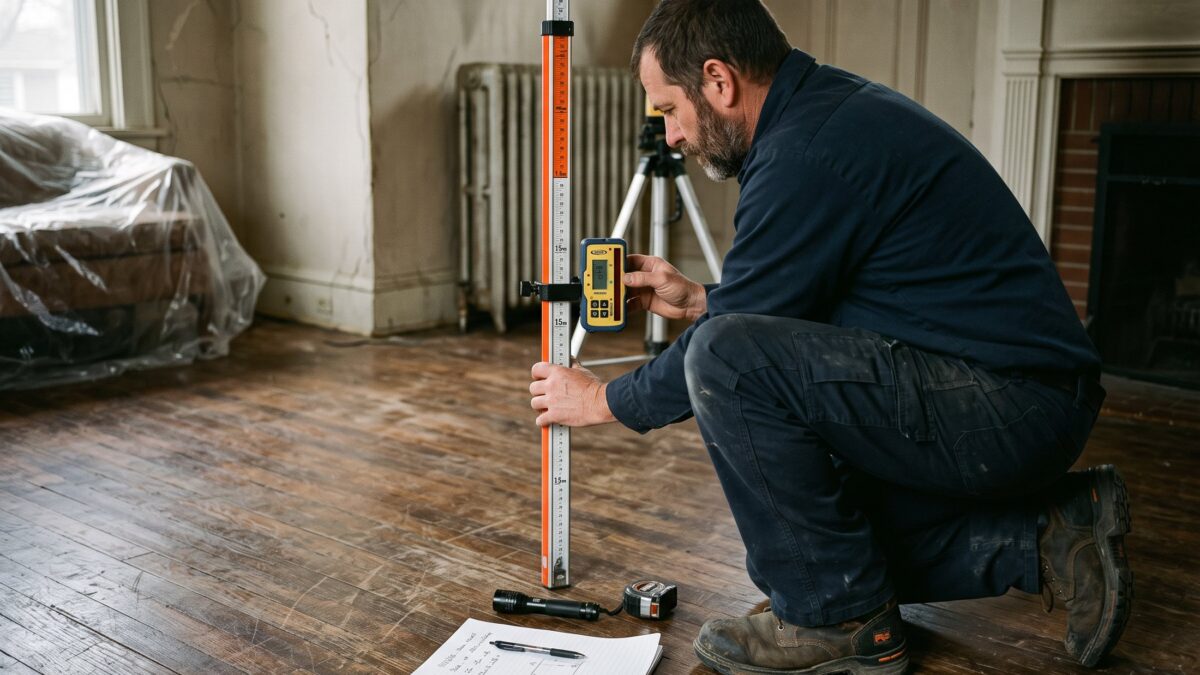
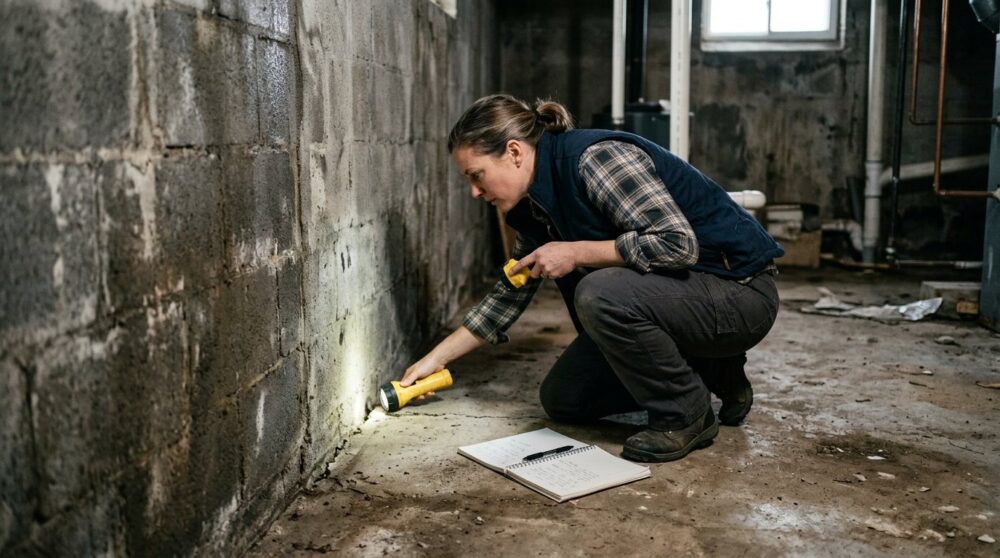 The measurement comes first: deflection, elevations, crack widths, in numbers.
What does foundation repair in Palos Heights include?
Six structural tools cover what hillside housing breaks, and the written plan always starts with the cheapest fix that genuinely holds. A $450 injection that solves the problem beats steel that was never needed.
 Urethane crack injection
Poured-wall cracks sealed full depth in a morning, from $450.
Learn more
Urethane crack injection
Poured-wall cracks sealed full depth in a morning, from $450.
Learn more
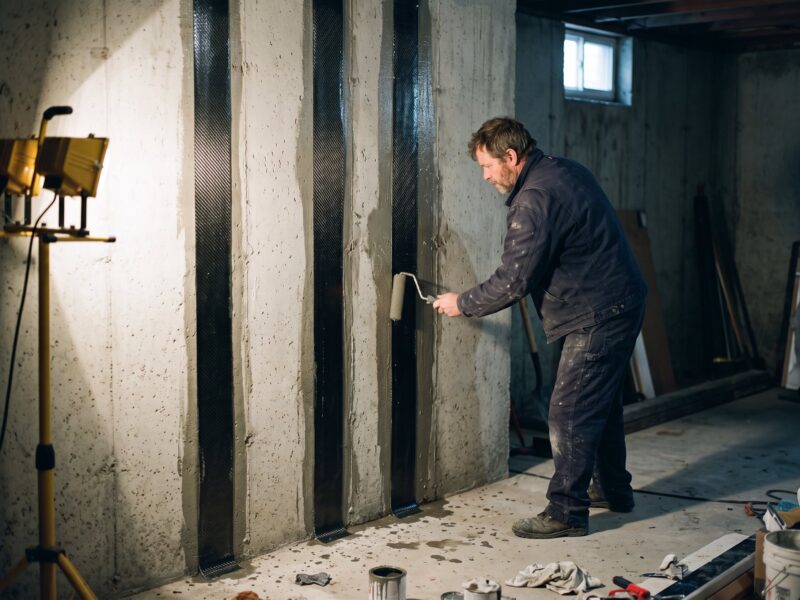 Carbon fiber straps
For clay-loaded uphill walls caught while the bow is still small.
Learn more
Carbon fiber straps
For clay-loaded uphill walls caught while the bow is still small.
Learn more
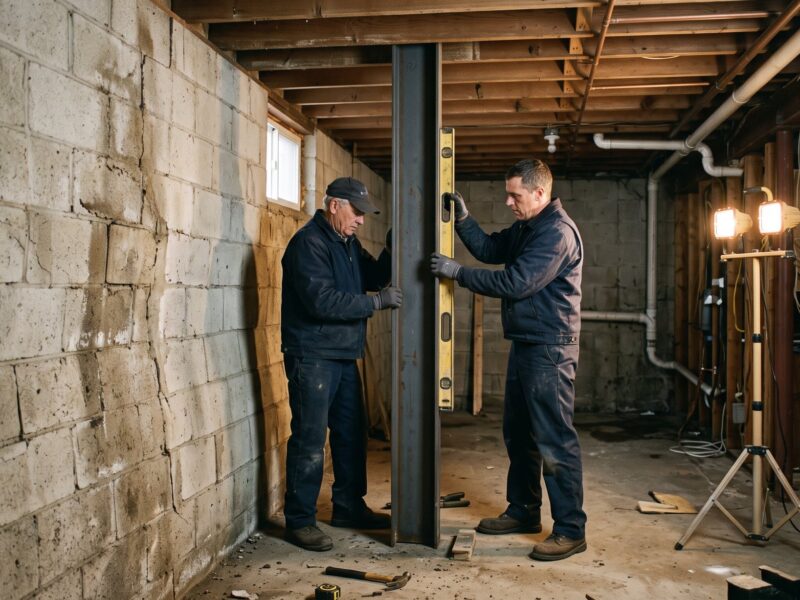 Steel I-beams & wall anchors
For mid-century block past the carbon fiber stage.
Learn more
Steel I-beams & wall anchors
For mid-century block past the carbon fiber stage.
Learn more
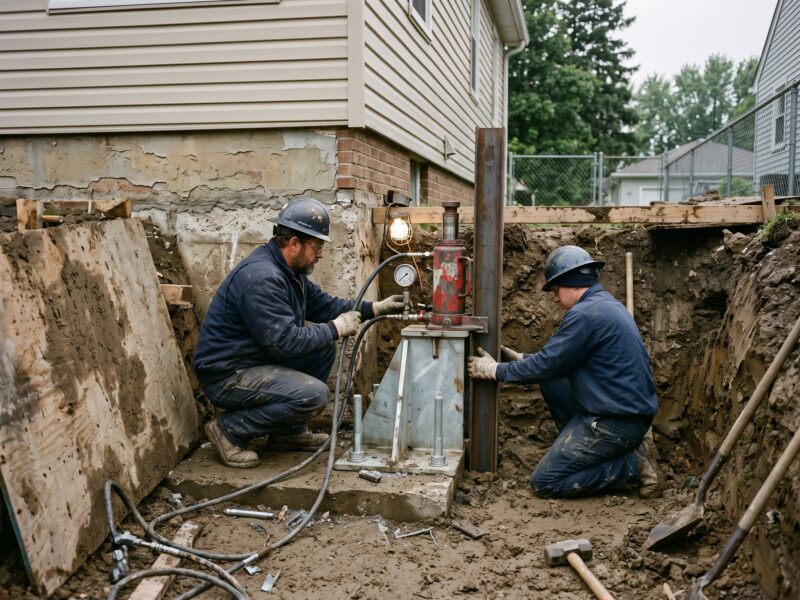 Push & helical piers
For settlement where footings step down a grade or fill has given way.
Learn more
Push & helical piers
For settlement where footings step down a grade or fill has given way.
Learn more
 House leveling
Beams, columns and footings under sagging split-level floors.
Learn more
House leveling
Beams, columns and footings under sagging split-level floors.
Learn more
 Not sure what you have?
The symptom guide walks you from what you see on a hillside wall to what it usually means.
Learn more
Not sure what you have?
The symptom guide walks you from what you see on a hillside wall to what it usually means.
Learn more
Why do Palos Heights foundations crack and settle?
Palos Heights foundations answer to the moraine: heavy clay pushing sideways on walls set into a grade, footings stepped down slopes that settle unevenly, and walkout walls doing structural work their flat-lot cousins never face.

Footings stepped down the grade
On a sloped lot the footing descends in steps, and each step can settle on its own schedule. The wall above documents it with stair-step cracking at the transitions, and the repair depends on whether the movement is finished or ongoing.

Uphill walls under clay load
The wall facing the high side of a graded lot carries decades of wet, heavy clay leaning on it. In the 1950s through 1970s block stock that eventually reads as a horizontal crack at mid-height and a measurable bow.

Splits, walkouts and custom builds
Split-levels change foundation depth mid-house, walkouts leave a tall rear wall with little soil bracing it, and hillside custom builds improvised more than one detail. Each wants its own measurement, not a template.
What makes Palos Heights ground move?
Palos Heights ground moves because it is both clay and hill. The heavy clay swells hard against walls in wet springs and shrinks away from footings in drought summers, the same cycle the whole region knows, but slope adds a second force: gravity keeps a constant downhill bias on everything, so saturated clay on a grade pushes with more intent than the same clay lying flat. Uphill walls feel it most.
The terrain also complicates the underside. Ravine and kettle-hole topography meant plenty of lots were cut, filled or both when the subdivisions went in between the 1950s and 1980s, and fill settles on its own timetable regardless of what sits on it. A corner over old fill can drop while the rest of the house holds, which is exactly the differential movement piers exist to stop. Elevation measurements find it before it finds your door frames.
 Cut on one side, fill on the other: how a hillside lot gets built, and how it moves.
Signs you need foundation repair in Palos Heights
Six symptoms account for most structural calls from Palos Heights, and on a hillside each one carries extra information: which wall, which direction, and where the house sits on the slope.
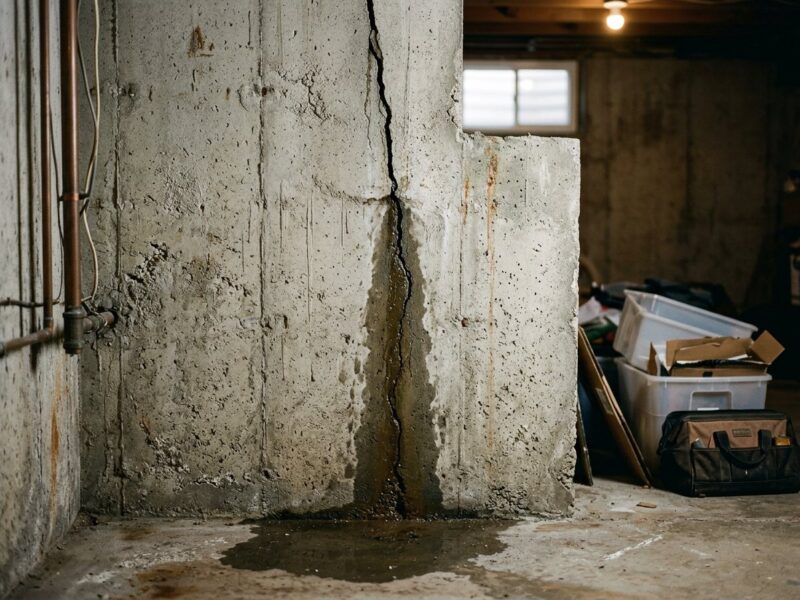
A horizontal crack on the uphill wall
The serious one on graded lots: clay load actively bowing the wall that faces the high side. Caught early it is carbon fiber money; left alone it graduates to steel and anchors.

Floors sloping toward the downhill side
When floors pitch toward the walkout or the low corner, something under that side moved. Sometimes it is the footing; often it is a beam or column, which costs far less to correct.
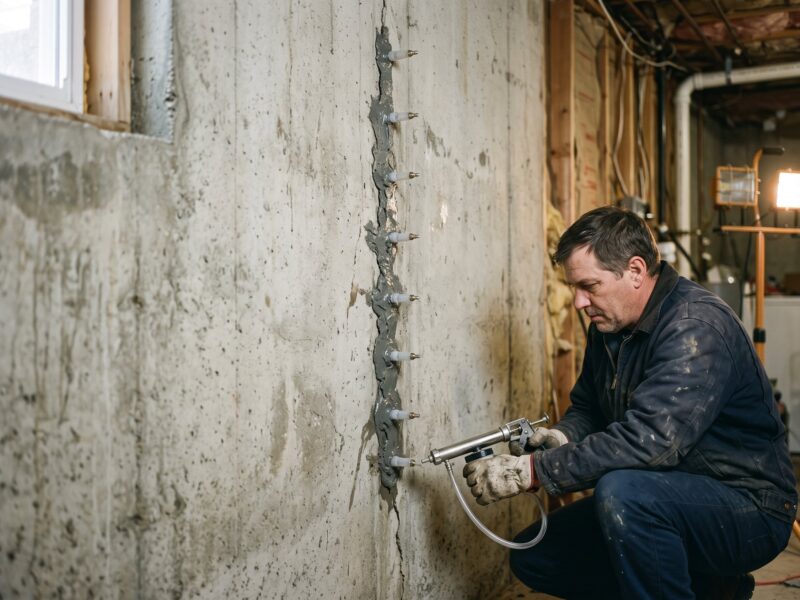
Cracks over doors and windows
Diagonal drywall cracks radiating from openings are the house redistributing load around a foundation that shifted. Width, direction and season tell us whether it is done moving.

Damp staining with the cracking
When the cracked wall is also the chronically damp one, the clay against it is both pushing and wet. The structural fix and the drainage fix get sequenced together, pressure relieved first.
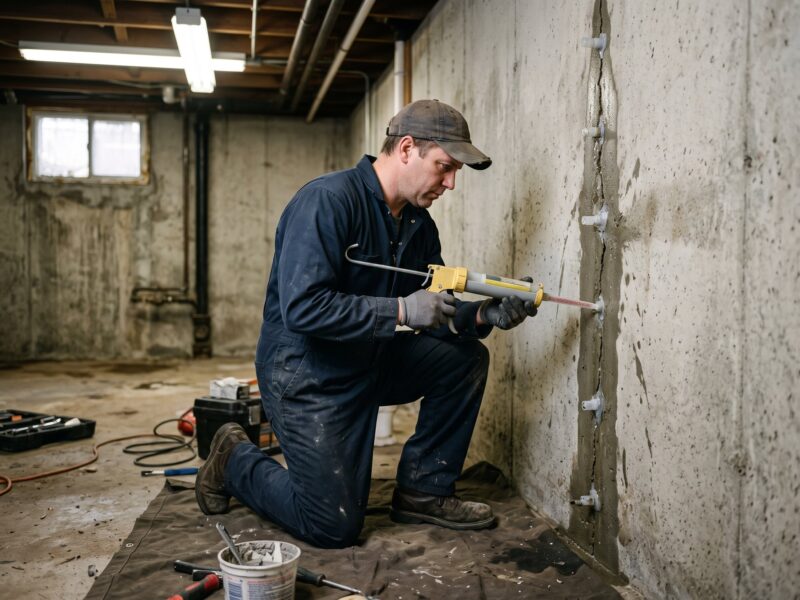
A patched crack that reopened
A surface patch that split again means the wall is still moving or the crack was never filled to full depth. Injection solves the second problem; measurement tells us if you have the first.

A low corner or a leaning stoop
A garage, stoop or addition pulling away from the house means its footing settles on its own schedule, common where hillside lots were part cut, part fill. Active movement is pier territory.
Crack on the uphill wall a little wider than last spring? Get numbers on it before the clay loads up again. The structural inspection is free.
How does foundation repair work in Palos Heights?
A Palos Heights foundation repair runs four steps: read the slope, measure the movement, match the method, verify the result. Most repairs finish in one to three days.
Read the lot, measure the wall
The inspection starts outside, establishing which walls carry uphill clay load and where cut meets fill, then maps cracks, bow and floor elevations in numbers. Free, within 48 hours.
Day 0Match the method to the movement
Lateral clay pressure gets carbon fiber, steel or anchors; differential settlement gets piers; a stable leaking crack gets a $450 injection and nothing more. The written plan shows the reasoning.
Day 0, same visitInstall and re-measure
The crew installs, torques to spec and checks the day-zero numbers before leaving. Pier work on stepped hillside footings logs drive pressure at every bracket.
Days 1 to 3Warranty to the address
Structural work carries the 25-year transferable warranty registered to the house, paperwork that answers a future buyer's inspector without a single awkward conversation.
On completionReinforce or rebuild: what do Palos Heights walls actually need?
Nearly every failing Palos Heights wall can be reinforced in place for a fraction of rebuild cost, and on this terrain the case is even stronger: excavating beside a wall that is holding back an uphill grade is exactly the kind of dig you avoid unless the wall has truly failed.
| Reinforce in place | Excavate and rebuild | |
|---|---|---|
| Best for | Bowing, cracked or settling walls still structurally sound, which is most of them | Walls sheared or collapsing, a small minority |
| On graded lots | Interior methods leave the uphill soil undisturbed and braced | Digging out the high side means shoring the very slope that loads the wall |
| On walkouts and splits | Straps, steel and piers adapt to changing wall heights mid-house | Rebuild scope balloons where foundation depth keeps changing |
| Cost | $450 injections to $3,000 piers, per published ranges | Tens of thousands per wall, plus excavation, shoring and landscaping |
| Time | One to three days for most repairs | Weeks, with machines working on a slope |
| Warranty | 25-year transferable, registered to the house | Varies by scope; get it in writing before signing |
If an estimator proposes rebuilding a hillside wall without deflection numbers, get a second opinion. Ours is free and arrives with the measurements.
When do Palos Heights foundations move?
Hillside foundations move on the clay's calendar with gravity keeping a thumb on the scale, and every season has a cheapest moment to act.
Spring: the push season
Saturated clay on a grade leans hardest now, and uphill walls do their year's bowing. Horizontal cracks widen measurably; this is when a wall worth watching becomes a wall worth strapping.
March to MaySummer: the shrink season
Drought pulls water out of the clay and lets footings drop, and stepped hillside footings rarely drop evenly. Settlement cracks over openings and sticking doors show up on the dry side of summer.
June to AugustFall: the measurement season
The clay relaxes between extremes, which makes fall readings the honest baseline. Repairs booked now finish before frost, at an unhurried pace and full crew availability.
September to NovemberWinter: the indoor season
Frost owns the top of the ground, but carbon fiber, steel bracing, injection and column work all happen inside at full speed. Winter is the fastest scheduling of the year.
December to FebruaryHow much does foundation repair cost in Palos Heights?
Foundation repair in Palos Heights costs $450 to $900 for crack injection, $600 to $1,000 per carbon fiber strap, $900 to $1,500 per steel beam, $1,000 to $1,800 per wall anchor and $1,600 to $3,000 per pier, the same published ranges we hold in every town we serve. Slope changes which method your wall needs, not the price of the method.
| Work | Range | What moves the number |
|---|---|---|
| Urethane crack injectionper crack | $450–$900 | Crack length and width, access to the full height |
| Carbon fiber strapsper strap | $600–$1,000 | Wall height, spacing the deflection requires |
| Steel I-beam wall bracingper beam | $900–$1,500 | Ceiling height, footing condition at the base |
| Push or helical piersper pier | $1,600–$3,000 | Depth to load-bearing strata, access for equipment |
The full structural table lives on the pricing page; your written Palos Heights quote lands inside it.
Where we repair foundations in Palos Heights
The structural calls in 60463 sort themselves by terrain. Lots backing the preserve system and the ravine streets near Lake Katherine send uphill-wall pressure and cut-and-fill settlement. The mid-century blocks off Ridgeland Avenue and along the 127th Street corridor send bowing block and stair-step cracking at the age when clay pressure starts winning. The Harlem Avenue corridor, the college area and the custom hillside builds send walkout rear walls, split-level transitions and the one-off details that come with houses designed for a slope.
The drive from our Joliet and New Lenox base runs twenty-five to thirty-five minutes, and we make it constantly, which matters for monitoring: when a wall deserves a re-measurement in six months rather than steel today, we actually come back and take it, because we are in the area every week anyway.
 A Ring 2 morning: the drive to the moraine is a routine one.
Palos Heights foundation repair questions, answered straight
Is a horizontal crack in my uphill wall serious?
Yes, and more so on a grade. Horizontal at mid-height means lateral clay pressure is actively bowing the wall, and the wall facing the high side of a Palos Heights lot carries more of that pressure than a flat lot ever applies. Caught early it is $600 to $1,000 per carbon fiber strap; ignored, it becomes steel, anchors or worse. Measure it now.
My split-level floors slope toward the low side of the lot. Is the foundation failing?
Not necessarily. Split-levels change foundation depth mid-house, and a pitched floor is often a beam or column issue, which costs $1,500 to $3,200 per column rather than pier money. The inspection shoots elevations through the whole footprint, and the numbers say whether the problem is under the floor or under the footing.
Do walkout basements have more foundation problems?
They carry a different load pattern. The buried uphill wall takes heavy clay pressure while the tall walkout wall stands with little soil bracing it, so the two ends of the house are stressed in opposite ways. Neither is a defect by itself, but it means a walkout deserves an inspector who measures both conditions instead of assuming a flat-lot basement.
How much does foundation repair cost in Palos Heights?
The same published ranges we hold everywhere: $450 to $900 per injected crack, $600 to $1,000 per carbon strap, $900 to $1,500 per steel beam, $1,000 to $1,800 per wall anchor, $1,600 to $3,000 per pier. What the slope changes is the diagnosis, and the free inspection settles that before any number goes on paper.
Do piers work on a sloped lot with stepped footings?
Yes; piers do not care what the surface is doing. Each pier drives from a small pit at the settling section until it refuses at competent strata, then the bracket takes the load off the failed soil. Stepped footings just mean the brackets land at different depths, and the drive logs document every one of them.
Does homeowners insurance cover foundation repair in Illinois?
Usually not. Standard Illinois policies exclude damage from soil movement and hydrostatic pressure, which covers nearly everything a moraine hillside does to a foundation. That exclusion is the financial argument for catching a bowing wall at strap prices instead of anchor prices.
Will documented foundation repair hurt my Palos Heights home sale?
It usually helps compared to the alternative, which is an unexplained crack in the disclosure. Our repairs come with the before-and-after measurements, photos, scope and a 25-year transferable warranty registered to the address, a packet your listing agent hands to the buyer's inspector instead of an argument.
You are based near Joliet. Can you really monitor a wall out here?
Yes, and we do it routinely. Palos Heights is twenty-five to thirty-five minutes from our base and we are in the area every week, so when a wall warrants watching rather than immediate steel, the six-month re-measurement actually happens. A monitored wall with numbers behind it is how you avoid paying for repairs a stable wall never needed.
Is the moving wall also a wet one?
On a graded Palos Heights lot the forces travel together: the clay leaning on your uphill wall is the same clay soaking it, and relieving the water often relieves the pressure. If the cracked wall also streaks or seeps in spring, one inspection covers both trades and sequences the fixes in the right order.
Basement Waterproofing in Palos Heights
Foundation repair near Palos Heights

Get the hillside numbers before the next wet spring
A free structural inspection within 48 hours, a method matched to what the slope is actually doing, and a 25-year transferable warranty that transfers with the house.
Or talk to a human right now
(630) 335-1128
Request your free estimate
Tell us what you're seeing. We'll call back fast and be out within 48 hours.