Foundation Repair in Tinley Park, Illinois
A split-level foundation is really two foundations wearing one house: a deep wall carrying full clay pressure and a shallow wall carrying almost none. When they age at different speeds, the block cracks in patterns Tinley Park sees everywhere. We measure first and repair to the number, backed by a 25-year transferable warranty.
- Structural warranty: 25-year transferable
- Published pricing: injection from $450, piers from $1,600
- Free structural inspection within 48 hours
 25-year transferable warranty
Who does foundation repair in Tinley Park?
ProSeal Basement Waterproofing repairs foundations across Tinley Park with crack injection at $450 to $900, carbon fiber straps at $600 to $1,000 each, steel I-beams at $900 to $1,500 per beam and settlement piers at $1,600 to $3,000 each, every figure published before an estimator sees the house, every structural repair carried by a 25-year transferable warranty.
Tinley Park's structural work is dominated by one geometry: block walls under 1960s through 1980s split-levels, where each wall carries a different backfill height and the deep side does all the suffering. Repairing that correctly means measuring each wall on its own terms instead of quoting the house as if it were a uniform box, which is exactly how our inspections are built.
 Wall by wall: a split-level inspection measures each one separately.
What does foundation repair in Tinley Park include?
Six structural tools handle what Tinley Park housing breaks, and the written plan always starts from the cheapest fix that actually holds. Nobody here is paid to escalate.
 Urethane crack injection
For the poured walls east of 80th Avenue, sealed full depth in a morning.
Learn more
Urethane crack injection
For the poured walls east of 80th Avenue, sealed full depth in a morning.
Learn more
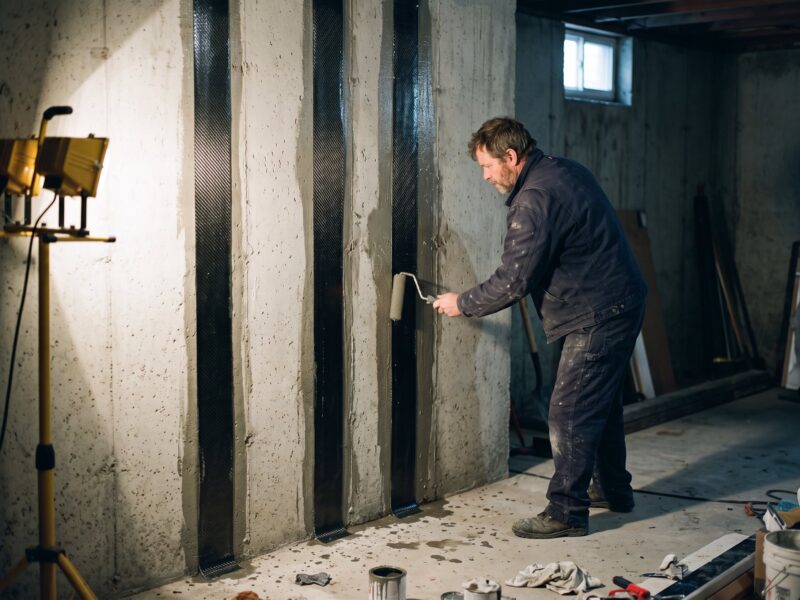 Carbon fiber straps
For split-level block caught while the bow is still under two inches.
Learn more
Carbon fiber straps
For split-level block caught while the bow is still under two inches.
Learn more
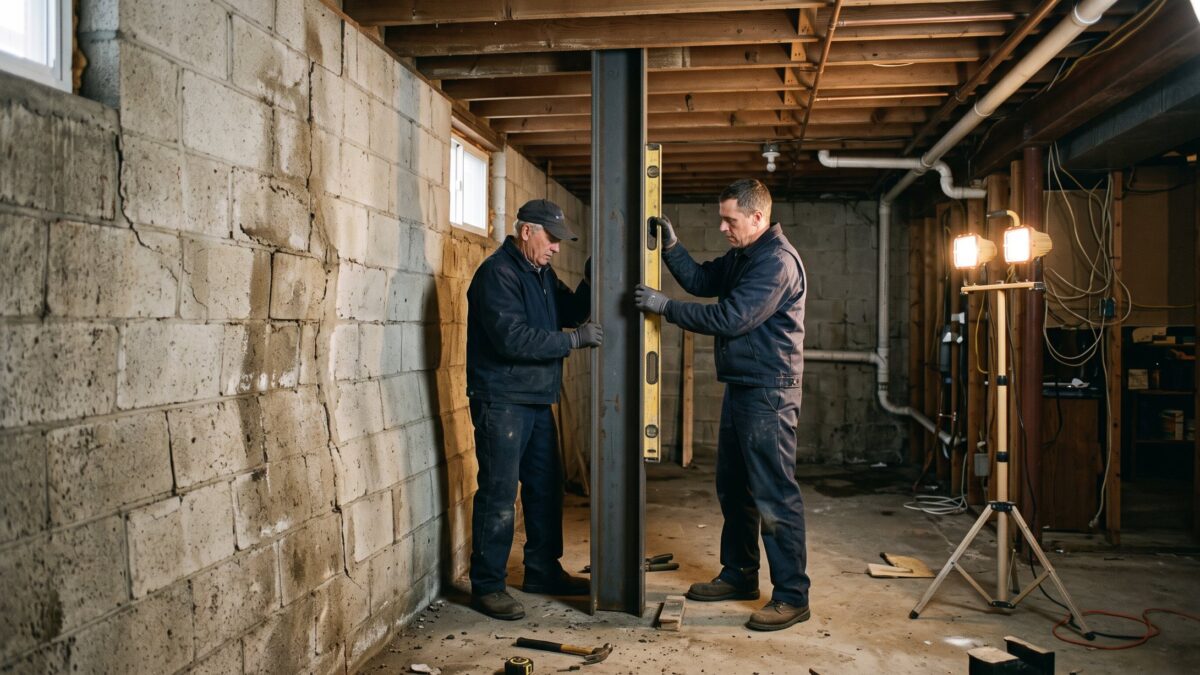
 Steel I-beams & wall anchors
For deep walls past the carbon fiber window.
Learn more
Steel I-beams & wall anchors
For deep walls past the carbon fiber window.
Learn more
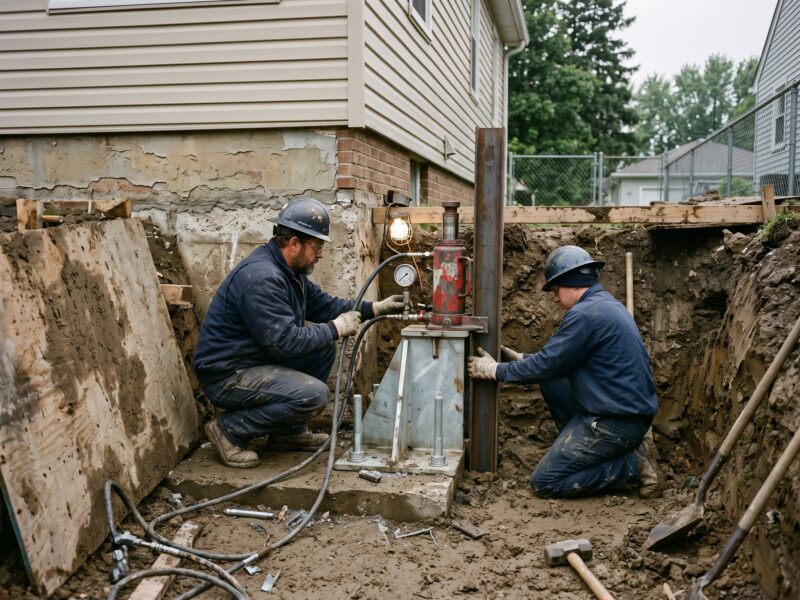 Push & helical piers
For settling corners and additions on water-softened clay.
Learn more
Push & helical piers
For settling corners and additions on water-softened clay.
Learn more
 House leveling
Columns and beams under sagging mid-level floors in the older ranches.
Learn more
House leveling
Columns and beams under sagging mid-level floors in the older ranches.
Learn more
 Not sure what you have?
Identify split-level era symptoms before the inspection.
Learn more
Not sure what you have?
Identify split-level era symptoms before the inspection.
Learn more
Why do Tinley Park foundations crack?
Tinley Park foundations crack because most of them are block walls now sixty years into a fight with wet clay, and the split-level design concentrates the fight on one or two walls per house. The village's other two eras fail in their own gentler ways.

Split-levels of the 60s through 80s
The deep rear or side wall carries full backfill while the front wall barely touches ground, so pressure, cracking and bowing all concentrate on one wall. The block is at the age where the clay starts winning if nobody measures.

The pre-war center
The older blocks near Oak Park Avenue and the Metra station stand on masonry that has cycled wet and dry for close to a century. Stair-step mortar cracks and slow settlement are the standing conditions; craft and patience are the repairs.

East of 80th Avenue
The 1990s and 2000s poured walls are strong but young, and their shrinkage cracks and first-decades settlement are the usual complaints. Most of it is injection money, occasionally pier money when a corner keeps moving.
What makes Tinley Park ground move?
Tinley Park ground moves because its clay rarely gets a chance to dry out. Tinley Creek and the surrounding forest preserve land hold the local water table high, and wet clay is heavy clay: it swells against the deep wall of every split-level through spring, then shrinks back through late summer, working the block like a slow lever. Sixty years of those cycles is exactly the fatigue the 1960s through 1980s stock is now showing.
The geometry decides where the damage lands. A uniform basement spreads clay pressure around four similar walls; a split-level hands nearly all of it to the one or two walls with full-height backfill, and the wall that bows is almost always that deep one, frequently with finished space on its other face. That is why our Tinley Park inspections measure deflection wall by wall and price the repair the same way.
 One house, several grade lines: the split-level distributes pressure unevenly.
Signs you need foundation repair in Tinley Park
Six symptoms drive most Tinley Park structural calls, and on a split-level several of them hide in the finished lower level where nobody looks behind the drywall. None of them heals on its own.

A horizontal crack in the deep wall
The serious one. Mid-height horizontal cracking means clay pressure is bowing the block inward, and on a split-level it targets the full-backfill wall. Early, it is strap money; late, it is steel.

Stair-step cracks in block or brick
Mortar joints tracing a staircase mean differential settlement, common where one wall bears on wetter ground than the rest. Width and direction get measured, not guessed.

Doors out of square upstairs
A split-level telegraphs movement through its short stair runs: doors rub, gaps open over frames, the half-flights creak differently. Sometimes structure, often a beam or column, which costs far less.
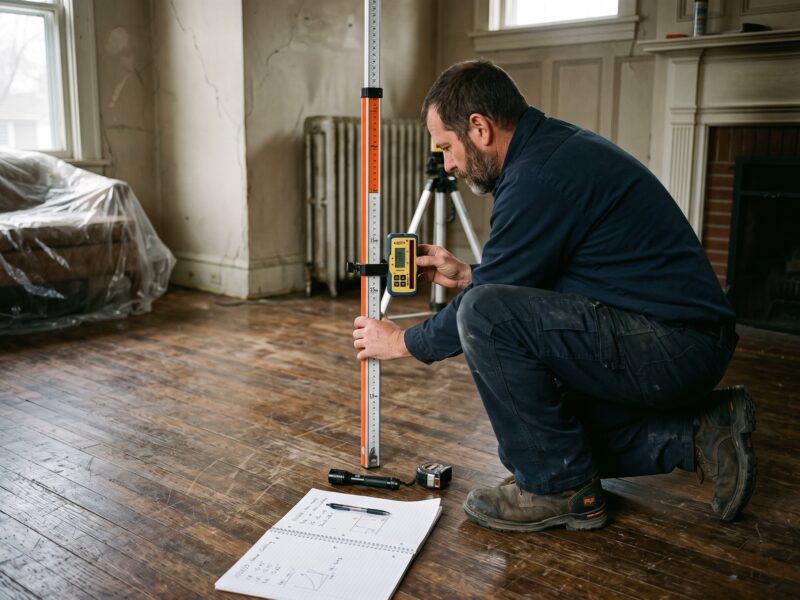
A sloping mid-level floor
The laser does not negotiate. Elevation readings across the mid floor show whether the sag is a settling foundation or a tired beam span, and the two fixes differ by thousands.
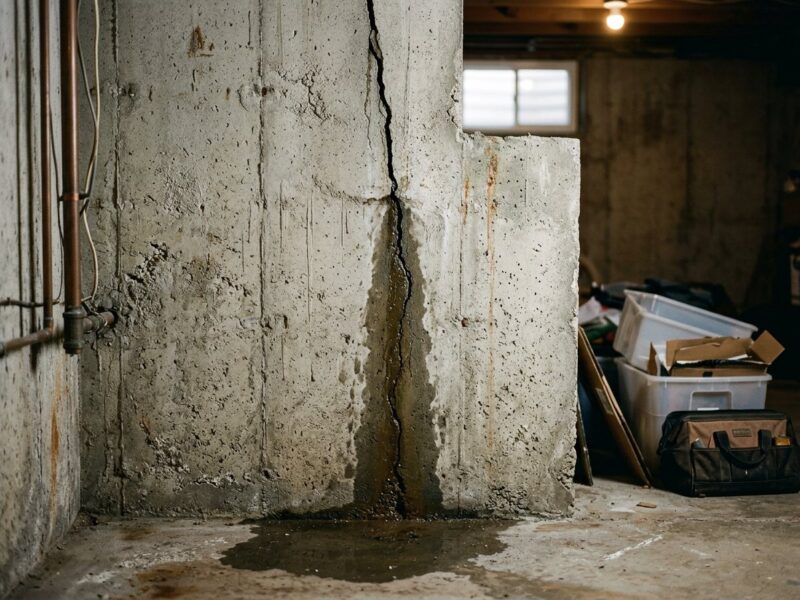
A crack that leaks in storms
On the poured walls east of 80th Avenue, a leaking crack is usually stable shrinkage: a $450 to $900 injection seals it for good, and the inspection confirms it is not moving first.

A crack someone painted over
Buying or selling one of the village's much-traded split-levels? Filled or painted cracks deserve a measurement and a written baseline before anyone signs anything.
Block wall in the lower level starting to lean? Bows only grow. A free measurement now beats steel prices later.
How does foundation repair work in Tinley Park?
Four steps run every Tinley Park repair from doorbell to warranty, and most jobs are finished within one to three working days of approval.
Measure every wall separately
Split-level walls carry different loads, so we map crack widths and deflection on each wall independently and check the finished side where damage hides. Free, within 48 hours.
Day 0Match the method to the wall
Straps for early bows, steel or anchors for advanced ones, injection for stable poured cracks, piers for live settlement: the written plan names which wall gets what and why, from published prices.
Day 0, same visitInstall and re-measure
The crew installs, torques to specification and re-checks the day-zero numbers before packing up. Pier work logs drive pressure at every bracket so the depth is provable.
Days 1 to 3Warranty to the address
The 25-year transferable warranty registers to the house and transfers at sale, which matters in a village whose split-levels turn over to new families constantly.
On completionReinforce or rebuild: what do Tinley Park block walls need?
Nearly every bowing block wall in Tinley Park can be reinforced in place for a fraction of rebuild money, and the split-level layout tilts the math further: the deep wall that needs help usually sits under finished space and beside a driveway, the two most expensive things a rebuild excavation destroys.
| Reinforce in place | Excavate and rebuild | |
|---|---|---|
| Best for | Bowed or cracked block still structurally intact, which is most of the village's stock | Walls sheared or collapsing, a genuine minority |
| On a split-level | Works from inside the lower level, wall by wall | Excavating the deep wall often means removing the driveway or patio above it |
| Finished lower levels | Drywall opens along the repair line and goes back | Wall comes down; the finished side comes with it |
| Cost | $450 injections to $3,000 piers, per published ranges | Tens of thousands per wall before landscaping returns |
| Time | One to three days for most repairs | Weeks, with shoring and machine access across the lot |
| Warranty | 25-year transferable, registered to the house | Varies by scope; insist on it in writing |
A rebuild quote without deflection numbers is a guess with a big invoice. Our measurement is free and you keep the numbers either way.
When do Tinley Park foundations move?
The clay under Tinley Park keeps a calendar, and each season gives a homeowner one smart move that costs less than the season after it.
Spring: the push
The water table crests, the clay swells, and deep split-level walls take their annual shove. Horizontal cracks widen measurably now, which makes spring the best season to establish a baseline reading.
March to MaySummer: the shrink
Dry stretches pull moisture out of the upper clay and let footings ease downward. Settlement symptoms peak: doors stick east of 80th Avenue and stair-step cracks open a little wider in the old center.
June to AugustFall: the repair window
Calm soil and dry lots make fall the easy season for straps, steel and pier driving. Work booked now is torqued, verified and closed up before the freeze.
September to NovemberWinter: inside work
Injection, carbon fiber, bracing and column adjustments all happen indoors at full speed. The frost holds the ground still, which makes winter readings a useful truth check on a wall being monitored.
December to FebruaryHow much does foundation repair cost in Tinley Park?
Foundation repair in Tinley Park costs $450 to $900 for an injected crack, $600 to $1,000 per carbon fiber strap, $900 to $1,500 per steel I-beam and $1,600 to $3,000 per pier, the same published ranges we hold in every town. A typical split-level bowing-wall job needs straps or beams on one wall, not four, and the quote reflects that.
| Work | Range | What moves the number |
|---|---|---|
| Urethane crack injectionper crack | $450–$900 | Crack length and width, access to the full height |
| Carbon fiber strapsper strap | $600–$1,000 | Wall height, spacing the deflection requires |
| Steel I-beam wall bracingper beam | $900–$1,500 | Ceiling height, footing condition at the base |
| Push or helical piersper pier | $1,600–$3,000 | Depth to load-bearing strata, access for equipment |
The full structural table lives on the pricing page; your written Tinley Park quote lands inside it.
Where we repair foundations in Tinley Park
Structural calls cover both ZIPs, 60477 and 60487, and follow the construction map. The split-level and ranch streets through Bremen Township and the 183rd Street corridor send bowing block and wall-by-wall measurements. The historic downtown around Oak Park Avenue and the Metra station sends aging masonry, stair-step cracks and slow settlement. Brookside Glen, Odyssey and the 80th Avenue corridor send poured-wall shrinkage cracks and the occasional corner that will not stop moving near preserve land.
First-ring distance changes how monitoring works: when a Tinley Park wall deserves watching instead of immediate steel, the twenty-to-thirty-minute drive from our Will County base means we actually return and re-measure it on schedule rather than rounding up to a sale.
 Measurement visits are short drives here, so walls get watched, not oversold.
Tinley Park foundation repair questions, answered straight
Why is only one wall of my Tinley Park split-level cracking?
Because only one wall is doing the hard job. A split-level buries one or two walls to full depth and leaves the rest shallow, so clay pressure concentrates where the backfill is tallest. That is normal for the design, and it is also why we measure and price each wall independently instead of quoting the whole perimeter.
Is a horizontal crack in split-level block an emergency?
It is a deadline more than an emergency. Horizontal mid-height cracking means the clay is actively bowing the wall, and block of 1960s to 1980s vintage has little reserve left. Caught under two inches of deflection it is usually carbon fiber at $600 to $1,000 per strap; waited on, it graduates to steel beams or anchors.
The wall behind my finished lower level sounds hollow and the drywall is cracking. What now?
Cracking drywall on the deep wall of a split-level is often the block moving behind it. We open a small inspection section, measure the wall directly, and if reinforcement is needed the drywall comes off only along the repair line and goes back when the steel or straps are in. The finished room survives the fix.
How much does foundation repair cost in Tinley Park?
The published ranges hold here like everywhere: $450 to $900 per injected crack, $600 to $1,000 per carbon strap, $900 to $1,500 per steel beam, $1,600 to $3,000 per pier and $1,500 to $3,200 for a support column. Because split-level damage usually lives on one wall, whole-house quotes are the exception, not the rule.
Does the high water table near the forest preserves affect my foundation?
Yes, indirectly and constantly. Ground that stays wet keeps the clay swollen and heavy against deep walls, which is fuel for bowing, and it softens bearing soil under footings, which is fuel for settlement. Lots backing to preserve or creek land get both questions checked at the same inspection.
Will foundation repair hurt the resale of my Tinley Park house?
Documented repair generally helps it. Split-levels here trade briskly, buyers' inspectors know exactly where to look, and a repaired wall with measurements, photos and a transferable 25-year transferable warranty answers questions an unexplained crack only raises. The packet goes to your listing agent when the work is done.
Do I need a permit for foundation repair in Tinley Park?
Structural work in the village generally involves the building department, and the answer varies with the method and scope. Directionally: we handle the paperwork conversation as part of the job, and a contractor who tells you to skip it is telling you something about the rest of their work.
My 1990s house east of 80th Avenue has a cracked poured wall. Is that serious?
Usually it is shrinkage, the poured-wall equivalent of a stretch mark, and a $450 to $900 urethane injection ends it in a morning. The exception is a crack that keeps widening or pairs with a dropping corner, which is why we measure before sealing. Stable gets injected; moving gets piers.
Is the cracked wall also a wet wall?
The saturated clay that bows a Tinley Park deep wall is the same clay pressing water through it, so structural calls here often start as mystery damp spots in the finished lower level. If the wall that moved also seeps every spring, one inspection scopes both trades and sequences the fixes correctly.
Basement Waterproofing in Tinley Park
Foundation repair near Tinley Park

Get the deep wall measured before it decides for you
A free structural inspection within 48 hours, a repair matched wall by wall to your split-level, and a 25-year transferable warranty that transfers with the house.
Or talk to a human right now
(630) 335-1128
Request your free estimate
Tell us what you're seeing. We'll call back fast and be out within 48 hours.