Foundation Repair in Oak Lawn, Illinois
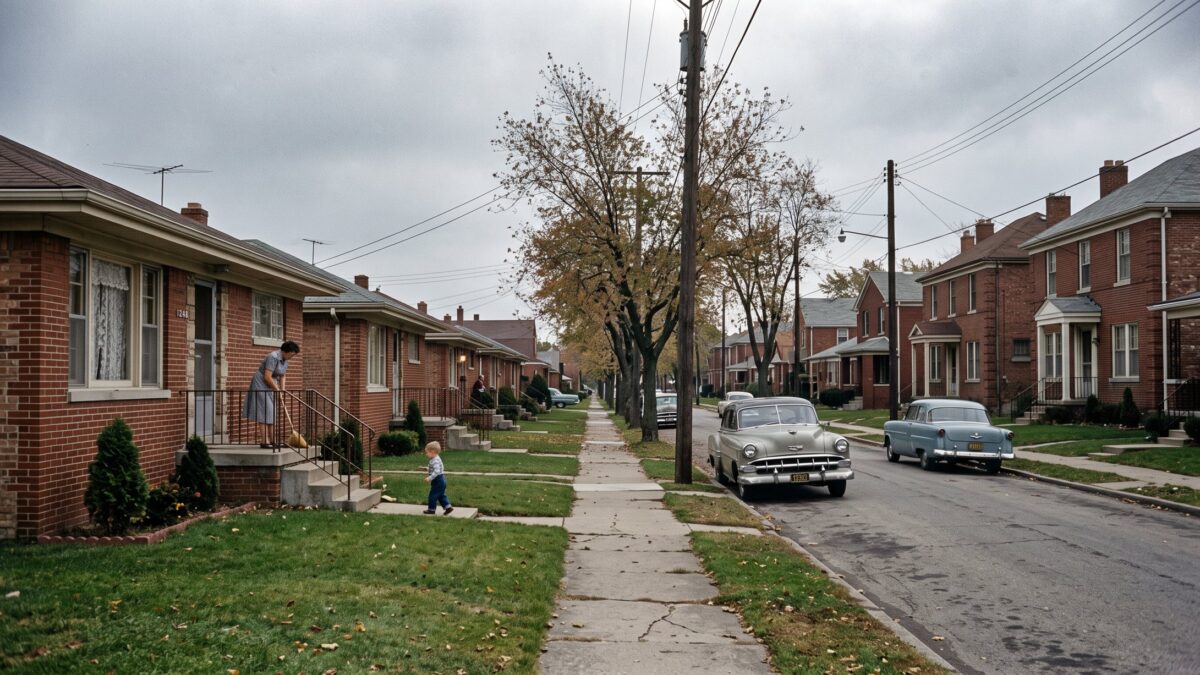
Oak Lawn's brick ranches and Georgians stand on concrete block that has spent seventy years holding back saturated lakebed clay, and the horizontal crack partway down the wall is how block finally says so. We measure the wall before we name the fix, then brace it for a fraction of rebuild money, covered by a 25-year transferable warranty.
- Structural warranty: 25-year transferable
- Published pricing: straps from $600, beams from $900
- Free measured inspection within 48 hours
 25-year transferable warranty on structural work
Who does foundation repair in Oak Lawn?
ProSeal Basement Waterproofing repairs bowing, cracked and settling foundations across Oak Lawn, working from our base in the Joliet and New Lenox corridor. Carbon fiber straps run $600 to $1,000 each, steel I-beams $900 to $1,500, wall anchors $1,000 to $1,800, and crack injection $450 to $900, every number published before an estimator sets foot in your basement, every repair carrying a 25-year transferable warranty.
This village is where the block-wall playbook earns its keep. Nearly the whole housing stock went up in the 1950s and 60s on concrete block, a material strong under weight and weak against sideways push, and quotes on the same bowing wall can differ by five figures depending on who measures it. Our estimators are paid for the diagnosis, not the invoice, and the written plan shows the deflection numbers behind every recommendation.
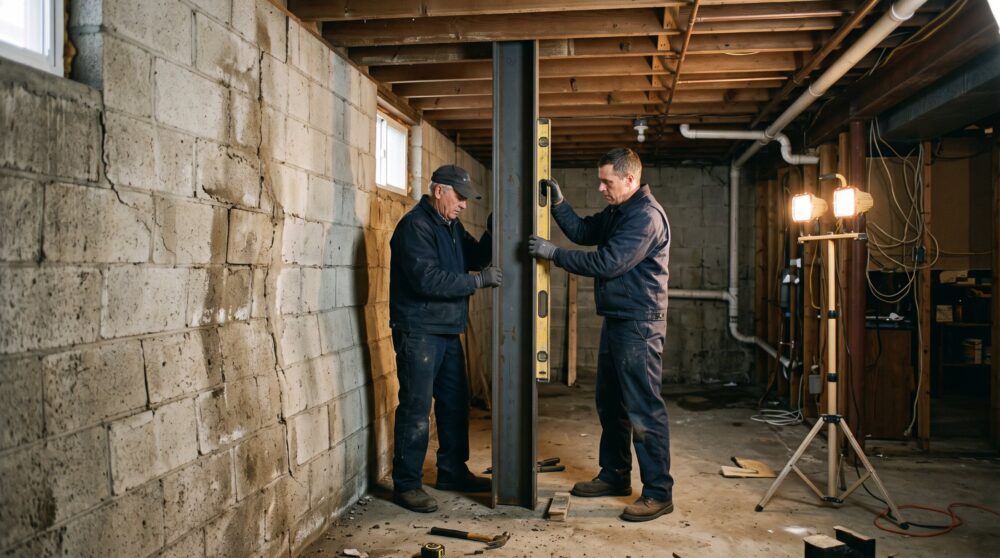 Steel meeting a bowed block wall: measured first, matched second.
What does foundation repair in Oak Lawn include?
Six structural tools cover what Oak Lawn block breaks, and the rule is cheapest adequate fix first. A wall that qualifies for carbon fiber never gets quoted steel, and the plan shows the measurement that decided it.
 Urethane crack injection
Leaking cracks in poured sections and parged block, sealed in a morning.
Learn more
Urethane crack injection
Leaking cracks in poured sections and parged block, sealed in a morning.
Learn more
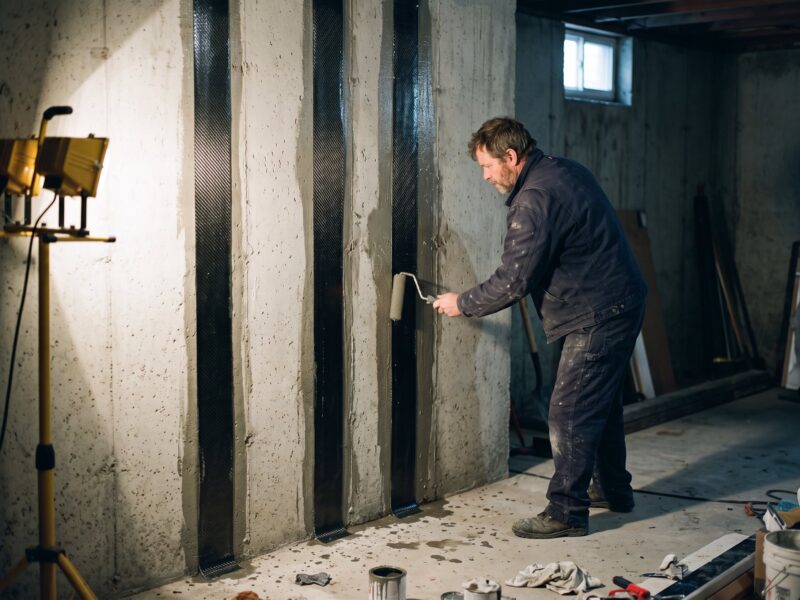 Carbon fiber straps
The early-stage answer for block walls bowed less than two inches.
Learn more
Carbon fiber straps
The early-stage answer for block walls bowed less than two inches.
Learn more
 Steel I-beams & wall anchors
For the walls that waited: bracing past the carbon fiber stage.
Learn more
Steel I-beams & wall anchors
For the walls that waited: bracing past the carbon fiber stage.
Learn more
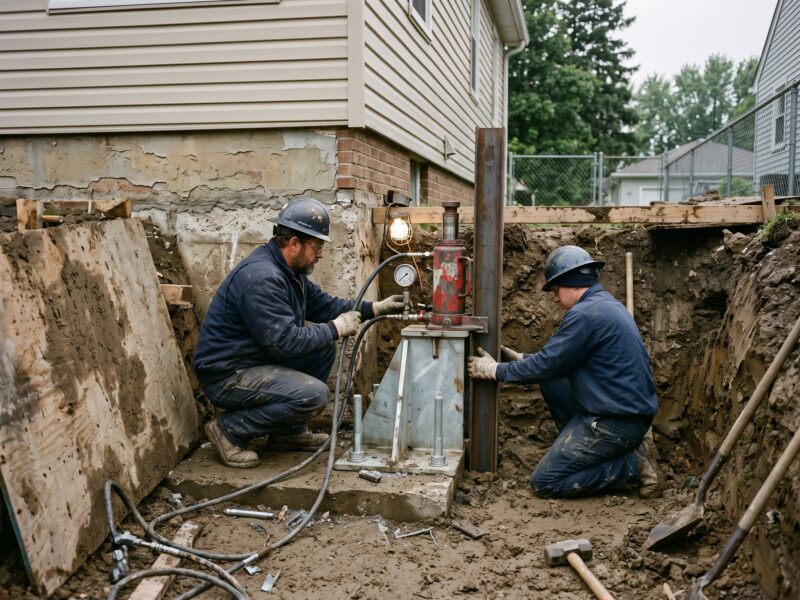 Push & helical piers
For the footing that drops when drought shrinks the lakebed clay.
Learn more
Push & helical piers
For the footing that drops when drought shrinks the lakebed clay.
Learn more
 House leveling
Columns and beams under sagging mid-century floor framing.
Learn more
House leveling
Columns and beams under sagging mid-century floor framing.
Learn more
 Not sure what you have?
The symptom guide reads Oak Lawn's usual cracks and says which trade each one calls for.
Learn more
Not sure what you have?
The symptom guide reads Oak Lawn's usual cracks and says which trade each one calls for.
Learn more
Why do Oak Lawn foundations bow and crack?
Oak Lawn foundations fail the way concrete block fails: strong in compression, weak against the sideways push of saturated clay, and this village's post-war stock has taken that push for seventy years. The horizontal crack partway down the wall is the signature, and it is the most common structural call we take here.

The horizontal crack, a third of the way down
This is Oak Lawn's defining failure. Clay pressure bows the block inward and the wall hinges where the bending is worst, opening a horizontal line along a mortar joint. It never improves on its own, and the price of fixing it climbs with every season it moves.

Ranches, Georgians and Cape Cods on block
The 1950s and 60s stock that fills the village stands on block that was built to code for its day and has simply been asked to resist sideways force ever since. Age is not the problem; seventy years of loaded clay is.

Flat lots that keep the clay wet
Small lakebed-flat lots shed almost nothing, so rain soaks in beside the foundation and the clay against the wall stays heavy for days. Wet clay weighs more and pushes harder, which is why bows advance in wet years and rest in dry ones.
What makes Oak Lawn walls move?
Oak Lawn foundations sit in glacial lakebed clay on ground with almost no relief, and that combination is hard on block. The clay swells when saturated and leans on the wall; drought shrinks it and lets footings ease downward. The push is slow, seasonal and cumulative, which is why a wall can look unchanged for a decade and still be measurably further in than it was, and why we measure instead of eyeballing.
Block changes the arithmetic of repair. A poured wall bends as one piece; a block wall hinges at its mortar joints, so the same inches of deflection are more serious in block and the window for the cheap fix is shorter. Caught early, carbon fiber at $600 to $1,000 per strap holds the line. Waited on, the same wall needs steel or anchors, and a wall left long enough becomes rebuild money. The measurement decides, not the salesperson.
 Deflection in numbers: the written record every repair here starts from.
Signs you need foundation repair in Oak Lawn
Six symptoms cover most Oak Lawn structural calls, ranging from "schedule a measurement" to "call this week." None of them heals on its own, and block gives less warning than poured concrete.
A horizontal crack at mid-wall
The serious one in this housing stock: clay pressure actively bowing the block. Early, it is strap money; late, it is steel and anchor money. Either way it wants a measurement now.

Stair-step cracks near the corners
Cracks climbing the mortar joints map one part of the foundation moving against the rest. Width, direction and change over time tell the story, and we record all three.
Doors out of square upstairs
When bedroom doors quit latching and floors tip a marble, something below moved. Sometimes the footing, often a beam or column at mid-span, which is a far cheaper repair.
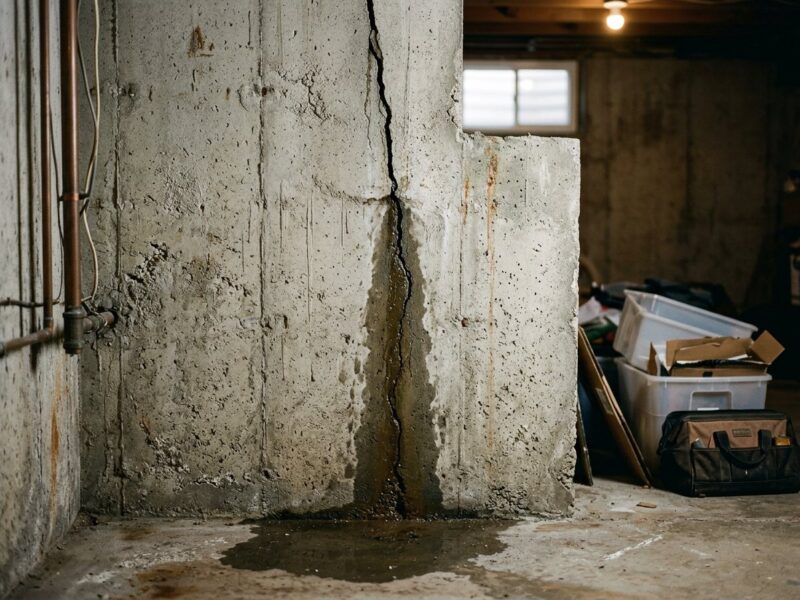
A crack that leaks in the rain
A wet crack costs $450 to $900 to inject when the wall behind it is stable. The inspection confirms stability first, because sealing a moving wall treats the symptom and skips the disease.

A bounce or sag in mid-century floors
Seventy-year-old framing over long basement spans settles into its columns. Sistered joists, new columns and proper footings bring floors back without touching the perimeter walls.
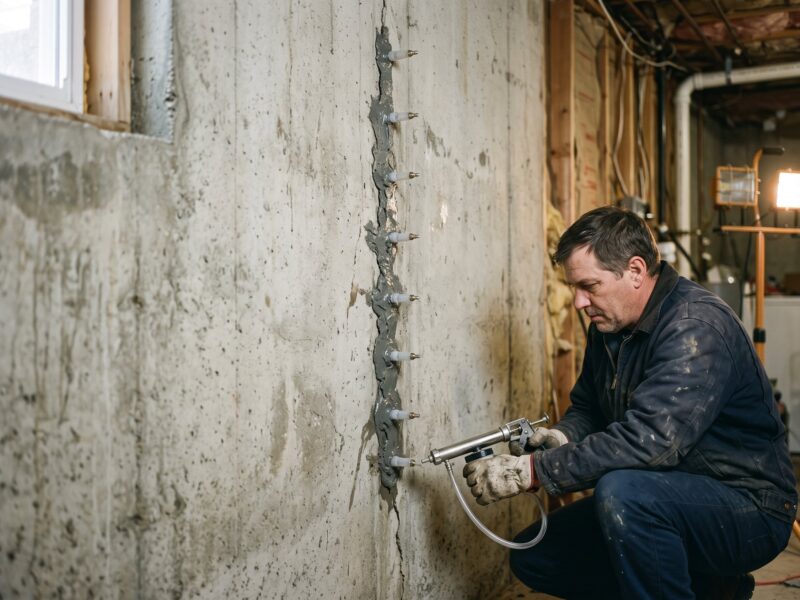
A wall patched more than once
Paint and hydraulic cement over a returning crack mean the cause was never addressed. We diagnose why it keeps opening before anything gets sealed again.
Horizontal line showing on the basement block? That crack is this village's signature problem, and measuring it costs nothing.
How does foundation repair work in Oak Lawn?
An Oak Lawn foundation repair runs four steps: measure the wall, match the method, install and verify, then register the warranty. Most block-wall repairs finish in one to three days.
Measure the wall
We map every crack and measure deflection in numbers, because on Oak Lawn block the inches decide the method. Free, scheduled within 48 hours, and you keep the written record either way.
Day 0Match the method to the movement
Under two inches of bow usually means carbon fiber; further gone means steel or anchors, and anchors need outside yard room that small Oak Lawn lots do not always have. The plan states which and shows why.
Day 0, same visitInstall and verify
The crew installs, torques to spec and re-measures against the day-zero numbers before packing up. Nothing is finished until the wall reads what the plan said it would.
Days 1 to 3Warranty to the address
The 25-year transferable warranty registers to the house and transfers at closing, which is exactly the paper a buyer's inspector wants to see on a braced post-war wall.
On completionReinforce or rebuild: what do Oak Lawn block walls need?
Nearly every bowing block wall in Oak Lawn can be reinforced in place for a fraction of rebuild cost, and the village's tight flat lots strengthen the case: excavating and rebuilding a wall between close-set post-war houses is disruptive, expensive and rarely necessary when the bow is caught in time.
| Reinforce in place | Excavate and rebuild | |
|---|---|---|
| Best for | Bowed or cracked block still structurally intact, which is most of Oak Lawn's | Walls sheared, collapsed or crushed, a small minority |
| On small flat lots | Straps and beams work entirely from inside the basement | Needs excavation room and machine access the lots rarely offer |
| Timing | Best value early, while carbon fiber still qualifies | The end of the road for walls that waited too long |
| Cost | $600 to $1,800 per strap, beam or anchor, from published ranges | Tens of thousands per wall, plus shoring and a wrecked yard |
| Time | One to three days for most walls | Weeks, with the house shored the whole way |
| Warranty | 25-year transferable, registered to the house | Varies by scope; get it in writing before signing anything |
An estimator who quotes rebuild without stating a deflection number has not earned the job. Our measured second opinion is free.
When do Oak Lawn foundations move?
Oak Lawn walls move on the clay's calendar, and every season has a cheapest moment to act on a bowing wall.
Spring: push season
Saturated lakebed clay swells and shoves, and this is when block walls announce themselves: horizontal cracks widen and bows gain their yearly fraction. A measurement taken now catches movement at its most honest.
March to MaySummer: shrink season
Drought pulls water out of the clay and footings ease downward. Settlement cracks open over windows and doors start rubbing, the other half of what flat clay does to post-war houses.
June to AugustFall: the calm window
The clay rests between swell and freeze, which makes fall the season to brace a wall on schedule instead of in a hurry. Work booked now is done before frost.
September to NovemberWinter: inside season
Carbon fiber, steel bracing, injection and column work all happen indoors at full speed while the ground is locked. Winter calendars are the least crowded of the year.
December to FebruaryHow much does foundation repair cost in Oak Lawn?
Foundation repair in Oak Lawn costs $600 to $1,000 per carbon fiber strap, $900 to $1,500 per steel beam, $1,000 to $1,800 per wall anchor and $450 to $900 per injected crack, the same published ranges we hold in every town. A typical single bowing wall lands between $4,000 and $12,000 depending on length and how far it has moved, and 0% for 12 months financing is available.
| Work | Range | What moves the number |
|---|---|---|
| Urethane crack injectionper crack | $450–$900 | Crack length and width, access to the full height |
| Carbon fiber strapsper strap | $600–$1,000 | Wall height, spacing the deflection requires |
| Steel I-beam wall bracingper beam | $900–$1,500 | Ceiling height, footing condition at the base |
| Push or helical piersper pier | $1,600–$3,000 | Depth to load-bearing strata, access for equipment |
The full structural table lives on the pricing page; your written Oak Lawn quote lands inside it.
Where we repair foundations in Oak Lawn
The structural calls come from every corner of 60453 because the housing stock is so uniform: block under nearly everything. The streets off 95th Street and Central Avenue send the textbook horizontal cracks in ranch and Georgian basements. The Stony Creek corridor sends the wettest clay and the walls that move most in spring. Around the Metra station, along Cicero Avenue and out the Southwest Highway corridor it is the mix: stair-step corners, sagging mid-century floors, and cracks that have been painted over once too often.
Oak Lawn is a thirty to forty minute drive from our base in the Joliet and New Lenox corridor, and we make it constantly, which is what lets us do monitoring honestly: when a wall deserves re-measuring in a season rather than steel today, we fold the return visit into a south-suburb run instead of pressuring you to buy now. Inspections are scheduled within 48 hours.
 The estimator arrives with a level and a notebook, not a contract.
Oak Lawn foundation repair questions, answered straight
How much does it cost to fix a bowing block wall in Oak Lawn?
Carbon fiber runs $600 to $1,000 per strap installed, set roughly four to six feet apart. Steel I-beam bracing runs $900 to $1,500 per beam, and wall anchors run $1,000 to $1,800 each but need yard room on the outside. A typical single wall lands between $4,000 and $12,000 depending on its length and how far it has moved, and every repair carries the 25-year transferable warranty.
My wall is bowed but has not moved in years. Do I have to do anything?
Possibly not this year. A wall that deflected and stopped is a different animal from one still moving, and the only way to know which you own is to measure it and check again in a season. We will show you how to track it yourself for free, because selling bracing to a stable wall is not diagnosis, it is commission.
Do you give second opinions on other companies' foundation quotes in Oak Lawn?
Yes, free, and bring the paperwork. On a bowing block wall in this housing stock the spread of what gets recommended is enormous, and the gap between the honest quote and the aggressive one is frequently five figures. A measured deflection number settles most of those arguments fast.
What does a horizontal crack partway down my block wall mean?
It means clay pressure is winning. Block resists weight from above far better than push from the side, so the wall hinges at a mortar joint where the bending is greatest, usually in the upper third to middle of the wall. In Oak Lawn's post-war stock this is the signature failure, and it is progressive: the earlier it is measured, the cheaper the fix.
Do wall anchors work on Oak Lawn's small lots?
Sometimes not, and the lot decides. Anchors need enough undisturbed yard beyond the wall to seat the earth plate, and Oak Lawn's modest setbacks do not always provide it. Where the yard is too tight we brace from inside with carbon fiber or steel instead, which is one reason the inspection walks the outside of the house too.
Can I sell an Oak Lawn house that has a braced basement wall?
Yes, and documented bracing usually reads better to a buyer's inspector than an unexplained crack. Our repairs come with the before-and-after measurements, photos and a 25-year transferable warranty registered to the address that transfers at closing, a packet your listing agent will be glad to hand over.
Do I need a permit for foundation repair in Oak Lawn?
It varies by municipality and by the scope of the work, so the honest answer is that it depends on what your wall needs. Where a permit is required for the repair we perform, we pull it as part of the job, and the written plan notes it before work is scheduled.
Does homeowners insurance cover a bowing wall in Oak Lawn?
Usually not. Standard Illinois policies exclude damage from earth movement and hydrostatic pressure, which is precisely what bows a block wall. That exclusion is the financial argument for catching the crack at the $600-per-strap stage instead of the five-figure stage, because nobody else is paying for the wait.
Is the bowing wall also a wet wall?
In Oak Lawn the push and the puddle share one cause: the saturated clay bending your block inward is the same clay feeding water through its joints, and relieving that water at the footing takes real load off the wall. If the cracked block also seeps each spring, one inspection scopes both trades and sequences the fixes in the right order.
Basement Waterproofing in Oak Lawn
Foundation repair near Oak Lawn

Get the block wall measured before it moves again
A free measured inspection within 48 hours, the cheapest adequate fix named in writing, and a 25-year transferable warranty that transfers with the house.
Or talk to a human right now
(630) 335-1128
Request your free estimate
Tell us what you're seeing. We'll call back fast and be out within 48 hours.