
Basement Waterproofing in Elgin, Illinois
Elgin's oldest streets climb the bluffs on both sides of the Fox River, which means water in this city moves sideways as much as down, and hundred-year-old stone cellars catch it first. We build drainage for exactly that, backed by a lifetime, fully transferable warranty.
- Elgin visits scheduled in blocks, dates given honestly
- lifetime, fully transferable warranty on interior systems
- Written inspection within 48 hours, no travel charge
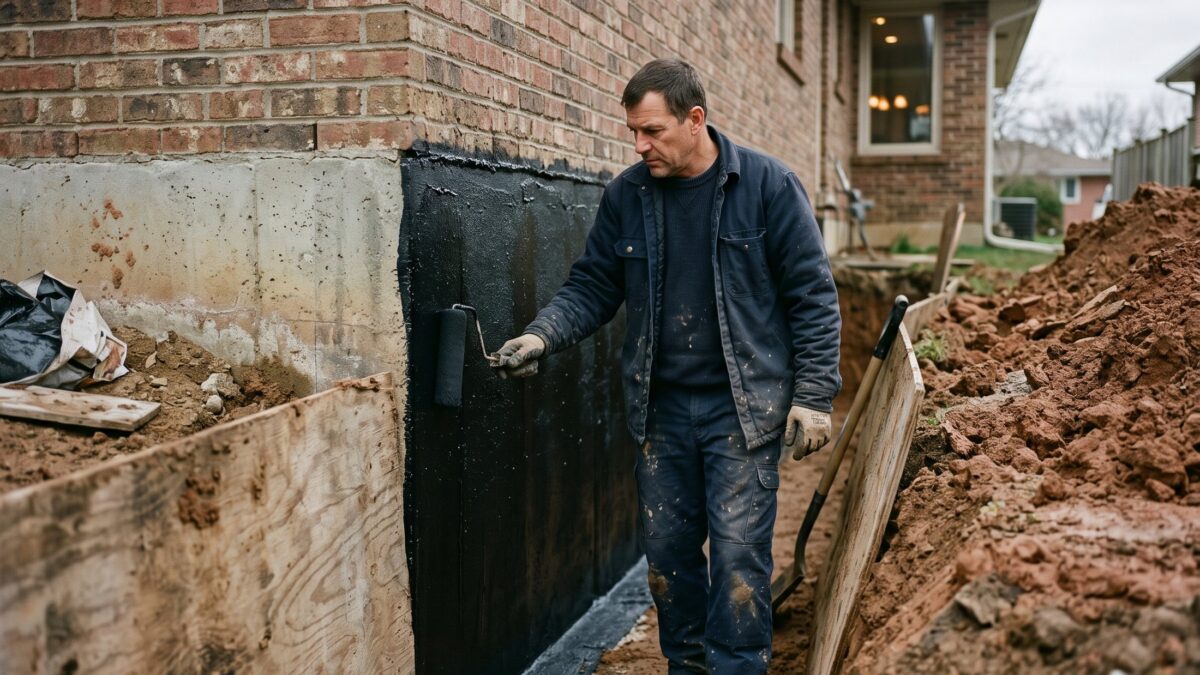 Scheduled in blocks: we tell you honestly when we can be there
Who does basement waterproofing in Elgin?
ProSeal Basement Waterproofing installs interior drain tile, sump pump systems and yard drainage throughout Elgin, from the historic districts down to the Fox and out the Randall Road corridor. Interior drain tile is $95 to $160 per linear foot, a full perimeter system with sump and battery backup runs $8,000 to $16,000 on most houses, and the ranges are published before we ever see yours.
Elgin asks more of a waterproofing crew than most towns because so much of its housing predates the trade itself. Stone and brick cellars under Victorians were never meant to be dry the way a modern basement is, and hillside lots feed them water from the uphill side all year. A contractor who has only ever trenched flat subdivision floors will learn on your house; we would rather arrive already knowing.
See the full basement waterproofing system, wall to discharge
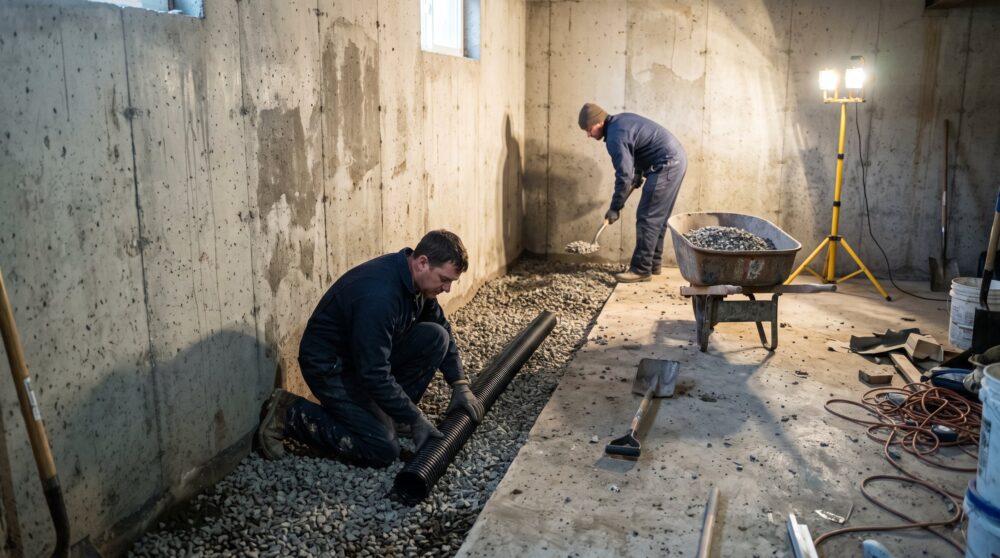 Drain tile at the footing: how a bluff-side cellar finally stays dry.
What does basement waterproofing in Elgin include?
Six systems cover every way water gets into an Elgin basement, and the inspection prices only what your house needs. All of it is our own crew working from published ranges.
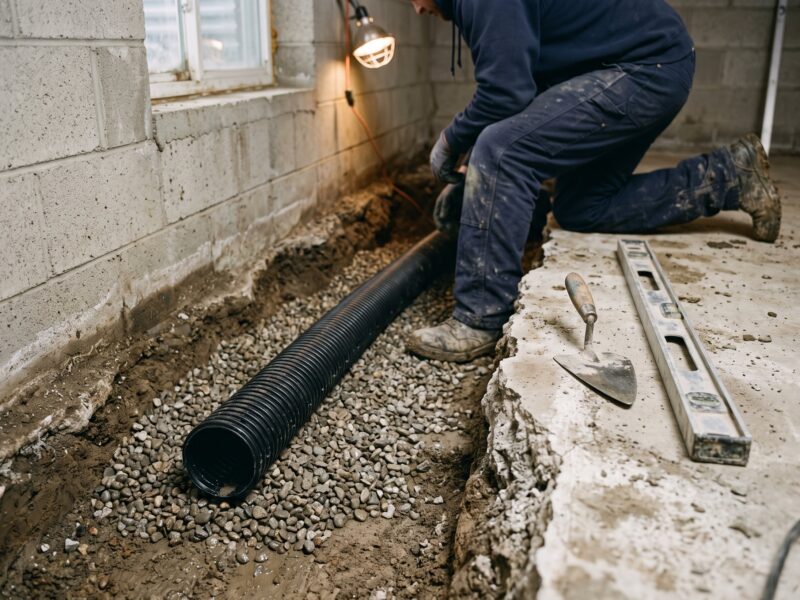 Interior drain tile
Set off the footing where stone and brick walls demand a gentler trench.
Learn more
Interior drain tile
Set off the footing where stone and brick walls demand a gentler trench.
Learn more
 Sump pumps & battery backup
Pits cut into century-old floors, sized for water coming off a slope.
Learn more
Sump pumps & battery backup
Pits cut into century-old floors, sized for water coming off a slope.
Learn more
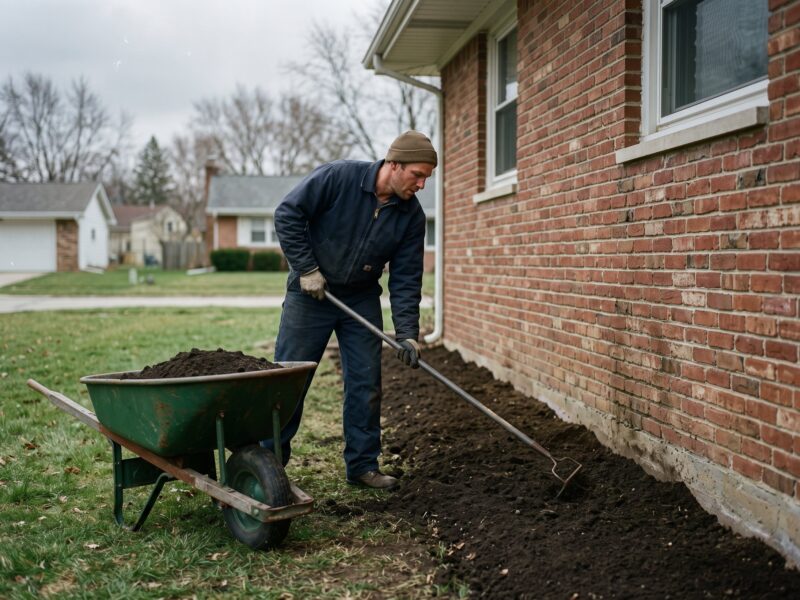 Yard drainage & regrading
Redirecting bluff runoff before it reaches the uphill wall.
Learn more
Yard drainage & regrading
Redirecting bluff runoff before it reaches the uphill wall.
Learn more
 French drains
The intercept line for lots that sit below a neighbor on the hill.
Learn more
French drains
The intercept line for lots that sit below a neighbor on the hill.
Learn more
 Crawl space encapsulation
For the dirt-floored sections and additions old Elgin houses collect.
Learn more
Crawl space encapsulation
For the dirt-floored sections and additions old Elgin houses collect.
Learn more
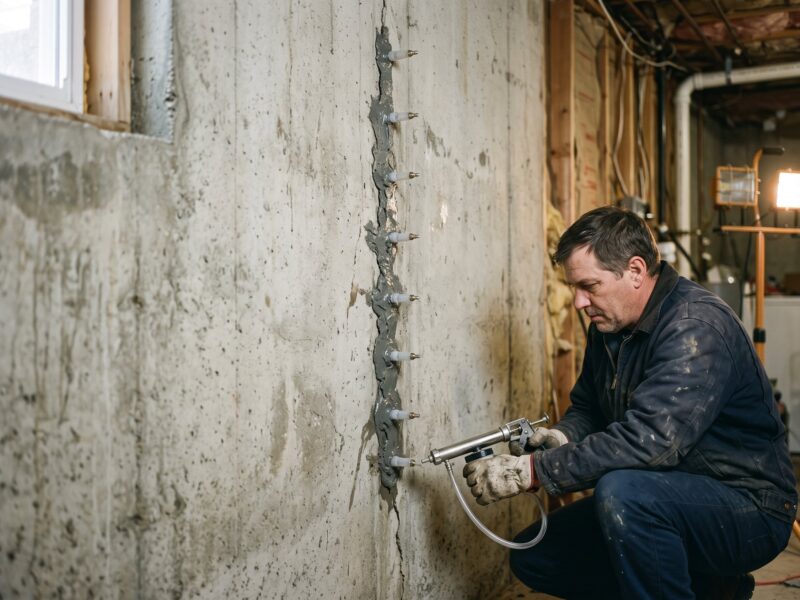 Leaking crack injection
For the west side's poured walls, sealed full depth from $450.
Learn more
Leaking crack injection
For the west side's poured walls, sealed full depth from $450.
Learn more
Why do Elgin basements leak?
Elgin basements leak for reasons the terrain assigns by neighborhood: stone cellars holding back a hillside, old-town brick and early poured walls in tight clay, and far-west subdivisions whose problem is usually the yard, not the wall.

The historic districts
Stone foundations under the Victorians were laid with no membrane and no footing drain, and many of them literally retain the grade behind them. They weep through joints on the uphill side, and drying them means drainage plus respect for the masonry.

Old town off the bluffs
Brick and early poured foundations from the 1910s and 1920s sit in clay that stays wet long after rain ends. Seepage at the floor edge every spring, a damp smell by June: the original tile, where it existed, silted shut generations ago.

The Randall Road corridor
The 1990s-onward west side behaves like a different city. Poured walls mostly hold; the calls are failed sumps, settled builder grading and downspouts dumping at the corner, which is often a $600 to $2,500 fix.
What makes Elgin water different?
Elgin water moves laterally, and that is the fact that shapes every job here. The Fox River cuts through the middle of the city, and the older neighborhoods climb real bluffs on both banks, so rain that lands uphill travels through the clay toward whatever foundation stands in its path. Poplar Creek and Tyler Creek drain their own corridors, and after a storm the ground between the high streets and the river stays loaded for days.
On flat ground, water pushes up under a basement floor; on Elgin's slopes it pushes through the high-side wall first. That is why so many stone cellars weep on one face only, and why the honest fix often pairs an interior system with an intercept drain or regrading on the uphill side. The inspection reads the slope before it prices anything, because the hill decides where your water comes from.
 Storm water working downhill through clay: Elgin's bluff-side pattern.
Signs your Elgin basement needs waterproofing
Six symptoms account for most Elgin water calls, and in a city this old the first job is separating a wet problem from a hundred-year-old stain. The free inspection tells you which you have.

Seepage at the floor edge
Water arriving where the slab meets the wall means hydrostatic pressure underneath, the classic drain tile symptom in the old-town clay below the bluffs.

White crust on stone or brick
Efflorescence is the mineral trail of water passing through the wall itself. On an uphill-facing cellar wall it usually marks the side retaining the grade.

A sump that never shuts off
On a slope, a busy pump may be drinking the whole hillside. Capacity helps, but an intercept drain or regrading uphill often cuts the volume at the source.

A cellar smell the house never loses
Victorians move basement air upward through the whole structure. If the mustiness swells every spring, the source is seasonal ground moisture, not an old-house inevitability.
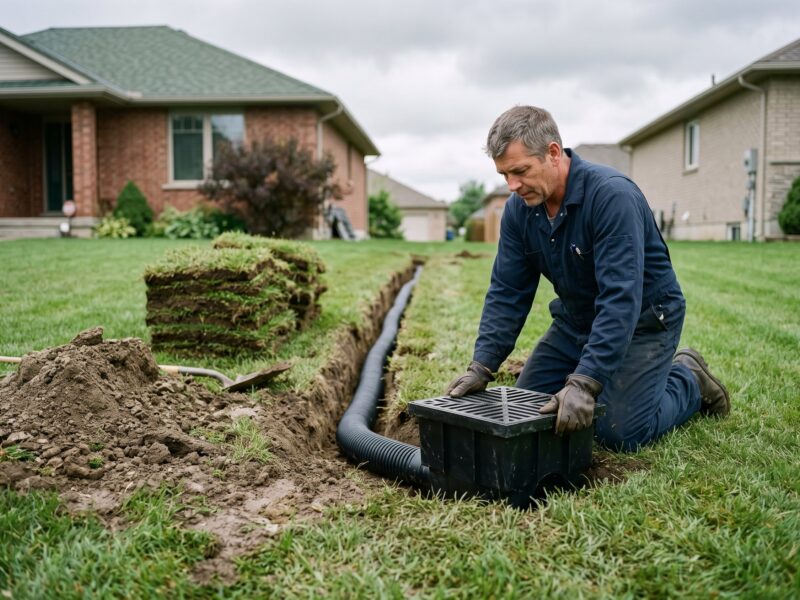
A yard that drains toward the house
Bluff lots frequently deliver a neighbor's runoff straight to your foundation. Catch basins and swales solve at the surface what a bigger pump only fights in the pit.
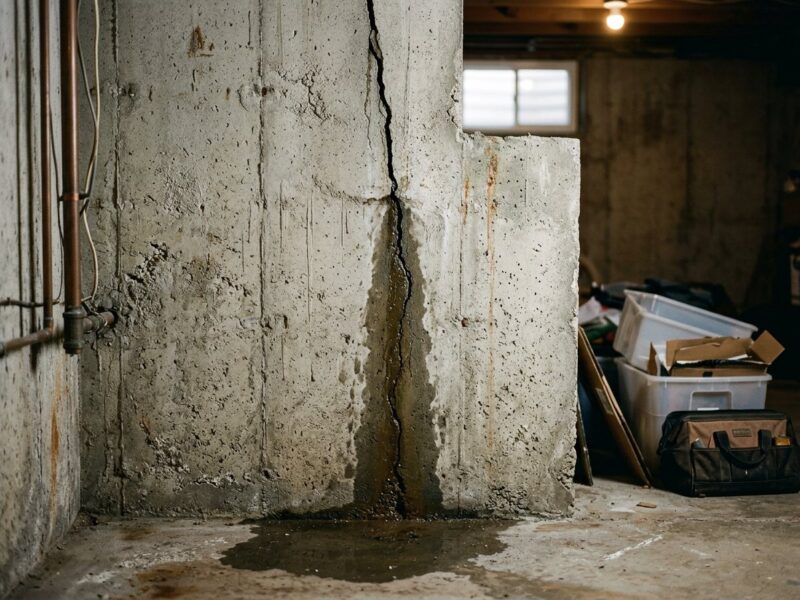
A poured-wall crack that runs in rain
West of Randall Road, a shrinkage crack that turns into a wet streak is normally a $450 to $900 injection, finished in a morning.
One wall of the cellar always wet after rain? On an Elgin hillside that wall is telling you which direction the water travels. The inspection is free.
How does basement waterproofing work in Elgin?
An Elgin waterproofing job moves through four steps, and because the drive is real we plan each one so no visit is wasted. Most full systems install in two to four days.
Walk the slope, then the cellar
The inspection starts outside, reading how the lot sheds water toward or past the house, then traces the entry points inside. Written findings within 48 hours of your call, free.
Day 0Design for the wall you own
A stone cellar gets the off-footing trench and a masonry conversation; brick and early poured get standard perimeter drainage; a west-side sump problem may get $900 of yard work instead of a system. The plan says why.
Day 0, same visitInstall in one mobilization
Because Elgin is a scheduled-block city for us, we arrive with everything: trench, tile, gravel, pit, pumps, backup, concrete, then a hose test you watch before we load the van.
Days 1 to 4Register the warranty
The lifetime, fully transferable warranty is recorded to the address and transfers to the next owner, which a buyer's inspector in a historic district will absolutely ask about.
On completionInterior or exterior waterproofing: which works in Elgin?
Interior drain tile wins most Elgin arguments, and the bluffs are the reason: excavating the downhill side of a hundred-year-old retaining foundation is a serious undertaking, while an interior system manages the same water from the safe side of the wall.
| Interior drain tile | Exterior excavation | |
|---|---|---|
| Best for | Seepage and hillside groundwater, the standard Elgin case | Walls whose outside face is failing and must be rebuilt or coated |
| On stone and brick | Off-footing trench keeps old masonry undisturbed | Digging beside a grade-retaining stone wall demands shoring and care |
| On sloped lots | Works regardless of grade; pairs well with an uphill intercept drain | Machine benching on a bluff lot adds cost and risk |
| Historic-district lots | No yard or garden disturbed on tight Victorian parcels | Mature trees, porches and landscaping usually stand in the dig path |
| Cost | $95 to $160 per linear foot | A multiple of interior cost, priced per wall after inspection |
| Season | Installs all winter; the work is indoors | Waits on thawed, workable ground |
Some walls genuinely need exterior work and we will say so in writing. The method should fit the wall, not the sales script.
When do Elgin basements get wet?
Elgin water keeps a schedule set by the river, the slopes and the clay. Acting one season early is routinely the cheapest decision a homeowner here makes.
Spring: the hillside drains
Snowmelt and rain send the whole bluff's water downhill through saturated clay, the Fox runs high, and uphill cellar walls weep for weeks. The season that fills our Elgin schedule blocks fastest.
March to MaySummer: the cloudburst test
Violent short storms overwhelm gutters on tall Victorian rooflines and cut power to sump pumps at the worst moment. This is why every system we install in Elgin includes the battery backup conversation.
June to AugustFall: fix the surface cheap
Dry ground is the window for regrading, downspout burials and intercept drains, the $600 to $2,500 work that keeps the hill's water away from the wall before the next melt.
September to NovemberWinter: the indoor season
Frozen ground stops excavators, not interior crews. Drain tile, pits and pumps all install through winter, and an Elgin system finished in February is proven before the thaw.
December to FebruaryHow much does basement waterproofing cost in Elgin?
Basement waterproofing in Elgin costs $95 to $160 per linear foot for interior drain tile, with a complete perimeter system including sump and battery backup landing between $8,000 and $16,000 on most homes. The drive north adds nothing to the price: Elgin pays the same published ranges as every town on our map, with no travel charge.
| Work | Range | What moves the number |
|---|---|---|
| Interior drain tileper linear foot | $95–$160 | Length of the run, slab thickness, what has to be moved off the walls |
| Sump pump with battery backupinstalled | $2,800–$4,500 | Pit condition, backup capacity, discharge routing |
| Exterior French drainper linear foot | $45–$90 | Trench depth, where the water can legally go |
| Downspout extensions and regradingtypical job | $600–$2,500 | Feet of grade to rebuild, soil hauling |
Every range is published on the pricing page, and your written Elgin quote lands inside it.
Where we waterproof in Elgin
We cover Elgin across 60120, 60123 and 60124, and the map sorts the calls for us. The Elgin Historic District and Gifford Park send weeping stone cellars and one-wall seepage on bluff lots. The blocks along the Fox River corridor and Route 20 send old-town brick, silted tile and spring floor-edge water. The Poplar Creek and Tyler Creek corridors send yard drainage and swollen-clay questions, and the Randall Road corridor sends sump failures and builder-grading fixes.
We will be straight about the geography: Elgin sits toward the northern edge of our territory, an hour and ten to an hour and a half from our Will County base, so we schedule this side of the map in blocks and give you a real date rather than a vague one. Inspections are booked within 48 hours, there is no travel charge and no minimum job size, and standing water still gets the 24/7 line.
 Elgin's older streets: tall houses, deep cellars, water on the move.
Elgin basement waterproofing questions, answered straight
Do you really come out to Elgin?
Yes, and we will not pretend it is around the corner. The drive from our Will County base runs an hour and ten to an hour and a half, so we group Elgin work into scheduled blocks that make the trip efficient. You get an honest date, no travel charge and no minimum job size.
Can you put drain tile in a stone-foundation cellar?
Yes, with the right detail. On stone we keep the trench off the footing so the excavation never undermines masonry that holds itself together by weight, and the system collects water at the slab edge where the wall delivers it. Hundred-year-old cellars in the historic districts take this system well.
Only one wall of my basement ever gets wet. Why?
On an Elgin slope that is the expected pattern, not a mystery. The wet wall is almost always the uphill face, the one retaining the grade, because the hillside feeds it water laterally. The fix reflects the cause: relieve that wall with drainage inside, and often intercept the water outside before it arrives.
How much does basement waterproofing cost in Elgin?
The same published ranges we hold everywhere: $95 to $160 per linear foot for interior drain tile, $8,000 to $16,000 for a full perimeter system with sump and battery backup, $2,800 to $4,500 for a sump with backup on its own, and $600 to $2,500 for downspout and regrading work. Distance changes nothing.
Is my house near the Fox River at flood risk?
Most of Elgin's housing stands well above the river on the bluffs, but low-lying blocks near the Fox and the creek corridors deserve a FEMA map check before anyone quotes a system. If your address maps into a flood zone, the honest sequence is flood coverage first, then drainage for the groundwater an interior system can actually control.
Can you dry a basement without wrecking the garden on a small historic-district lot?
That is precisely what interior systems are for. The entire job happens from inside the cellar, so the perennial beds, the mature trees and the porch footings never enter the conversation. Tight Victorian parcels are a reason to choose the method, not an obstacle to it.
My west-side sump runs constantly. Do I need a whole system?
Possibly not. In the Randall Road corridor the pump is often recycling the house's own roof water off short downspouts and settled grading, and correcting the yard for a fraction of system cost calms the pit down. We check that before quoting anything larger, because selling you the big fix first would be the easy and wrong answer.
How do I pick a waterproofing company for an old Elgin house?
Ask every bidder what changes about their trench on a stone wall, whether their pricing was published before the visit, and whether the warranty transfers to a buyer without fees. In a city with this much pre-1930 stock, a contractor without a specific stone-and-brick answer is the wrong contractor for the house.
Is the wet wall also moving?
On Elgin's slopes, the hillside that pushes water through a cellar wall pushes on the wall itself, and stone that weeps is often stone quietly losing mortar. If the damp face also bulges, leans or sheds grit, one visit measures both problems and one plan sequences both fixes.
Foundation Repair in Elgin
Basement waterproofing near Elgin

Dry the cellar the hill keeps filling
A free inspection within 48 hours, a system designed for stone, brick or poured, and a lifetime, fully transferable warranty registered to the address.
Or talk to a human right now
(630) 335-1128
Request your free estimate
Tell us what you're seeing. We'll call back fast and be out within 48 hours.