
Foundation Repair in Aurora, Illinois
Illinois' second-largest city holds four foundation eras at once, from mill-town rubble beside the Fox to poured walls finished a decade ago past Orchard Road. Each era fails its own way and deserves its own repair, chosen from measurements and covered by a 25-year transferable warranty.
- Structural warranty: 25-year transferable
- Published pricing: injection from $450, piers from $1,600
- Free structural inspection within 48 hours
 25-year transferable warranty
Who does foundation repair in Aurora?
ProSeal Basement Waterproofing repairs foundations across all of Aurora, with urethane crack injection at $450 to $900, carbon fiber straps at $600 to $1,000 each, steel beams and wall anchors at $900 to $1,800, and settlement piers at $1,600 to $3,000 apiece, every figure published before an estimator sees your wall. All structural work carries a 25-year transferable warranty.
The reason Aurora demands range from a contractor is simple arithmetic: the city grew from a Fox River mill town into the second-largest city in the state, and every growth ring built differently. Limestone and rubble near the water, brick and block through the middle decades, splits from the 1970s, poured concrete on the edges. The correct repair genuinely changes four times between downtown and the city limits.
 Reinforcement sized from the numbers, not from the age of the house.
What does foundation repair in Aurora include?
Six structural tools handle everything Aurora's four building eras can break, and the estimate always starts from the cheapest fix the measurements support. The written plan shows the reasoning next to the price.
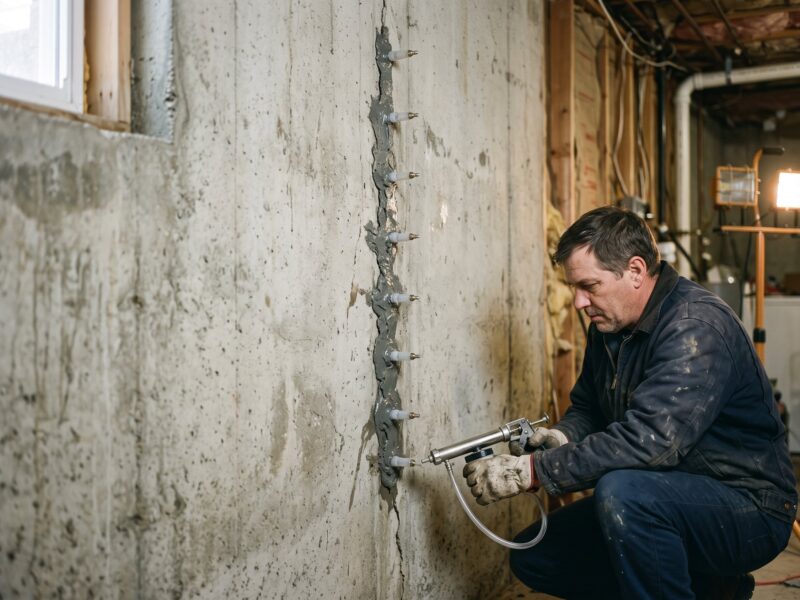 Urethane crack injection
Full-depth sealing for cracked poured walls on the newer far sides.
Learn more
Urethane crack injection
Full-depth sealing for cracked poured walls on the newer far sides.
Learn more
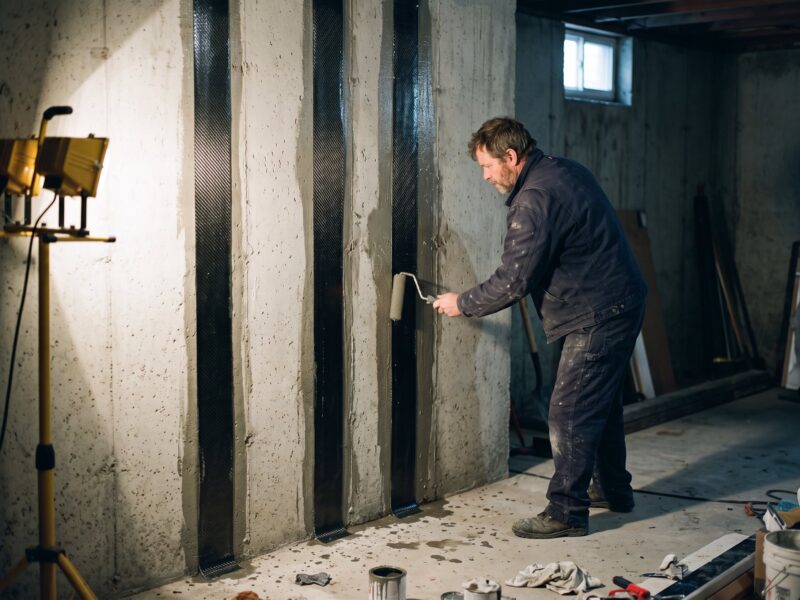 Carbon fiber straps
For mid-century block caught while the bow is still small.
Learn more
Carbon fiber straps
For mid-century block caught while the bow is still small.
Learn more
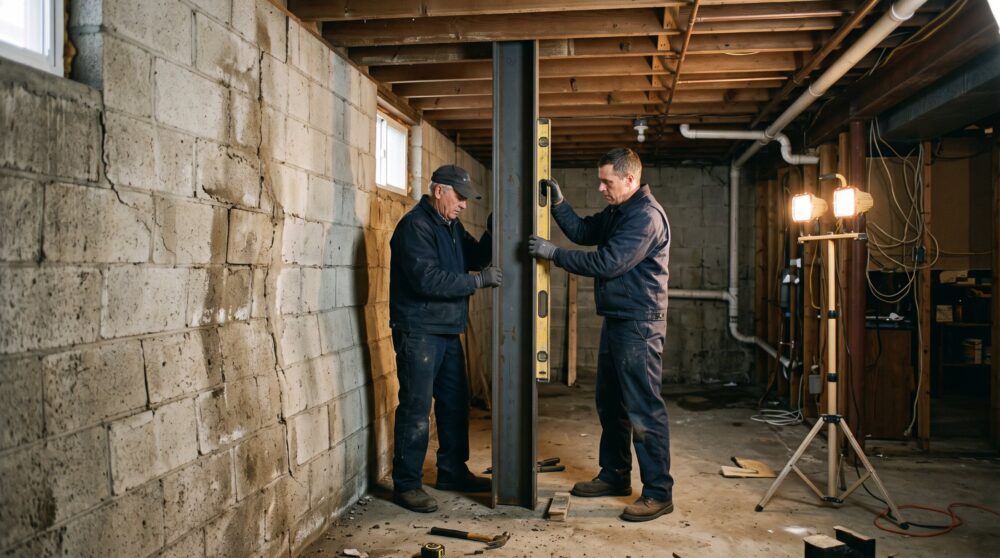
 Steel I-beams & wall anchors
For walls whose deflection numbers have outgrown carbon fiber.
Learn more
Steel I-beams & wall anchors
For walls whose deflection numbers have outgrown carbon fiber.
Learn more
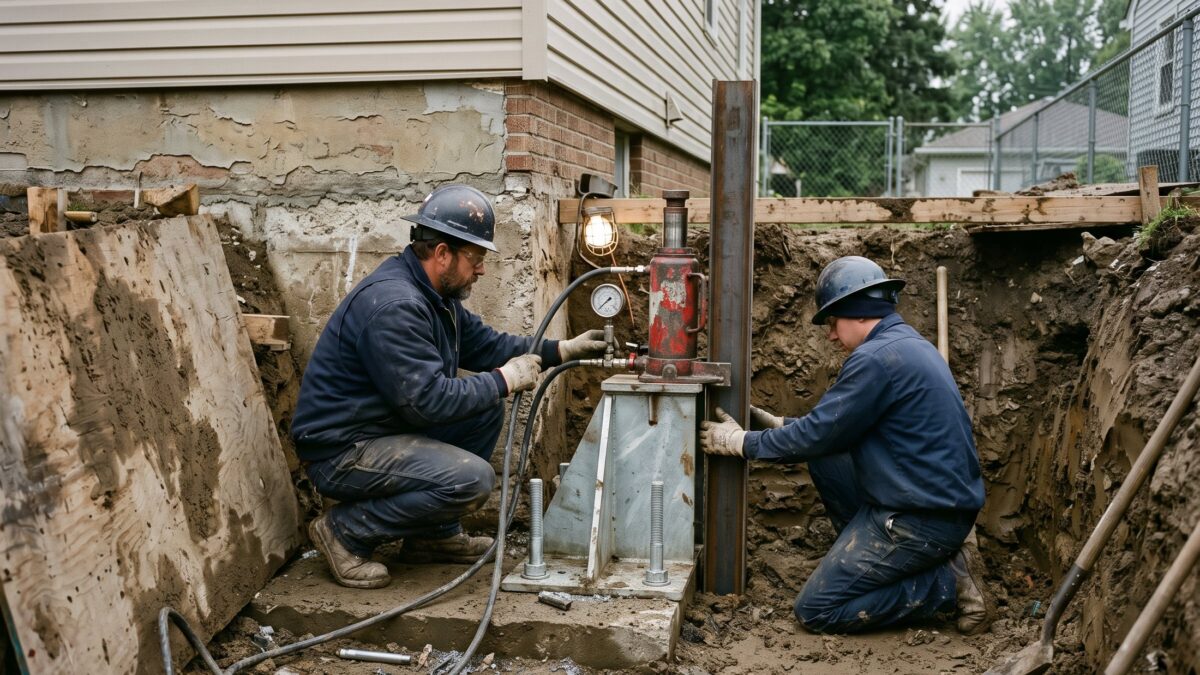
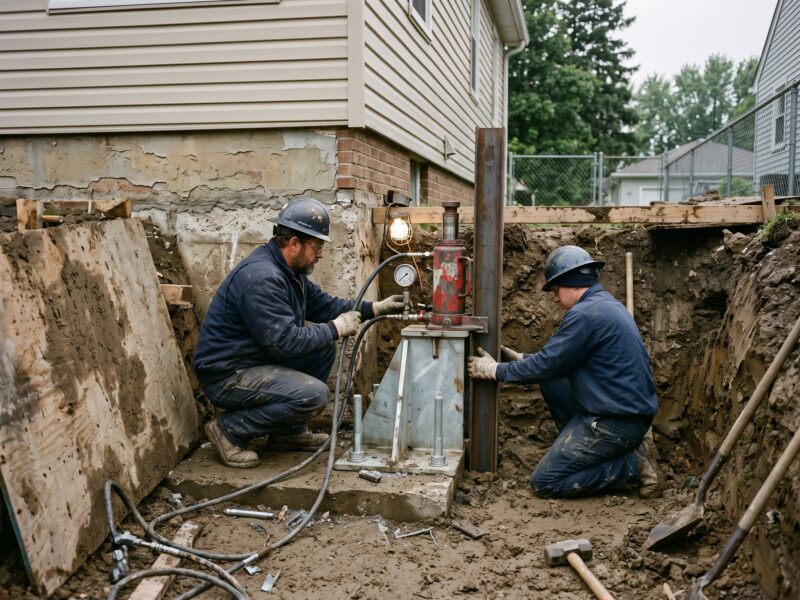 Push & helical piers
For settlement in the subdivision belt built on graded farmland.
Learn more
Push & helical piers
For settlement in the subdivision belt built on graded farmland.
Learn more
 House leveling
Beams, columns and footings under sagging mill-era floor frames.
Learn more
House leveling
Beams, columns and footings under sagging mill-era floor frames.
Learn more
 Not sure what you have?
Sort stone-era cracks from subdivision settling before you spend.
Learn more
Not sure what you have?
Sort stone-era cracks from subdivision settling before you spend.
Learn more
Why do Aurora foundations crack and settle?
Aurora foundations fail on a schedule set by their birth year: stone walls losing century-old mortar by the river, block bowing under mature clay pressure in the middle rings, and young poured walls settling into regraded farmland at the edges. Prescribing across eras is how walls get wrecked.

Mill-town stone and brick
The pre-1900 inventory near downtown stands on limestone, rubble and brick that hold together by weight and honest mortar. Saturation from the Fox's water table and past patches of hard modern mortar are what actually kill these walls, not age itself.

Block and splits of the middle rings
Post-war block and 1970s split-levels have now spent fifty-plus years against swelling clay. Horizontal cracking at mid-height and stair-steps at corners are that clay winning slowly, and the cost of stopping it roughly doubles with every year of waiting.

The subdivision edges
Past Eola and Orchard Road, strong young poured walls sit on farm clay that was cut and filled to grade. The wall is rarely the problem; the fill beneath a corner is, and elevation readings separate live settlement from history.
What makes Aurora ground move?
Aurora ground moves because two different soils are doing two different things. Along the Fox River corridor the clay never fully drains; a permanently high water table keeps it heavy and pushing, which is why the oldest walls fail by slow saturation rather than sudden events. Out on the far east and far west sides, regraded farm clay does the opposite, swelling in wet springs and shrinking hard in dry summers, ratcheting footings a little each cycle.
That split rewrites the repair menu by neighborhood. River-ward stone wants moisture relief, soft lime repointing and restraint, because aggressive digging beside a gravity wall creates the emergency it was meant to prevent. Subdivision settlement wants piers driven past the fill to soil that has never moved. Between the two, mid-ring block wants reinforcement matched to measured deflection. One city, three mechanisms, and the measurements decide which one your house is in.
 Elevation readings first: Aurora repairs are chosen from numbers.
Signs you need foundation repair in Aurora
Six symptoms produce nearly all of Aurora's structural calls, ranging from a cheap morning fix to genuine urgency. Every one of them is cheaper this year than next year.

A horizontal crack at mid-height
The urgent one. Clay pressure is actively flexing the wall inward, and in the middle-ring block stock this is the difference between carbon fiber money now and steel or rebuild money later.
Stair-step cracks through mortar joints
Block and brick record differential movement through their joints like a chart. Width, direction and change over time tell us which part of the footing moved; we measure all three.

Doors out of square, sloping floors
Movement below always shows up first in the trim carpentry upstairs. In the older stock the culprit is often a tired beam or column rather than the foundation, which is a far cheaper repair.
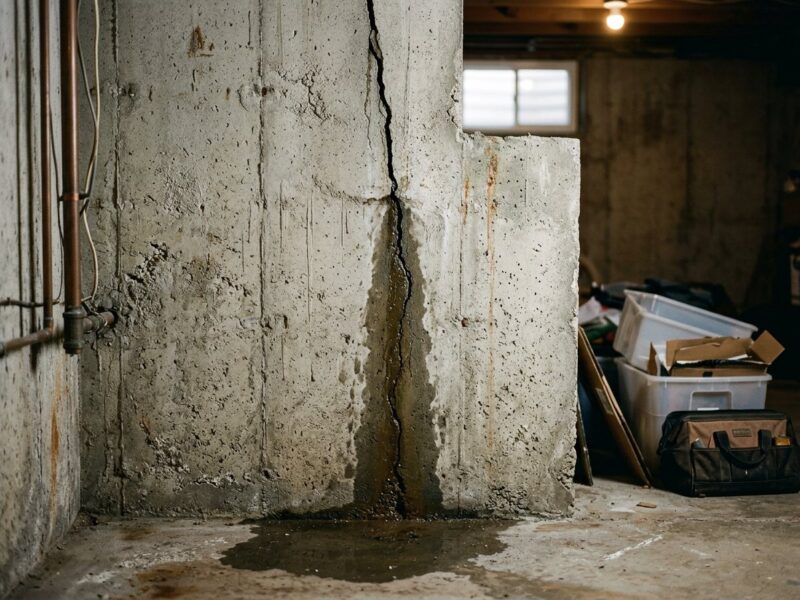
A poured-wall crack that also leaks
Standard in the newer subdivisions. If measurements show the crack is stable, a $450 to $900 injection seals it permanently and nobody should be selling you steel.

A bouncy or sagging main floor
Mill-era frames over stone basements were sized for another century's loads. Columns, footings and sistered framing bring them level for far less than owners fear.

A stoop, garage or addition drifting away
Anything poured on its own shallow footing can settle separately from the house, and on regraded farm clay it often does. A widening gap is the fill talking; elevations confirm it.
Watching a crack instead of measuring it? A pencil line and a date beat worry, and a free structural inspection beats both.
How does foundation repair work in Aurora?
An Aurora structural job follows four steps, and because Fox Valley visits run in scheduled blocks, the distance never slows the calendar. Most repairs finish inside one to three working days.
Date the foundation, measure the movement
The first question in Aurora is always which era built your wall, because stone, block and poured fail differently. Then we put numbers on every crack and bow. Free, within 48 hours.
Day 0Choose from the right playbook
Repointing and relief for the river-ward stone, carbon or steel for mid-ring block, injection or piers for the subdivision edges. The plan names the method, the published price and the evidence.
Day 0, same visitRepair and re-measure
The crew arrives from the Fox Valley block fully loaded, installs to spec, then checks the finished work against the day-zero readings before leaving Aurora. Pier work logs drive pressure at every bracket.
Days 1 to 3Paper the result
Measurements, photos, scope and the 25-year transferable warranty are registered to the address, a file that answers any future buyer's inspector on your behalf.
On completionReinforce or rebuild: what do Aurora walls actually need?
Most failing Aurora walls can be saved in place for a fraction of replacement cost, and the case is strongest in exactly the neighborhoods where rebuilding is scariest: you do not casually excavate beside a hundred-and-thirty-year-old rubble wall in saturated floodplain clay.
| Reinforce in place | Excavate and rebuild | |
|---|---|---|
| Best for | Bowed, cracked or settled walls still carrying load, the large majority | Sheared or collapsing walls, a genuine minority |
| On mill-era stone | Repointing, drainage relief and gentle restraint preserve the wall | Digging beside rubble in wet floodplain clay endangers it |
| On subdivision poured walls | Injection and piers address the actual failure, which is usually the fill | Replaces a healthy wall without touching the soil problem |
| Cost | $450 injections through $3,000 piers, from published ranges | Tens of thousands per wall before landscaping |
| Time | One to three days on site for most Aurora repairs | Weeks of shoring, machines and an open trench |
| Warranty | 25-year transferable, registered to the house | Varies with scope; demand it in writing first |
A rebuild quote that arrives without deflection measurements is a sales document. Get the numbers; our inspection provides them free.
When do Aurora foundations move?
Aurora's clay works on a four-season cycle, and each quarter favors a different move. Acting in the right season routinely saves four figures.
Spring: pressure season
Fox Valley snowmelt saturates the clay and the pushing starts. Mid-ring block announces new horizontal cracks, and river-ward stone weeps through joints. A measurement taken now catches walls at their most honest.
March to MaySummer: settlement season
Dry heat pulls water out of the regraded farm clay under the subdivision belt, and footings follow it down. Cracks over windows and doors on the far sides mostly date to summers, not springs.
June to AugustFall: the calm window
The clay pauses between swelling and shrinking, which makes autumn the ideal season to brace walls, drive piers and repoint stone without the ground arguing back.
September to NovemberWinter: the indoor season
Frost locks the top of the soil, but injection, carbon fiber, steel bracing and beam-and-column work all happen inside the basement, so Aurora structural work runs at full pace through February.
December to FebruaryHow much does foundation repair cost in Aurora?
Foundation repair in Aurora costs $450 to $900 for an injected crack, $600 to $1,000 per carbon fiber strap, $900 to $1,500 per steel beam, and $1,600 to $3,000 per pier, straight off the published sheet with no Fox Valley travel charge. Mill-era stone repointing is craft work and gets scoped at the free inspection.
| Work | Range | What moves the number |
|---|---|---|
| Urethane crack injectionper crack | $450–$900 | Crack length and width, access to the full height |
| Carbon fiber strapsper strap | $600–$1,000 | Wall height, spacing the deflection requires |
| Steel I-beam wall bracingper beam | $900–$1,500 | Ceiling height, footing condition at the base |
| Push or helical piersper pier | $1,600–$3,000 | Depth to load-bearing strata, access for equipment |
The full structural table lives on the pricing page; your written Aurora quote lands inside it.
Where we repair foundations in Aurora
Aurora's structural calls read like its growth rings. Downtown, the blocks around Stolp Island, the Near East Side and Near West Side send stone and brick work: repointing, bulge relief, beams and columns under old floor frames. The post-war and 1970s rings send bowing block and stair-step corners. The Eola Road area, the Orchard Road corridor and the Farnsworth Avenue corridor send settlement surveys and pier work into regraded farm clay. ZIPs 60502 through 60506 are all on the route.
Honestly stated: Aurora is a forty-five minute to one hour drive from our Joliet and New Lenox base, and we make it week in, week out. Structural visits ride the same scheduled Fox Valley blocks as our waterproofing work, so re-measuring a watched wall is a planned stop rather than a special trip, and no Aurora invoice ever includes the mileage.
 The Fox Valley block: loaded in the morning, in Aurora by the first appointment.
Aurora foundation repair questions, answered straight
My Aurora foundation is old limestone. Is that worse than concrete?
Different, not worse. A well-built limestone wall has already stood a hundred and thirty years and can stand another hundred if it stays reasonably dry and gets repointed with soft lime mortar rather than hard modern mix. Saturation and the wrong mortar are what kill these walls; concrete has its own failure modes and some arrive faster.
Who repairs stone foundations in Aurora?
We do, and Aurora's mill-era wards supply steady practice. Rubble and limestone are gravity structures that want repointing, moisture relief and restraint rather than the poured-wall playbook. Any contractor offering your stone basement the same fix as a 2005 subdivision wall has not understood the question.
Is a horizontal crack in my mid-century Aurora block wall an emergency?
It is a deadline. Horizontal at mid-height means clay pressure is actively bowing the wall, and block that age has little reserve. Caught under two inches of deflection it is usually carbon fiber at $600 to $1,000 per strap; left to grow, it becomes steel, anchors or rebuild money. Measure it this season.
My newer house past Orchard Road has cracks over the windows. Should I worry?
You should measure. Subdivisions on regraded farmland commonly settle through their first couple of decades, and the question is whether yours has finished. If elevations show live movement, piers at $1,600 to $3,000 each end it permanently; if the movement is old and done, sealing the cracks is the whole honest answer.
Do you monitor a wall from an hour away, or just quote steel?
We monitor when monitoring is the right call. Aurora sits on our regular Fox Valley schedule, so a re-measurement is a planned stop on a route we already run, not a favor. A wall that deserves watching gets watched, with dated numbers, before anyone proposes reinforcement.
Does homeowners insurance cover Aurora foundation repair?
Rarely. Illinois policies almost universally exclude soil movement and hydrostatic pressure, which between them cause most foundation damage in a river city on clay. The practical takeaway is to catch problems at the injection or strap stage, because the five-figure stage is usually yours alone.
Will past foundation repair hurt my Aurora home sale?
Documented repair typically helps. Buyers fear the unexplained crack, not the repaired one, and our jobs close with measurements, photos, the scope and a 25-year transferable warranty registered to the address. That transferable file is what your agent hands the buyer's inspector.
Do I need a permit for foundation repair in Aurora?
Structural work in Aurora generally involves the city's permitting process, and the specifics depend on the scope. We handle the paperwork as part of the job and build inspection milestones into the schedule, so the permit question costs you no time and no phone calls.
Is the cracked wall also a wet wall?
In Aurora the overlap is the rule, not the exception: the river-fed clay that bows a near-side wall is soaked, and the mortar joint that lets water through is the same joint losing strength. If your structural symptom comes with spring dampness, one visit scopes both trades and sequences the fixes correctly.
Basement Waterproofing in Aurora
Foundation repair near Aurora

Whatever era built your Aurora wall, get it measured
A free structural inspection within 48 hours, a repair chosen from your wall's actual numbers, and a 25-year transferable warranty that transfers with the house.
Or talk to a human right now
(630) 335-1128
Request your free estimate
Tell us what you're seeing. We'll call back fast and be out within 48 hours.