
Foundation Repair in Dixon, Illinois
Most Dixon foundations are older than the methods invented to repair them: stone, brick and early poured walls with soft mortar and a century of freeze-thaw behind them. That is exactly the work that justifies our drive from Will County, measured first, priced from published ranges, and covered by a 25-year transferable warranty.
- Structural warranty: 25-year transferable
- Published pricing: injection from $450, piers from $1,600
- A real inspection date with the Lee County block, kept
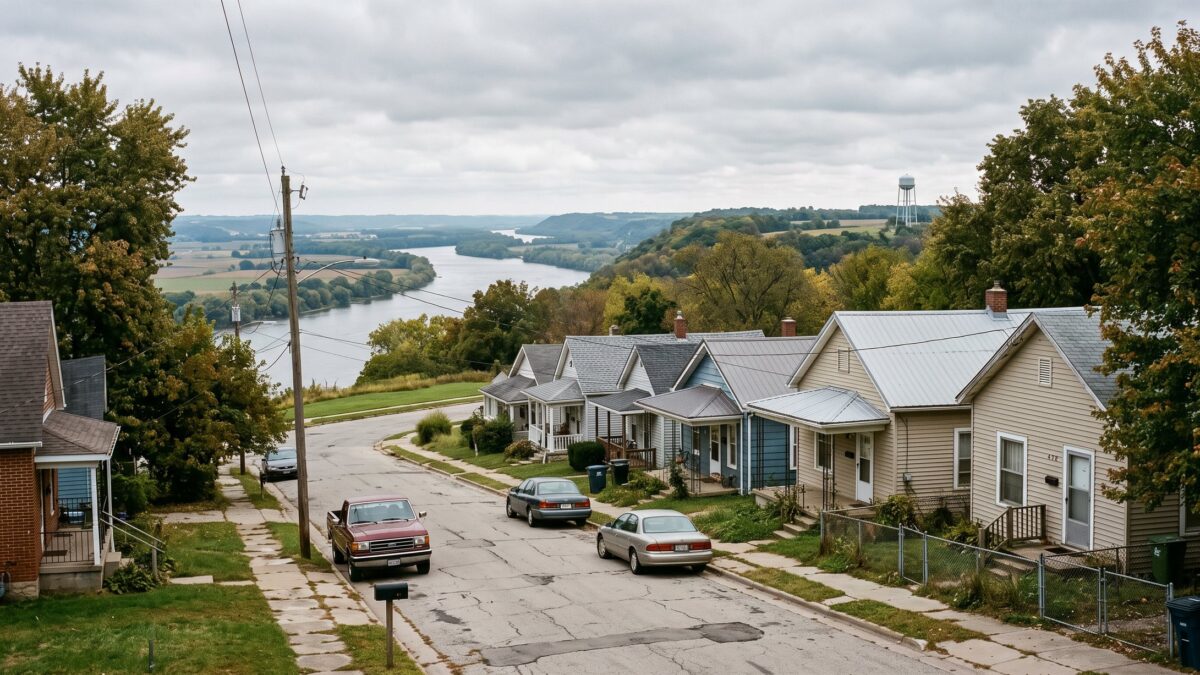 Worth the drive: 25-year transferable warranty
Who does foundation repair in Dixon?
ProSeal Basement Waterproofing repairs foundations in Dixon from our Will County base, at the same published prices we hold everywhere: crack injection $450 to $900, bowing-wall reinforcement $600 to $1,800 per strap, beam or anchor, and settlement piers $1,600 to $3,000 each, all under a 25-year transferable warranty. Dixon sits at the western edge of our map, so we schedule Lee County work in dedicated blocks.
Dixon punishes the standard playbook. A contractor whose experience is all poured subdivision walls will mis-read a stone wall that holds itself up by weight and friction, and mis-repairing one can cost you the wall. This town wants a company fluent in soft mortar, brick coursing, early concrete and the river-valley ground under all of it, and honest enough to say when a crack needs $450 and not $10,000.
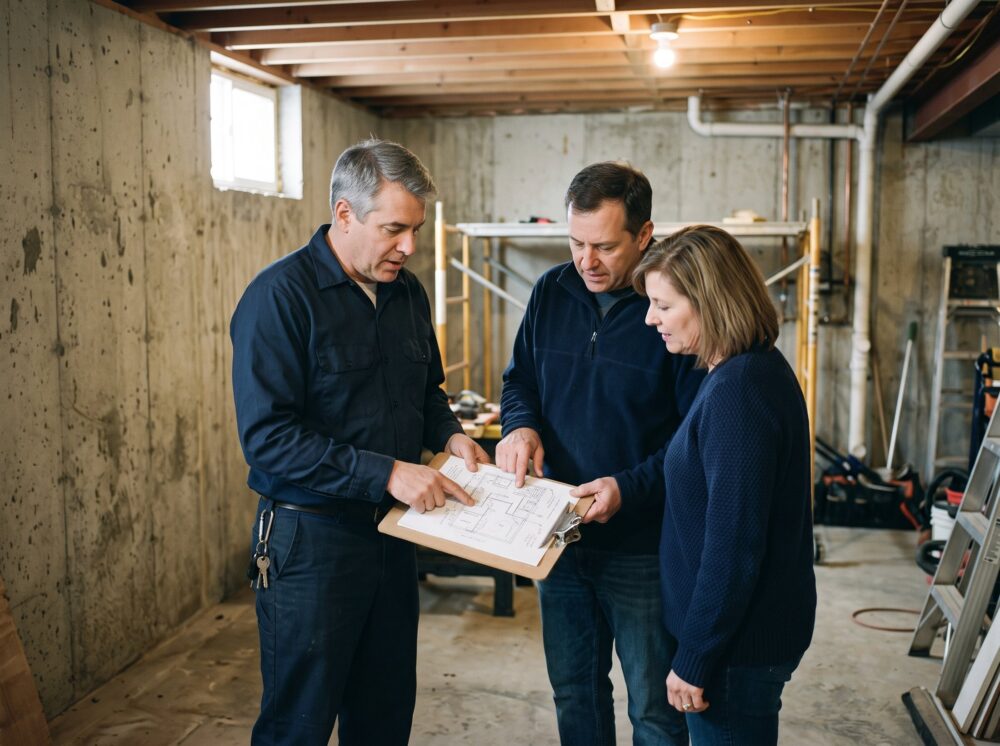 The diagnosis comes with numbers: era, measurements, method and the published price.
What does foundation repair in Dixon include?
Six structural tools cover what a century and a half of Dixon construction can break, and the written plan always starts from the cheapest fix that actually holds. A long drive is no excuse for a padded scope; if anything it sharpens the honesty.
 Urethane crack injection
Leaking poured-wall cracks on the newer edges, sealed full depth in one visit.
Learn more
Urethane crack injection
Leaking poured-wall cracks on the newer edges, sealed full depth in one visit.
Learn more
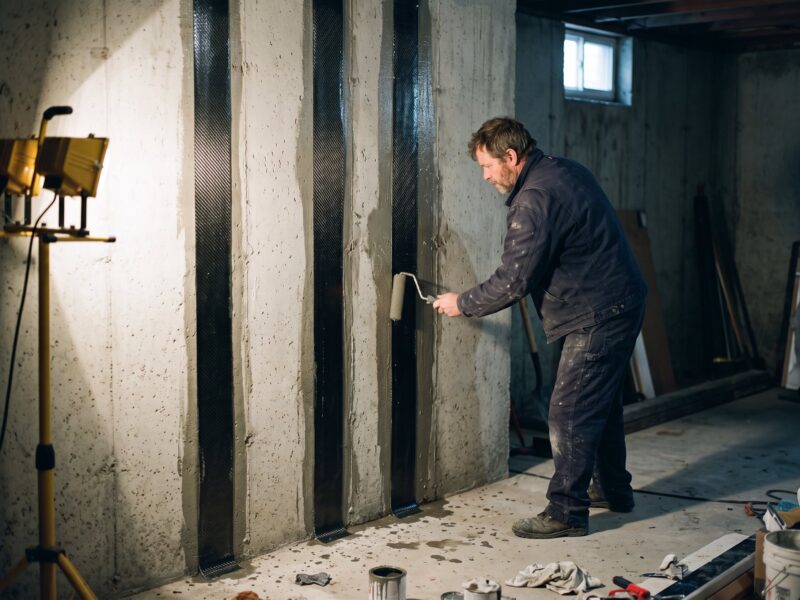 Carbon fiber straps
For block and poured walls caught while the bow is still small.
Learn more
Carbon fiber straps
For block and poured walls caught while the bow is still small.
Learn more
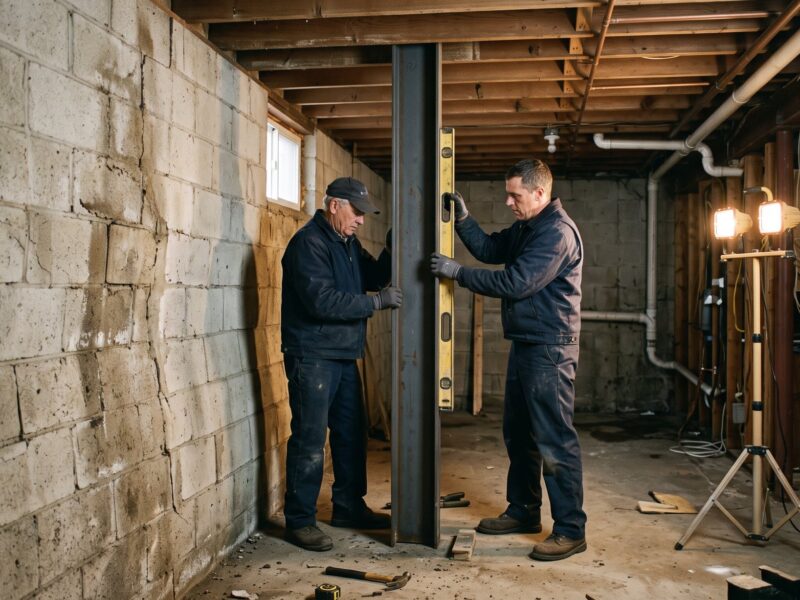 Steel I-beams & wall anchors
For walls past the carbon fiber stage, torqued and documented.
Learn more
Steel I-beams & wall anchors
For walls past the carbon fiber stage, torqued and documented.
Learn more
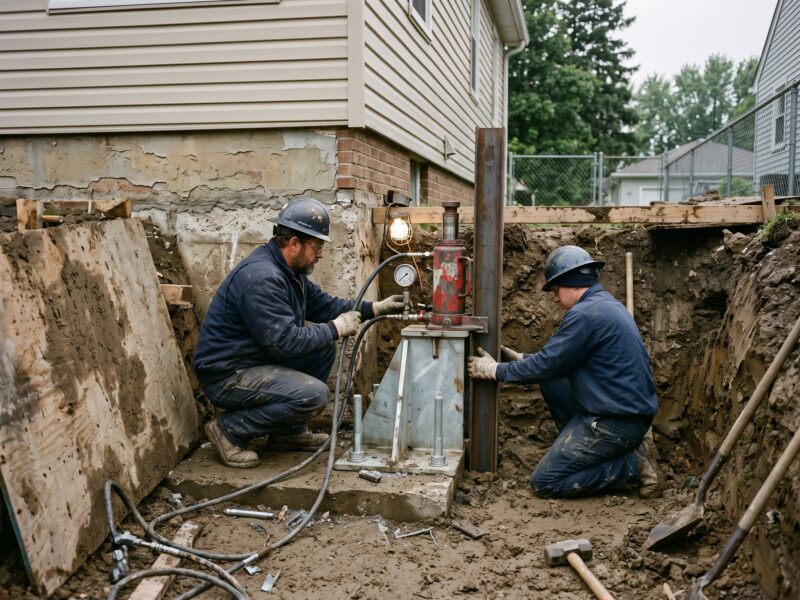 Push & helical piers
For settling farmhouses, additions and porches on rural Lee Township ground.
Learn more
Push & helical piers
For settling farmhouses, additions and porches on rural Lee Township ground.
Learn more
 House leveling
Columns, beams and footings under a river town's sagging hundred-year floors.
Learn more
House leveling
Columns, beams and footings under a river town's sagging hundred-year floors.
Learn more
 Not sure what you have?
A field guide to what stone, brick and poured walls each do when they start to fail.
Learn more
Not sure what you have?
A field guide to what stone, brick and poured walls each do when they start to fail.
Learn more
Why do Dixon foundations crack and settle?
Dixon foundations fail along the town's own timeline: stone and brick walls losing a century of mortar, post-war block and early poured walls taking ground pressure, and rural footings settling under farmhouses and their additions. Each era fails its own way and wants its own repair.

Stone and brick before 1930
The downtown and the historic neighborhoods north of the river stand on gravity walls of stone and brick laid in soft mortar, with a hundred winters of freeze-thaw worked into every joint. They fail by mortar loss and bulging faces, and they want repointing and relief, never rough excavation.

The post-war edges of town
Along the Galena Avenue and Route 2 corridors the block and poured walls are younger but not immune: ground pressure finds weak coursing, corners stair-step, and settlement cracks open over doors and windows as the decades add up.

Farmhouses and Lee Township
Rural properties add their own structural math: old farmhouse footings, porches and additions poured shallow in different decades, each settling on its own schedule. A gap opening where an addition meets the house is the classic township call.
What makes Dixon ground move?
Dixon ground moves differently from the Chicago suburbs because the Rock River valley gives it relief. Houses on the bluffs sit on ground that drains fast and creeps downhill over decades; houses on the low ground live with a river-controlled water table under their footings. The soils run sandier in places than dense glacial clay, which usually means less lateral pressure on walls, but where clay does occur it swells and shrinks exactly as it does everywhere else.
The bigger Dixon variable is time. A wall from 1905 has endured a century more freeze-thaw than anything in the newer suburbs, and soft lime mortar gives a little more of itself every winter water gets into a joint. That is why our Dixon inspections lead with the masonry: measure the bulge, read the mortar, find where water has been working, and only then choose between repointing, reinforcement and piers. The era of the wall decides the method.
 The laser does not flatter: a century of movement, measured to the millimeter.
Signs you need foundation repair in Dixon
Six symptoms account for most Dixon structural calls, and their urgency runs from "watch it" to "book the next block." A wall that has moved for a century can still be saved; the measurement tells us how urgently.

A horizontal crack at mid-height
The serious one: ground pressure actively bowing the wall inward. Caught early it is strap money; ignored, it graduates to steel, anchors or rebuild territory.

Stair-step cracks in block or brick
Mortar joints map differential settlement, one part of the foundation moving against the rest. On Dixon brick the pattern is common and the width and direction tell the story.

Mortar going soft and sandy
When old lime mortar rakes out under a finger, water and freeze-thaw have been eating the binder. Repointing money now beats rebuilding money later.

Floors that slope toward the middle
In hundred-year houses the cause is often a tired beam or crushed post, not the foundation. That distinction can save five figures, and the inspection makes it honestly.

A porch or addition pulling away
Additions and porches sit on their own shallower footings and settle on their own schedule. An opening gap means active movement, which is pier territory on rural ground.
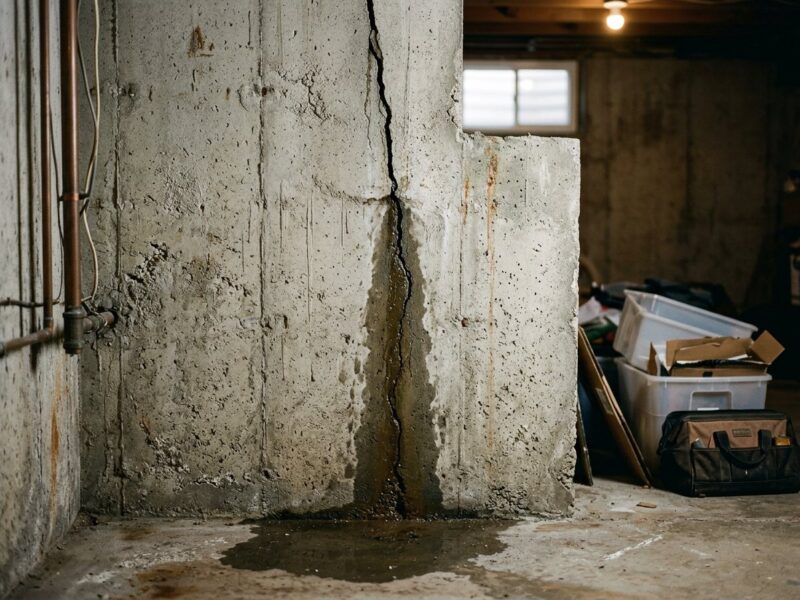
A crack that leaks when it rains
On the newer edges of town, a leaking poured-wall crack is usually stable and sealable for $450 to $900. The inspection confirms it is not moving before anyone sells you more.
Bulge in the stone wall getting bigger? Get it measured before another winter works on the mortar. The structural inspection is free.
How does foundation repair work in Dixon?
A Dixon foundation repair runs four steps: schedule the block, identify the era and measure, match the method, verify and warranty. Most repairs finish inside a single Lee County block.
Schedule into the Lee County block
We tell you the drive plainly: Dixon is our western edge, and we group the area's work into blocks. The inspection date you get at booking is a real one, and it holds.
At bookingIdentify the era, measure the movement
Stone, brick, block or poured changes everything, so the inspection starts with the wall's construction, then maps cracks, bulges and elevations in numbers you keep.
Block day 1Match the method and install
Repointing and relief for stone, straps or steel for bowing walls, piers for settling footings, all priced from published ranges. The crew works the job to completion within the block.
One to three daysVerify and register the warranty
We re-measure against the day-one numbers before leaving and register the 25-year transferable warranty to the address, so it transfers with the house and answers the next inspector.
On completionReinforce or rebuild: what do Dixon walls actually need?
Nearly every failing Dixon wall can be reinforced or repointed in place for a fraction of rebuild cost, and on a stone gravity wall the in-place approach is not just cheaper, it is safer: excavating beside a hundred-year wall risks the wall you came to save.
| Reinforce in place | Excavate and rebuild | |
|---|---|---|
| Best for | Bowed, cracked or settling walls still structurally intact, which is most of them | Walls sheared or genuinely collapsing, a small minority |
| On stone and brick walls | Repointing, relief and gentle reinforcement respect a gravity wall | Digging beside soft-mortar masonry can bring the wall with it |
| On a Dixon schedule | Fits cleanly inside a scheduled Lee County block | Weeks of exposure, hard to manage well from a distance |
| Cost | $450 injections to $3,000 piers, per published ranges | Tens of thousands per wall, plus excavation and landscaping |
| Time | One to three days for most repairs | Weeks, with shoring, machines and an opened yard |
| Warranty | 25-year transferable, registered to the house | Varies by scope; get it in writing before signing |
If an estimator quotes a rebuild without measuring deflection first, get a second opinion. Ours comes with the numbers and costs nothing.
When do Dixon foundations move?
Dixon foundation movement follows the freeze-thaw calendar more than anything else, because the oldest walls in town fail one winter of mortar at a time. Every season has a cheapest moment to act.
Spring: the reveal
Thaw and saturation show the winter's damage: joints that opened, bulges that grew, cracks that widened. Measurements taken now catch movement at its most visible and set the baseline.
March to MaySummer: shrink and settle
Dry spells pull moisture from the ground and let footings drop, especially under rural additions on shallow foundations. Doors stick, gaps open at porches, and settlement does most of its year's work.
June to AugustFall: the repair window
Calm ground and dry weather make fall the best season to repoint, brace or pier at an unhurried pace, and the easiest time to line your job up with a Lee County block before frost.
September to NovemberWinter: the mortar's enemy
Freeze-thaw is what ages Dixon's soft-mortar walls, and every winter takes its cut. Interior work continues all season: injection, straps, bracing and column work all happen indoors at full speed.
December to FebruaryHow much does foundation repair cost in Dixon?
Foundation repair in Dixon costs $450 to $900 for crack injection, $600 to $1,800 per strap, beam or anchor for bowing walls, and $1,600 to $3,000 per pier for settlement, the same published ranges we hold across every town we serve. Stone and brick repointing is masonry craft, scoped honestly at the free inspection.
| Work | Range | What moves the number |
|---|---|---|
| Urethane crack injectionper crack | $450–$900 | Crack length and width, access to the full height |
| Carbon fiber strapsper strap | $600–$1,000 | Wall height, spacing the deflection requires |
| Steel I-beam wall bracingper beam | $900–$1,500 | Ceiling height, footing condition at the base |
| Push or helical piersper pier | $1,600–$3,000 | Depth to load-bearing strata, access for equipment |
The full structural table lives on the pricing page; your written Dixon quote lands inside it.
Where we repair foundations in Dixon
The structural map of Dixon follows its construction history through ZIP 61021. The downtown on the Rock River and the historic neighborhoods north of it send stone and brick work: repointing, bulge relief and the careful judgment gravity walls demand. The Galena Avenue and Route 2 corridors send bowing block, stair-step cracks and settlement over openings. The bluff streets near Lowell Park send slow-creep questions that start with an elevation survey, and Lee Township sends farmhouse footings, porches and additions that have settled apart from their houses.
We are straight about the geography: Dixon is the western edge of our service area, roughly an hour and three quarters each way from our Will County base, and we schedule Lee County in blocks rather than one-off trips. The structural work this town needs is exactly the kind that justifies that drive, and we will say on the phone when a job is too small to.
 The van earns the miles on structural days: stone, steel and a warranty worth the drive.
Dixon foundation repair questions, answered straight
You are based almost two hours away. Why would I hire you for foundation repair in Dixon?
Only if the work justifies it, and we will tell you when it does not. Where we earn the drive is the bigger structural work: wall stabilization, underpinning, stone and brick repair, jobs where the diagnosis and the 25-year transferable warranty matter more than the mileage. For a small patch job, hire local, and we will say exactly that on the phone before anyone drives anywhere.
Who repairs stone foundations in Dixon?
We do, and river towns are where that skill matters most. A stone wall holds itself up by weight and friction, fails through its mortar, and gets hurt by the standard poured-wall playbook. The right work is repointing, moisture relief and careful reinforcement, priced after measurement. If a quote treats your 1905 wall like a subdivision basement, keep shopping.
Is a horizontal crack in a Dixon block wall serious?
Yes. Horizontal at mid-height means ground pressure is actively bowing the wall inward, and the repair gets more expensive the longer it moves. Caught early it is carbon fiber at $600 to $1,000 per strap; later it becomes steel beams or wall anchors. This is exactly the kind of job worth booking into the next Lee County block rather than watching another season.
My wall has had the same crack for decades. Is it still moving?
That is a measurement question, not a guessing question. Old walls often carry stable historic cracks, and the honest answer comes from numbers: we record widths and deflections at the inspection so any future check has a baseline. Because Dixon runs on scheduled blocks, we pair monitoring with clear thresholds, so you know exactly what change would mean calling us back.
My old Dixon house has sloping floors. Is the foundation failing?
Often not. In hundred-year houses the sag is frequently a tired center beam, a crushed post or an undersized footing under the middle of the house, and the fix is columns and beams at $1,500 to $3,200 per column rather than perimeter foundation work. The inspection measures the floor with a laser and tells you which problem you actually have.
How much does foundation repair cost in Dixon compared to the Chicago suburbs?
The same. Our ranges are published and they do not flex with the mileage: $450 to $900 per injected crack, $600 to $1,000 per carbon strap, $900 to $1,500 per steel beam, $1,600 to $3,000 per pier. Stone and brick repointing is scoped at the inspection because a mason's hours depend on the wall, not the town.
Do I need a permit for foundation repair in Dixon?
It varies by municipality and by scope: structural work is more likely to need one than a simple crack injection, and rural township rules differ from the city's. We handle it as part of the job, and where a permit is required we pull it. What you should be wary of is any contractor who suggests skipping one on structural work.
Can I sell an old Dixon house that has had foundation work?
Documented repair usually sells better than an unexplained bulge. Buyers of century homes expect some history; what they want is proof it was handled. Our work leaves a packet of measurements, photos and scope plus a 25-year transferable warranty registered to the address, which your listing agent hands the buyer's inspector in place of an awkward conversation.
Is the moving wall also a wet one?
On Dixon's old masonry the two problems are the same problem at different stages: water in the joints is what softens the mortar, and a wall that weeps every spring is a wall being slowly disassembled. If the bulging stone is also damp, one inspection covers both trades and sequences the fixes correctly, drainage relief with the repair.
Basement Waterproofing in Dixon
Foundation repair near Dixon

Get the old wall measured by people who know its era
A free structural inspection scheduled with the Lee County block, a method matched to stone, brick or poured, published pricing, and a 25-year transferable warranty that transfers with the house.
Or talk to a human right now
(630) 335-1128
Request your free estimate
Tell us what you're seeing. We'll call back fast and be out within 48 hours.