Foundation Repair in DeKalb, Illinois
A century of pre-war block, brick and stone near campus, much of it carried through decades of rental turnover, and poured walls settling into farm clay at the edges: DeKalb foundations fail quietly and get discovered late. We measure first, repair what the numbers show, and back it with a 25-year transferable warranty.
- Structural warranty: 25-year transferable
- Published pricing: injection from $450, piers from $1,600
- Free structural inspection within 48 hours
 25-year transferable warranty
Who does foundation repair in DeKalb?
ProSeal Basement Waterproofing is a foundation repair contractor serving DeKalb from the Joliet and New Lenox corridor. Urethane crack injection runs $450 to $900, carbon fiber straps $600 to $1,000 each, steel I-beams $900 to $1,500 per beam, wall anchors $1,000 to $1,800, and settlement piers $1,600 to $3,000 apiece. Every figure is published before an estimator sees your wall, and structural work carries a 25-year transferable warranty.
The DeKalb complication is history: a large share of the pre-war core has cycled through rental ownership, which means cracks that were painted over at turnover, block that carried decades of unmanaged roof water, and problems that surface only when a property changes hands. The estimator's job here is archaeology as much as engineering, separating old, stable movement from movement still underway, because only one of those needs steel.
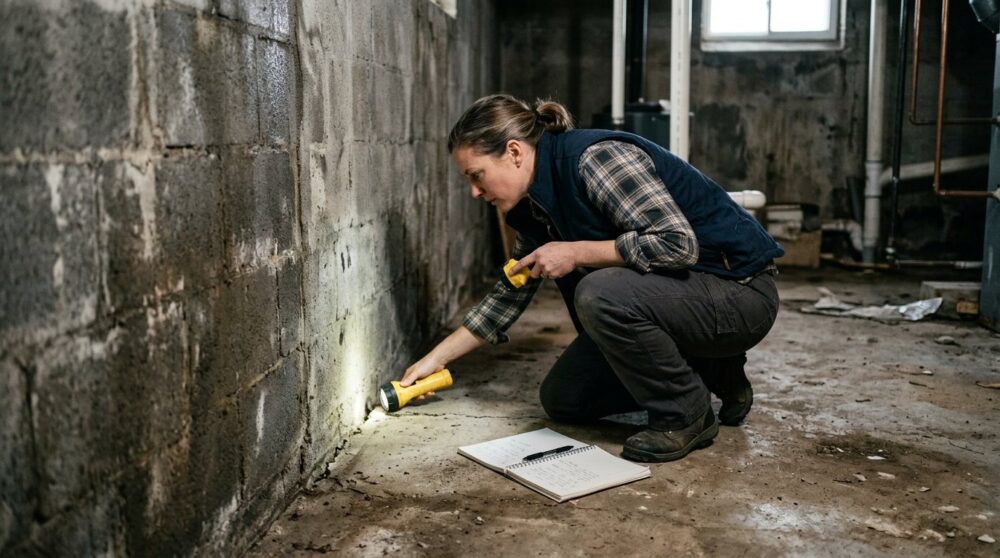 Numbers before hardware: the DeKalb inspection starts with a tape and a level.
What does foundation repair in DeKalb include?
Six structural tools cover what DeKalb housing breaks, and the written plan always argues for the least expensive one the measurements support. Nobody walking your basement is paid on the invoice.
 Urethane crack injection
Leaking poured-wall cracks on the newer edges, sealed in a morning.
Learn more
Urethane crack injection
Leaking poured-wall cracks on the newer edges, sealed in a morning.
Learn more
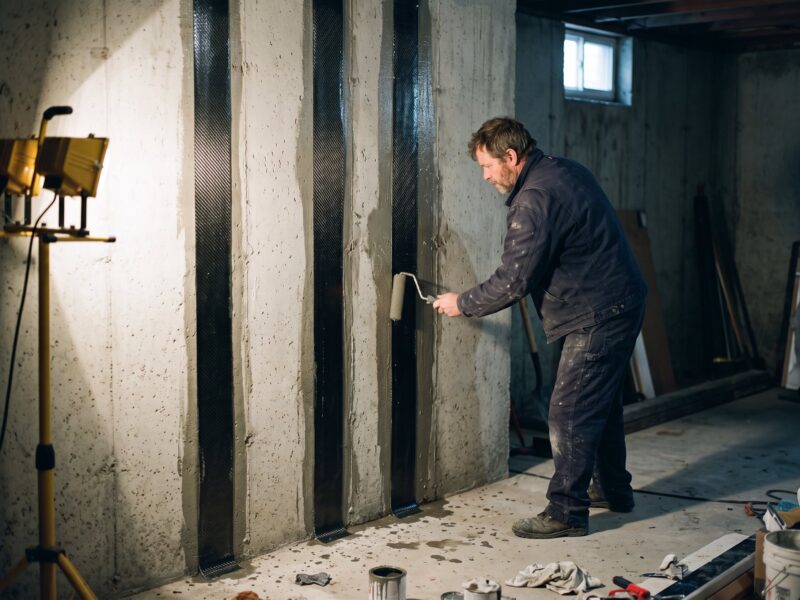 Carbon fiber straps
For block caught while the bow is still under two inches.
Learn more
Carbon fiber straps
For block caught while the bow is still under two inches.
Learn more
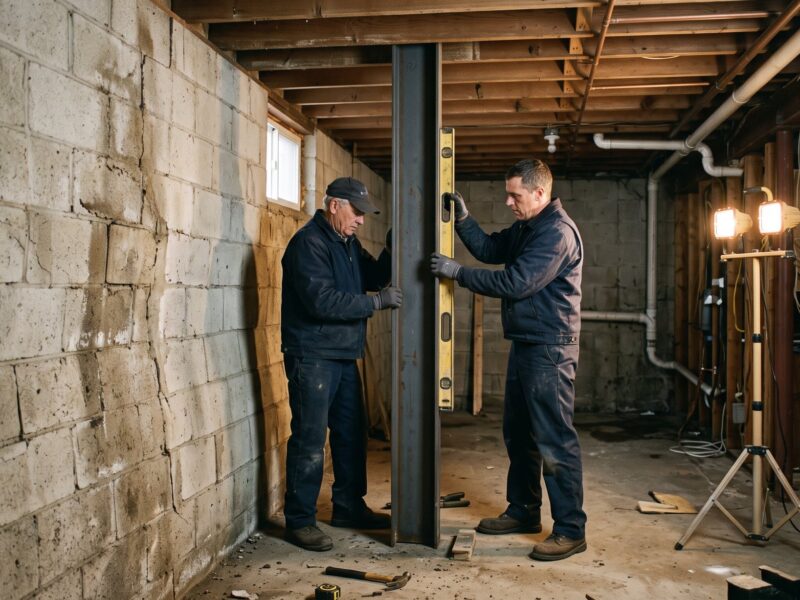 Steel I-beams & wall anchors
For pre-war walls that waited too long between owners.
Learn more
Steel I-beams & wall anchors
For pre-war walls that waited too long between owners.
Learn more
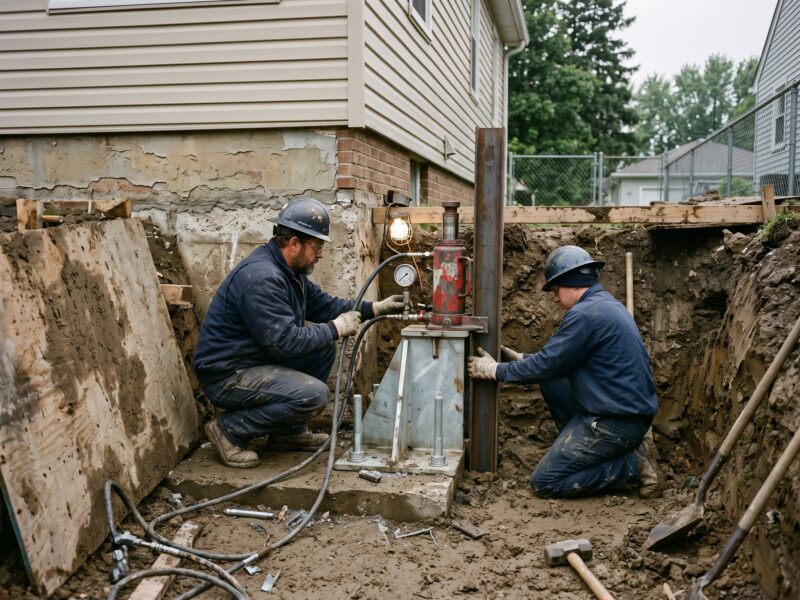 Push & helical piers
For settlement in the farm clay under the newer subdivisions.
Learn more
Push & helical piers
For settlement in the farm clay under the newer subdivisions.
Learn more
 House leveling
Columns, beams and sistered joists under the old core's tired floors.
Learn more
House leveling
Columns, beams and sistered joists under the old core's tired floors.
Learn more
 Not sure what you have?
A plain-language guide to what each crack, slope and gap usually means.
Learn more
Not sure what you have?
A plain-language guide to what each crack, slope and gap usually means.
Learn more
Why do DeKalb foundations crack and settle?
DeKalb foundations fail along the same line that divides the housing: pre-war masonry in the core worn down by moisture cycling and deferred upkeep, and young poured walls at the edges adjusting to the farm clay beneath them.

Pre-war walls near downtown and NIU
Block, brick and some stone, most of it built before anyone managed water around a foundation. A century of wet-dry cycling works on the mortar, and walls that were merely damp for decades eventually start to move.

The rental-converted blocks
Rental economics defer the small stuff, and the small stuff is gutters and grade. Roof water concentrated at one wall for twenty years swells the clay against it season after season, and the wall keeps score in cracks.

Poured walls on farm clay
The newer edges sit on graded prairie clay that shrinks hard in drought summers and swells in wet springs. The walls are strong; the ground under a corner sometimes is not, and settlement cracks over openings tell you which corner.
What makes DeKalb ground move?
DeKalb sits on deep prairie clay, the same soil that makes the surrounding farmland productive, and that clay changes volume with its moisture. Wet springs swell it against basement walls; drought summers shrink it and let footings ease downward. On flat ground the water leaves slowly, so the swing between soaked and dry is long and heavy, and a foundation rides that cycle every single year.
There is a DeKalb-specific wrinkle: the water table across this area is managed by agricultural field tile that predates the housing, and the old runs are unmapped. When a tile under or near a lot clogs or collapses, the moisture regime around that foundation changes without anyone touching the house, and a wall that behaved for forty years starts moving. That is why we measure before we prescribe; the numbers say whether movement is history or news.
 The written findings: crack widths, floor elevations and what they mean.
Signs you need foundation repair in DeKalb
Six symptoms bring DeKalb structural calls, and in a town full of rentals many arrive at purchase, sale or tenant turnover. Age of the symptom matters as much as size, and measurement settles both.

A horizontal crack at mid-height
The urgent one: clay pressure actively pushing the wall inward. Pre-war block near campus has no strength to spare, so this crack gets measured this week, not this year.

Stair-step cracks in block or brick
The mortar joints trace differential movement, one section of foundation shifting against the rest. Width, direction and freshness of the crack faces tell the story.
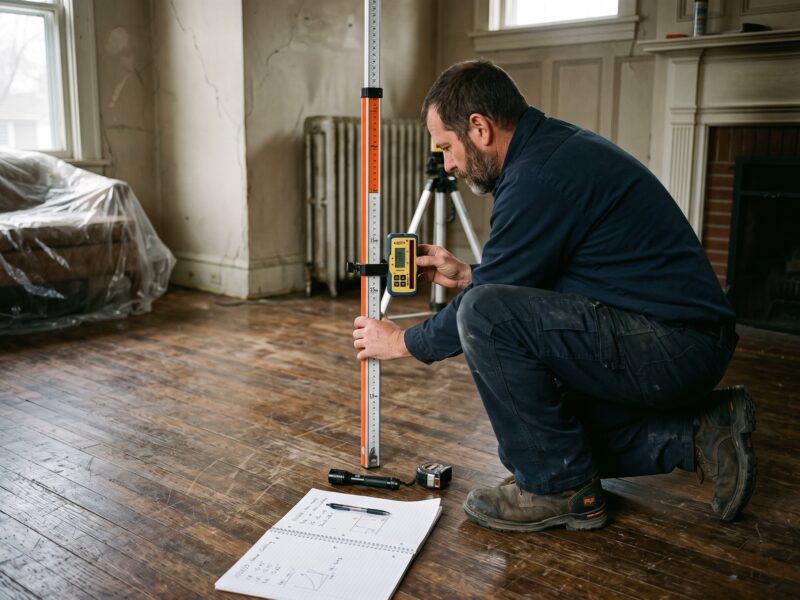
Sloping floors and doors that will not latch
Common in the old core, and often a beam or column problem rather than the foundation itself. The laser survey finds the low point and the far cheaper fix.
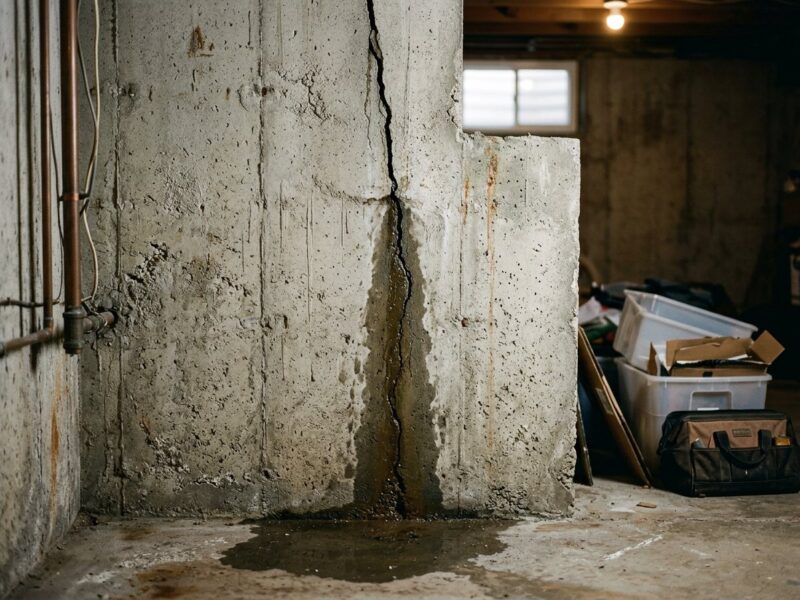
A crack that leaks when it rains
On the newer edges, a wet crack in a poured wall is usually a $450 to $900 injection once measurement confirms the crack is stable and not widening.

Mortar dust and bulging old masonry
Stone and early block foundations shed mortar as moisture cycles through them. Bulges and stones proud of the wall face are the wall asking for relief and repointing, not demolition.
A porch, stoop or addition pulling away
A widening gap means one footing settling separately from the house. If elevations show the movement is active, that side is pier territory.
Buying or inheriting a DeKalb rental with a cracked wall? Get the numbers before you negotiate. The structural inspection is free and written.
How does foundation repair work in DeKalb?
A DeKalb foundation repair runs four steps from call to warranty, on a schedule we quote honestly: the county runs in blocks with Sycamore, and the date you get is real.
Measure everything first
Crack widths, wall deflection and floor elevations go into a written baseline, with the pre-war versus poured question answered on arrival because it changes every fix. Free, within 48 hours.
Day 0Match the method to the era
Repointing and relief for old masonry, carbon or steel for bowing block, injection or piers for the poured edges. The plan names the method, the reason and the published price.
Day 0, same visitRepair on the county block
The crew arrives on the scheduled DeKalb and Sycamore run, installs, torques to spec and re-measures against the baseline before packing up. Most repairs finish in one to three days.
Days 1 to 3Paper the result
Measurements, photos, scope and the 25-year transferable warranty register to the address, a file that matters twice over in a town where properties trade between landlords.
On completionReinforce or rebuild: what do DeKalb walls actually need?
Nearly every failing DeKalb wall can be reinforced in place for a fraction of rebuild money, and in a rental town the difference is not just cost: reinforcement keeps a property livable and leased while rebuild empties it for weeks.
| Reinforce in place | Excavate and rebuild | |
|---|---|---|
| Best for | Bowing, cracked or settling walls still structurally intact, which is most of them | Walls sheared or collapsing, a genuine minority |
| On occupied rentals | Interior work, tenants stay, income continues | Excavators, shoring and a vacated building |
| On pre-war masonry | Relief, repointing and reinforcement respect old walls | Digging beside aged block or stone risks the wall mid-repair |
| Near old field tile | No excavation, no chance of cutting an unmapped run | Deep digs at the town edges gamble on tile nobody mapped |
| Cost | $450 injections to $3,000 piers, per published ranges | Tens of thousands per wall before landscaping |
| Time | One to three days on the scheduled county run | Weeks, weather permitting, an hour and a half from our base |
If someone quotes a rebuild without showing you deflection numbers, get a second opinion. Ours is free and arrives with a tape measure.
When do DeKalb foundations move?
DeKalb foundation movement runs on the clay's moisture calendar, and flat ground that drains slowly makes both ends of the cycle heavier.
Spring: the push
Saturated prairie clay swells against walls for weeks because the flat ground cannot shed the melt quickly. Horizontal cracks widen and bows advance; a spring measurement catches movement at its loudest.
March to MaySummer: the drop
Drought bakes the clay and footings settle into the shrinkage. The newer subdivisions do most of their moving now, opening cracks over windows and doors that were tight in April.
June to AugustFall: the fix window
Calm clay, workable ground and turnover season make fall the time to brace, pier and level. Repairs booked on the autumn county runs finish before frost locks the ground.
September to NovemberWinter: the indoor season
Injection, carbon fiber, bracing and beam work all happen inside at full speed. The drive out is the same in January as June, and the winter block schedule usually has the most room.
December to FebruaryHow much does foundation repair cost in DeKalb?
Foundation repair in DeKalb costs $450 to $900 per injected crack, $600 to $1,000 per carbon fiber strap, $900 to $1,500 per steel beam, $1,000 to $1,800 per wall anchor and $1,600 to $3,000 per pier, identical to the published ranges we hold in every town, with nothing added for the drive. Masonry repair on the old stone and brick stock is craft work, scoped at the free inspection.
| Work | Range | What moves the number |
|---|---|---|
| Urethane crack injectionper crack | $450–$900 | Crack length and width, access to the full height |
| Carbon fiber strapsper strap | $600–$1,000 | Wall height, spacing the deflection requires |
| Steel I-beam wall bracingper beam | $900–$1,500 | Ceiling height, footing condition at the base |
| Push or helical piersper pier | $1,600–$3,000 | Depth to load-bearing strata, access for equipment |
The full structural table lives on the pricing page; your written DeKalb quote lands inside it.
Where we repair foundations in DeKalb
DeKalb's structural map follows its growth rings, all inside ZIP 60115. The downtown core, the Northern Illinois University blocks and the Annie Glidden Road corridor send pre-war masonry: bowing block, tired mortar and floors that slope toward a settled beam. Hopkins Park and the Lincoln Highway corridor mix eras. The Sycamore Road corridor and the newer edge subdivisions send poured-wall settlement into graded farm clay, and the Kishwaukee River corridor adds lots where old drainage tile complicates the diagnosis.
Honesty about distance: DeKalb is an hour and a quarter to an hour and a half from our base, and we run it anyway, in scheduled blocks with Sycamore. That structure is what makes monitoring real at this range; a wall that deserves watching gets re-measured on the next county run, on a date we commit to, rather than a vague promise to swing by.
 The western block: DeKalb structural calls ride with Sycamore on the schedule.
DeKalb foundation repair questions, answered straight
Is a horizontal crack in a rental block wall near campus serious?
Yes, treat it as urgent. Horizontal at mid-height means clay pressure is actively bowing the wall, and pre-war block has little reserve strength left. Caught early it is carbon fiber money at $600 to $1,000 per strap; left through more tenant cycles it graduates to steel, anchors or worse. Measure it now, whoever holds the lease.
My newer house off Sycamore Road has cracks over the windows. Is it settling?
Probably, and the real question is whether it has finished. Poured walls on graded farm clay commonly adjust through their first decades, especially after drought summers. We shoot elevations: active movement is pier territory at $1,600 to $3,000 each, while old stable movement usually needs nothing but sealed cracks.
How much does foundation repair cost in DeKalb?
The same published ranges as every town we serve: $450 to $900 per injected crack, $600 to $1,000 per carbon strap, $900 to $1,500 per steel beam, $1,600 to $3,000 per pier. There is no distance surcharge for DeKalb. Old-masonry repointing gets scoped at the free inspection because stone and early block are their own craft.
Can you repair the stone and early block foundations in the old core?
Yes, and they ask for different instincts than poured concrete. Old masonry holds itself together through mortar and mass, so the work is repointing, moisture relief and measured reinforcement rather than aggressive digging. If a quote treats your 1910 wall like a subdivision basement, get a second opinion; ours is free.
How does monitoring work when you are more than an hour away?
On a schedule, which is better than proximity without one. When a wall warrants watching rather than immediate steel, the re-measurement gets booked onto a future DeKalb and Sycamore block with a committed date. You get the baseline numbers in writing, so every follow-up is a comparison, not an opinion.
Does homeowners or landlord insurance cover foundation repair?
Usually not. Standard Illinois policies exclude damage from soil movement and hydrostatic pressure, which is most foundation trouble, and landlord policies read the same way. That exclusion is the financial argument for catching a bowing wall at the strap stage instead of the five-figure stage.
I am selling a DeKalb rental property. Does documented repair help or hurt?
Documented repair sells better than an unexplained crack, especially to investors who will inspect hard. Our work closes with measurements, photos, the written scope and a 25-year transferable warranty registered to the address and transferable to the buyer, a package that answers the inspector before the conversation gets awkward.
Do I need a permit for foundation repair in DeKalb?
It varies by municipality and by the scope of the work; structural repairs often require one and minor crack sealing often does not. Where a permit is required for your job, we pull it and build it into the schedule, and the written plan says so before work begins.
Is the cracked wall also a wet wall?
In DeKalb the two trades share one villain: roof water left unmanaged beside a foundation both soaks the wall and swells the clay that bends it. If the wall that needs steel also seeps every March, one inspection scopes both, and the drainage fix goes in with the reinforcement so the cause leaves with the symptom.
Basement Waterproofing in DeKalb
Foundation repair near DeKalb

Get the DeKalb wall measured before it gets worse
A free structural inspection within 48 hours, a repair matched to pre-war masonry or poured concrete, and a 25-year transferable warranty that transfers with the property.
Or talk to a human right now
(630) 335-1128
Request your free estimate
Tell us what you're seeing. We'll call back fast and be out within 48 hours.