
Dry Wells, Catch Basins and Pop-Up Emitters
Three very different tools get sold under one phrase. One buries a hole and hopes the ground drinks, one collects water at the low spot and hands it to a pipe, and one is just the lid where that pipe comes back up.
- Free written diagnosis within 48 hours
- Published pricing on every drainage line item
- Own crews, 20+ on Chicago clay
 Drainage work: 5-year warranty
The short answer
A dry well stores runoff underground in stone or a chamber and lets the surrounding soil take it slowly. A catch basin collects surface water in a grated box and hands it to a solid outlet pipe. A pop-up emitter is only the lid where that pipe surfaces. On Chicago clay, a real outlet beats infiltration nearly every time.
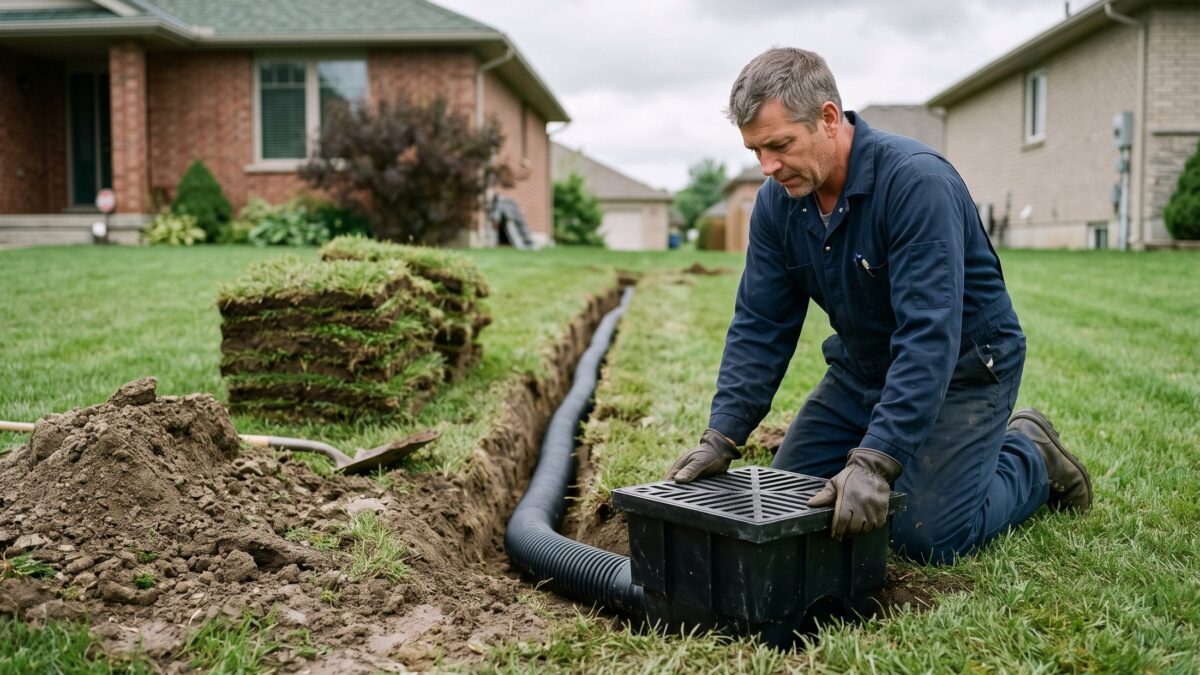
A dry well is storage. It is a pit or a chambered box packed in washed stone, wrapped in filter fabric and sized to hold a volume of water until the soil around it can absorb that volume. A catch basin does the opposite job. It is a grated box set at a low point that takes surface water in and forwards it through a solid pipe to somewhere else. One buys time and lives or dies on soil. The other moves water and lives or dies on having a legitimate place to put it.
Around Chicago the soil settles that argument for us. Glacial clay accepts water at a crawl, so a dry well here behaves as a holding tank first and an infiltration device a distant second. We open wells in Will and DuPage County subdivisions that were still brim full a week after the storm that filled them, because nothing underneath ever drained. Basins, solid pipe and a downhill outlet carry more of the load on this ground. The yard drainage hub shows how these pieces sit alongside grading and downspout work.
What does a dry well actually do with the water?
A dry well does not make water vanish. It holds a measured volume underground and gives the surrounding soil time to take that volume in.
Follow one storm from the moment it reaches the pit and the whole design explains itself.
-
The water all arrives at once
An inch of rain on a 1,500 square foot roof is close to 900 gallons, which is arithmetic rather than an estimate. Downspouts deliver most of that inside the first half hour, so a well has to be sized against the peak and not the daily average.
-
The stone holds the volume
The pit gets filled with washed stone or a plastic chamber. Only the empty space counts as storage, roughly a third of the hole with stone and much more with a chamber, so hole size and storage size are never the same number.
-
Filter fabric keeps the fines out
The whole assembly is wrapped before backfill. Silt washing in from the lawn is what finishes a dry well, because once fines pack the voids the storage is gone for good and no amount of digging it up recovers it.
-
The soil drinks it slowly
Between storms the stored water seeps out through the sides and the bottom. In sand that can happen overnight. In the dense clay under most of this region it takes days, and that number decides everything about whether the design works.
-
It has to be empty before the next front
A well still holding last week's rain is not a drain, it is a puddle you cannot see. That is the failure we find most often on this ground, which is why we test how a lot actually drains before quoting one.
Works when
- Sandy or genuinely well drained soil, which does exist in pockets here
- Modest roof volume and ordinary storms rather than cloudbursts
- There is honestly nowhere downhill to send the water
- It sits well out into the yard and downhill of the house
- You want nothing visible once the sod knits back over it
Where it fails
- Heavy clay, where the stored water has nowhere to go
- A high water table that fills the well before the rain does
- Silt loading, which quietly eats the storage over a few seasons
- Placement near the wall, which just feeds the footing on purpose
How does a catch basin work?
A catch basin is a collection point with a trap in the bottom. It takes water off a low spot, keeps the grit, and sends the rest down a solid pipe.
Four parts, and each one announces itself the first time it is missing.
-
The grate takes water in
A grated lid sits flush with the low point of a yard, drive or patio. Everything runs to it only because the ground is shaped to send it there, so the grading around a basin matters as much as the basin itself.
-
The sump below the outlet traps solids
The box runs deeper than the outlet pipe. Sand, grit and shingle granules settle into that dead space instead of travelling down the line, which is the entire reason a basin outlives a bare pipe inlet.
-
Solid pipe carries it away
The outlet leaves the side of the box with continuous fall in solid wall pipe, not perforated and not flexible corrugate. Past the basin the job is transport, and pitch is the only thing keeping water moving.
-
The run ends somewhere legitimate
The line surfaces at a pop-up emitter, a swale, or wherever your village permits, always downhill and never over the property line. A run that arrives with no fall left has turned your basin into a storage tank.
-
Someone lifts the lid twice a year
The sump fills. Scooping it out in spring and again after leaf drop takes ten minutes, and it is the difference between a basin that serves for decades and one that plugs solid in three seasons.
Best for
- A defined low spot that ponds after every storm
- Driveway aprons, patio edges and clustered window wells
- Gathering several downspout lines into one buried run
- Any lot with somewhere downhill to actually send water
- Clay, because nothing is being asked to soak in
What it needs
- A real outlet, with fall the whole distance to it
- A lid you can reach and open, not one lost under sod
- Grading that genuinely delivers water to the grate
- Ten minutes of attention twice a year, or it plugs
Dry well or catch basin: which one does my yard need?
This is not a contest between two good products. It is a question of whether your soil can absorb water or whether the water has to be carried somewhere.
| Dry well | Catch basin and piped outlet | |
|---|---|---|
| What it does with the water | Stores it underground until the soil takes it | Collects it at the low spot and pipes it away |
| What it needs to work | Soil that drains, and room away from the house | A downhill outlet you are permitted to use |
| On dense Chicago clay | Short term storage at best | The workhorse, because nothing has to soak in |
| What you see afterward | Nothing once the sod knits back over it | A grate at the low point, an emitter at the far end |
| Taking roof and sump together | Only if it is sized for the combined peak | Yes, several lines can feed one run |
| Maintenance | None possible; when it silts up it is finished | Lift the lid and scoop the sump twice a year |
| How it fails | Silently, sitting full between storms | Visibly, water standing over the grate |
| In an Illinois winter | Frozen ground stops absorption completely | Keeps working while the outlet stays clear of ice |
| Published cost | Priced with drainage work, $600 to $2,500 | Priced with drainage work, $600 to $2,500, more on long runs |
Neither one is allowed to solve your problem by creating one next door. Illinois handles surface water between neighbors on a reasonable use standard, so ask your village what it permits before an outlet gets placed, and read standing water in the yard for the diagnosis side of it.
Water pooling in the same spot after every storm? We shoot the grades, write down what we find and quote from published ranges, free within 48 hours.
What tends to work on your kind of lot?
Lot width, how the builder left the grade and how much soil has moved since decide this more than anything inside the house. These four cover most of what we walk.

Pre-war bungalows and two-flats
A four foot gangway carrying roof water, sump water and whatever runs off the neighbor. There is rarely a spot far enough from both foundations to put a well without feeding one of them.
Pipe it out front
Post-war block ranches
Wide flat yards on graded clay with almost no fall to work with. A basin at the low corner and a long shallow run usually beats a pit, because the pit has nothing to drain into.
Basin and a long run
1980s and 90s poured wall homes
Swales built between the houses at closing, then filled in over twenty years with topsoil, mulch and one raised bed. Water now stops halfway and ponds against the same wall each storm.
Restore the swale first
Newer subdivision homes
Basins, buried downspout lines and pop-up emitters already in the ground from day one. The design is usually sound and the fault is a packed sump or an emitter the sod grew over.
Clean before addingWhat does a dry well or a catch basin cost?
Work of this kind is priced as a package rather than by the piece, and downspout extensions and regrading run $600 to $2,500 on most Chicago lots. A long buried run feeding several basins sits at the top of that range.
| Work | Range | What moves the number |
|---|---|---|
| Downspout extensions and regradingtypical job | $600–$2,500 | Feet of grade to rebuild, soil hauling |
| Exterior French drainper linear foot | $45–$90 | Trench depth, where the water can legally go |
| Sump pump with battery backupinstalled | $2,800–$4,500 | Pit condition, backup capacity, discharge routing |
Depth, distance and the number of inlets feeding one run are what move the number, so we walk the lot with a level rather than pricing from a photograph. Every range we quote from lives on the pricing page, and drainage work carries a 5-year warranty.
When you do not need a basin or a well at all
A good share of the ponding we get called out to look at is a grading problem in a drainage costume. Saying so on the first visit costs us a sale and keeps the phone ringing.
The downspout is the whole story
One spout dumping at a corner will pond a lawn and soak a footing entirely on its own. A length of extension pipe costs under thirty dollars, takes ten minutes, and tells you in one storm whether anything further is needed. Start there every time.
Under thirty dollarsThe ground tipped back toward you
Backfill keeps settling for years after a house is built until the first six feet of grade fall the wrong way. Rebuilding that slope has fixed more wet basements for us than anything we have ever buried. Slope comes before structures.
Fix the slope firstIt clears on its own by the next afternoon
Water standing for a few hours after a hard storm is a yard behaving normally. If it is gone the following day and nothing is reaching the basement, mark the spot, watch it through one spring, and decide with a season of evidence.
Wait a seasonThe water is rising, not running in
Water coming up out of a floor drain during a storm is sewer backup, and nothing built in the yard changes that by a gallon. The fix belongs to a plumber, and often to a backflow valve. The two are easy to separate once you know the tells.
Call a plumberQuestions homeowners ask about dry wells and basins
Do dry wells work in clay soil?
They work as storage and barely at all as absorption. Dense glacial clay takes water in very slowly, so a well sized for a large roof can still be holding that water days after the storm. That is acceptable when the problem is a short peak and there is genuinely nowhere downhill to send anything. It is not acceptable near the house, because a stored volume of water beside a foundation is the exact condition you were trying to get rid of.
How far from the foundation should a dry well be?
Further out than most people put it. The purpose is to keep a held volume of water away from the wall you are protecting, so it belongs out in the yard and downhill of the house, never in a gangway and never tucked beside a patio slab. Closer than that and you have built a reservoir at the footing. When a lot has no room to do it properly, a piped outlet is the better answer than a compromised well.
What is the difference between a catch basin and a dry well?
A catch basin collects and forwards. A dry well stores. The basin is a grated box with a solid outlet pipe, and it only earns its keep if there is somewhere downhill for that pipe to end. A dry well has no outlet at all and holds water in the voids between stones until the surrounding soil absorbs it. The two are often used together, with a basin catching surface water and a well or an emitter at the far end of the run.
What is a pop-up emitter and do I need one?
A pop-up emitter is the hinged lid at the end of a buried drain line. Water pressure lifts the cap, the water surfaces onto the lawn, and the cap drops closed so mulch and mice stay out of your pipe. It is an outlet, not a drainage system, and it only works if the line reaches it with fall to spare. We set them clear of where snow gets plowed, because a buried emitter in January is simply a plugged line.
Can my sump pump discharge into a dry well?
Sometimes, and it deserves thought first. A sump can move hundreds of gallons an hour through a thaw, which fills a small well fast, and a full well near the house sends the same water back toward the footing for the pump to lift a second time. Where sump water may legally end up also varies from one village to the next around here, so ask yours before anything is dug. <a href="/yard-drainage/where-sump-water-should-go/">This page covers the routing</a>.
How often do catch basins need cleaning?
Twice a year on most lots. Once in spring, after the melt has washed a winter of grit down to the low point, and once after leaf drop. Lift the grate and scoop out whatever has settled in the sump below the outlet. Ten minutes keeps the outlet pipe clear for decades. A basin nobody has opened since installation is usually packed to the outlet, which is why the yard quietly started ponding again.
Is the clay the real reason nothing drains?
Most yards we grade around Chicago sit on soil that accepts water at a fraction of an inch per hour, and every decision downstream of that fact changes because of it. It is why we lean on pipe and outlets here rather than pits, why a swale earns its keep, and why a design copied out of a sandy region disappoints everyone who tries it on this ground.
Yard drainage on clay soil

Get the low spot measured before anything gets buried
Free written diagnosis within 48 hours, published pricing, own crews, and a 5-year warranty on the drainage work.
Or talk to a human right now
(630) 335-1128
Request your free estimate
Tell us what you're seeing. We'll call back fast and be out within 48 hours.