
The quick answer
A sump pump with battery backup runs $2,800 to $4,500 installed in the Chicago area. That covers the pump, the backup system, basin work, a check valve and a discharge line routed to a legal outlet. A straight replacement in a sound existing pit sits at the low end. Cutting a new pit into an intact floor sits at the high end.
Two things separate a $2,800 job from a $4,500 one, and neither is the pump itself. The first is whether a usable pit already exists. The second is where the water is allowed to go once it leaves the house, which in older suburbs is not a matter of pointing a hose at the lawn. Our sump pump installation page lays out the equipment and the process; every price we publish, for this and everything else, is kept on the basement waterproofing cost page. Here is how the number gets built.
What is included in the $2,800 to $4,500?
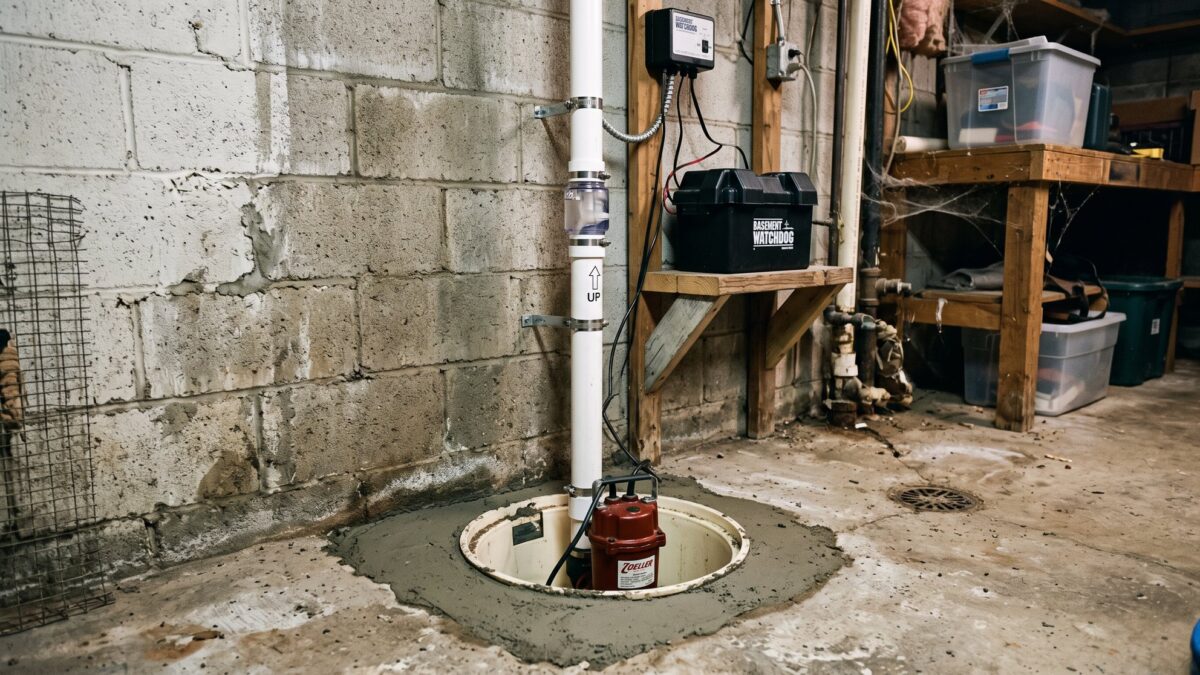
The pump is the cheapest part of a pump installation. The money goes into the parts that decide whether it still works during the storm that matters: a basin sized and set deep enough to hold water without short-cycling the motor, a check valve so the column of water in the pipe does not fall back into the pit every time the pump shuts off, rigid discharge pipe routed to an approved outlet, a sealed lid, and a backup that keeps pumping when the power goes out. Storms here take the power and deliver the water in the same hour, which is why we quote the backup as part of the job instead of as an option.
What the numbers look like
- Sump pump with battery backup, installed$2,800 to $4,500
- Interior drain tile feeding a new pit$95 to $160 per linear foot
- Full perimeter interior system, average basement$8,000 to $16,000
- Downspout extensions and regrading$600 to $2,500
- Free inspection, scheduled within48 hours
These are our published ranges and they apply across all seven counties we serve. Nothing here is a quote-night special.
Four variables move you through that band. Whether a pit exists and is deep and wide enough to reuse. Whether there is a grounded outlet at the pit or an electrician needs to bring one. How far the discharge has to travel and how it exits, since a long run under a walk costs more than a short run through a rim joist. And what happens to the water at the other end, which is where local rules decide the design. We wrote the plain-language version of those rules in where a sump pump can legally discharge in Illinois, and the short answer is that it varies by municipality and you check with your village before the pipe goes in the ground.
Why do Chicago basements work a sump pump so hard?
A pump in this region is not a precaution, it is the drain for an entire soil column. Glacial clay under the yard sheds water slowly, so after a heavy rain the ground stays loaded for days and keeps feeding whatever drainage sits next to your footing. Every gallon that reaches the pit has to be lifted, moved and released far enough from the house that it does not simply come back. A pump in a dry climate idles for months. A pump in Will or DuPage County can cycle every few minutes for a week straight in April.
Two local details raise the stakes further. Older suburbs built on combined sewers restrict what you may tie a discharge into, so the correct route is often a buried line out to daylight rather than the nearest convenient pipe. And winter turns the discharge itself into a failure point: a line that ices closed leaves a perfectly good pump pushing against a plug, which is its own kind of flood. Freeze protection on that line belongs in the design conversation, not in the spring repair conversation.
What will a sump pump cost at your house?
What you are buying depends almost entirely on what the builder left you.
Pre-war bungalows and two-flats with no pit
Many of these houses never had a sump at all, because the original clay tile drained to daylight or to a sewer connection that is no longer legal or no longer open. Installing a pump here means cutting a pit into the slab, and a pit that is not fed by anything mostly collects the water that was already going to reach it. That is why a pump in a bungalow is usually quoted alongside drain tile at $95 to $160 per linear foot: the pit is only the destination.
Post-war block ranches with an old crock
Plenty of 1950s and 60s basements have a shallow clay crock or an undersized steel pit with a pump wedged into it. These are replacements with a catch: a pit too shallow makes the pump start and stop constantly, and short-cycling kills motors faster than heavy pumping does. If the existing pit can be deepened or replaced, the job stays inside the published range.
1980s and 90s poured wall homes
These houses generally have a proper pit tied to perimeter drainage, so the work is a straight swap plus a discharge review, and it lands near the bottom of $2,800 to $4,500. The item worth spending on is the backup. A house of this age has enough finished basement space that one outage during a storm costs more than the backup system does. If you are weighing that, we made the case in detail in whether a battery backup sump pump is necessary in Illinois.
Newer subdivision homes
Builder-grade pumps are chosen to satisfy a code inspector on a budget, not to serve a finished basement for a decade. The pit and drainage are usually fine; the pump, the switch and the flexible discharge line are the weak links. Upgrading the equipment while leaving good drainage alone is often all a ten-year-old house needs. Sizing matters here, and how to size a sump pump covers it without the sales math.
When should you not spend money on a pump?
We turn down pump work every month, because a surprising share of pump complaints are not pump problems.
The pump is fine and the outlet is dead. Before anything else, check that the plug is seated, the outlet has power, and the breaker or GFCI has not tripped. A pump that failed during a storm because a receptacle tripped is a five-minute discovery and a $0 repair, and it is worth ruling out before you call anyone.
The float is stuck against the pit wall. A float switch that catches on the basin, the discharge pipe or a piece of debris will leave a healthy pump silent while the pit fills. Unplug it, look inside, clear the obstruction and reseat the float. If it happens twice, the pit is too tight or the switch is worn, and that is a real repair. Once is a Saturday.
The thing in the pit is not a sump pump. A sealed basin handling waste from a basement bathroom is an ejector pump, and it is a plumbing fixture with different equipment and different rules. Quoting waterproofing for it is the wrong trade entirely. The difference is spelled out in sump pump versus ejector pump.
The pit runs because the roof is filling it. If your pump only works overtime during rain and your downspouts discharge next to the foundation, you are paying electricity to move roof water in a circle. Extensions and regrading at $600 to $2,500 reduce the load on the pump instead of upgrading the pump to handle a load it should never see.
How do you read a sump pump quote?
A sump pump quote should describe equipment, a pit, a power source and a route for the water. Anything shorter than that is a price tag, not a scope.
| Your situation | What the work involves | Where it prices | What to watch |
|---|---|---|---|
| Replacing a pump in a good pit | New pump, check valve, lid, discharge review | Low end of $2,800 to $4,500 | Reusing a tired check valve or a cracked lid |
| Adding a backup to a working primary | Second pump or battery system, wiring, alarm | Quoted from the same published range | Backups sized so small they buy you an hour |
| New pit in an intact floor | Cutting concrete, setting the basin, restoration | High end of $2,800 to $4,500 | A pit with no drainage feeding it |
| Pump plus perimeter drainage | Drain tile tied into a new basin | $95 to $160 per linear foot, systems $8,000 to $16,000 | Paying system prices for a pump-only problem |
Then hold the written quote against this list before you sign it.
- The pump is named with its capacity. Horsepower alone means little. You want the gallons-per-hour figure at the actual lift height in your basement.
- The switch type is stated. Float switches are the most common failure point in the whole assembly, and the quote should say which kind is going in.
- The basin is specified. Depth and diameter, and whether the existing pit is being reused, modified or replaced.
- The discharge route is drawn or described. Where the line exits, where it terminates, and how it is protected from freezing and from backflow.
- The power source is addressed. Whether the existing outlet is adequate, and who handles electrical work if it is not.
- The backup is a real system. Battery type, expected runtime and whether it alarms when it engages. A backup nobody hears fail is not a backup.
- The warranty is in writing. Ask what covers equipment, what covers labor, and what transfers when you sell. Our terms are public on the warranty page.
What should you do next?
First, test what you already have. This is free. Pour a few gallons of water into the pit and watch. The pump should start before the water reaches the top of the basin, run smoothly, shut off cleanly, and the check valve should thump once instead of letting water fall back. If any part of that goes wrong, you learned it on a dry day instead of at 2 a.m.
Second, follow the discharge outside. Walk to where the pipe ends. If the water lands within a few feet of the foundation, the pump is feeding itself, and a longer extension is cheap. Note the route now, because that walk decides a real slice of the installation price.
Third, have the pit, the power and the outlet route priced together. Those three items are where quotes diverge, and seeing them itemized tells you who actually looked. Ask for that breakdown through our free estimate request, or reach us at (630) 335-1128 and describe what your pit does during a storm. If a pump has already quit and water is rising, say so when you call: we run 24/7 for active flooding.
Questions homeowners ask about sump pump costs
Does the price change if my basement has no sump pit at all?
Yes. Cutting a pit into an intact slab adds concrete work, excavation and restoration, which pushes a job toward the top of the published range. The bigger question is what will feed it. A pit with no drainage running to it collects only the water that already found its way there, so in a house with no existing perimeter system, the pump is usually quoted together with drain tile rather than on its own.
Do I need a permit to install a sump pump in Illinois?
It depends on your municipality. In Illinois these requirements are set locally, and many villages regulate the discharge point and any related electrical or plumbing work rather than the pump itself. Call your village building department before work starts, and ask any contractor to state in the quote who is responsible for pulling permits and scheduling inspections. Rules differ between towns that sit two miles apart, so never assume a neighbor’s answer applies to you.
Can I install a sump pump myself and save the labor cost?
Swapping a pump into an existing pit is within reach for a confident homeowner, and if that is all you need, do it. The parts that go wrong are the ones people skip: a check valve installed backward, flexible pipe that sags and freezes, a discharge line ending too close to the house, or a pit too shallow for the switch. Cutting a new pit into a structural slab is not a beginner project.
Does a sump pump need its own electrical outlet?
It needs a grounded outlet it does not have to share with equipment that could trip it, and it should never run on an extension cord. Many older basements have one convenient receptacle serving the freezer, the workbench and the pump, which means one overload takes the pump offline exactly when you need it. If your pit has no dedicated power nearby, budget for an electrician, and confirm who is arranging that before the install date.
A pump is the least expensive piece of equipment protecting the most expensive room to repair, and the right time to price one is before it quits. We inspect free within 48 hours and quote from the published range you just read, and the interior waterproofing systems we install carry a lifetime, fully transferable warranty. Reach us at (630) 335-1128.


