
The quick answer
Most sump pumps last 7 to 10 years. In the Chicago area, hours of runtime rather than calendar age decide where a given pump lands: one that cycles for weeks each spring can wear out early, while a pump in a rarely wet basement can pass ten years and still fail from sitting. Past year seven, test it and plan for replacement.
The number that matters is not on the calendar, it is on the motor. A sump pump is a small electric motor with a seal, a bearing and a switch, and every start cycle uses a little of all three. Two identical pumps installed the same week in Naperville and in a dry basement two towns over will not retire together, because one of them has been working. That is worth understanding before you replace anything, and it shapes how we spec a sump pump installation in the first place: the pump you can afford to leave in place for a decade is the one sized for the water it will actually see.
How long does a sump pump actually last?
Seven to ten years is the service life the industry plans around, and it holds up well in this region. What that range hides is the spread inside it. A pump handling a high spring water table in a house on flat clay may see more running hours in three wet seasons than another pump sees in its whole life. We treat the range as a schedule rather than a promise: under five years, watch and test; between five and seven, test more often and know what a replacement costs; past seven, assume you are on borrowed time and choose the moment yourself.
The lifespan numbers
- Typical sump pump service life7 to 10 years
- Age at which we start watching a pump closelyYear 7
- How often to test a working pumpEvery 3 months
- Replacement pump with battery backup$2,800 to $4,500
- Free inspection, scheduled within48 hours
Runtime hours, not birthdays, decide where a pump lands in that range. A hard-working pit ages a pump faster than a quiet one.
The battery in a backup system is a separate clock entirely. It is a consumable that gets replaced several times across the life of the pump it protects, and a backup with a dead battery is a decoration on a shelf. If you own one, check it on a schedule and confirm it still alarms, because a silent failure in a backup system is the failure you find out about during the outage.
What wears a sump pump out in a Chicago basement?
Runtime is the main killer, and this region supplies plenty of it. Dense glacial clay releases water for days after a storm ends, so a pit here does not empty once and go quiet, it refills on a slow drip for the rest of the week. Spring is worse: frozen ground thaws from the top down while meltwater has nowhere to soak, which is why so many pumps that survived a whole summer of storms quit in March. If yours never seems to stop, read why a sump pump runs constantly before you assume the pump is the problem.
Four other conditions shorten the clock. A pit too shallow makes the pump start and stop in short bursts, and start cycles wear a motor faster than steady running does. Silt and grit accumulating in the basin get pulled through the impeller until the pump is grinding instead of pumping. A failing check valve lets the water in the discharge line drop back into the pit after every shutoff, so the pump lifts the same gallons twice, all season. And a discharge line that ices closed in January forces the motor to push against a wall it cannot move, which is the fastest way to cook a pump in this climate. That freeze risk gets its own answer in why sump pump discharge freezes.
How can you tell your pump is near the end?
Pumps almost always warn you before they quit, but the warnings are quiet and they happen in a corner of the basement nobody visits. Go stand next to yours during the next rain and look for these.
- It runs, but the water level barely drops. A worn impeller moves less with every year. If a cycle takes noticeably longer than it used to, capacity is going.
- The motor grinds, rattles or hums without starting. Bearing noise and a hum that does not turn into pumping are both end-of-life sounds.
- It cycles on and off every few seconds. Rapid short-cycling points at a stuck float, a shallow pit or a check valve letting water fall back. All three shorten what is left.
- It runs when the pit is empty. A switch that will not release means the pump is running dry, and running dry damages the seal fast.
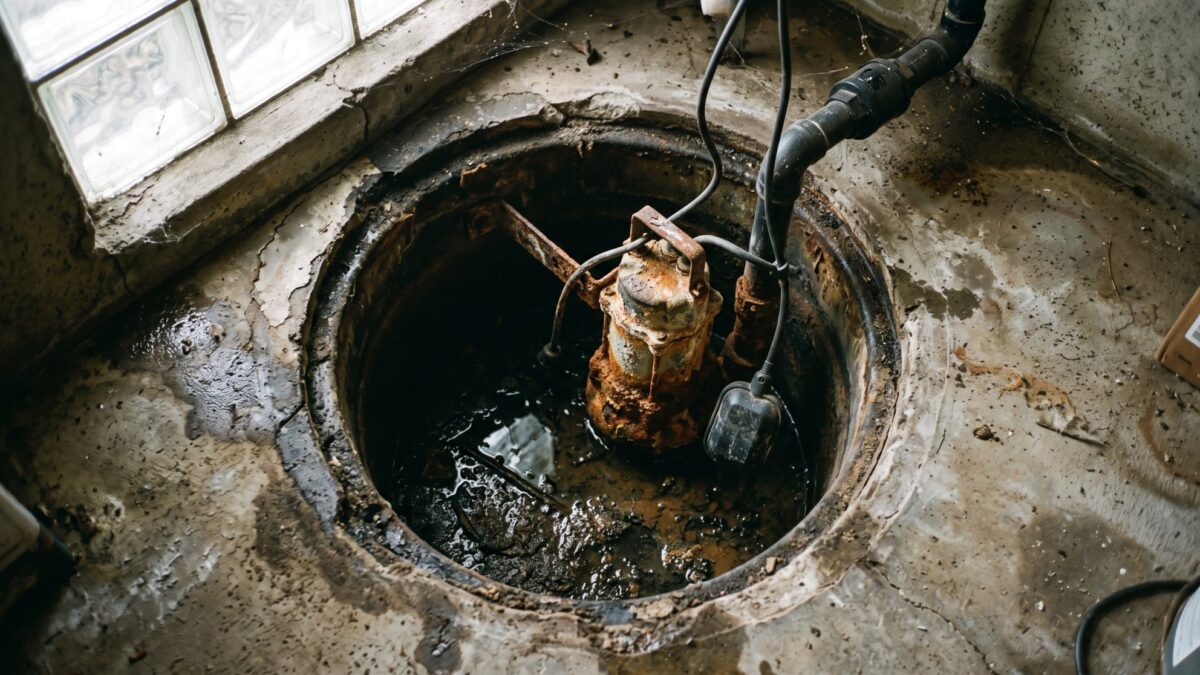
- Visible rust, scale or a chalky crust on the housing. Corrosion at the base and around the fittings is a good read on how much water has passed through.
- It has tripped a breaker even once. A motor drawing enough current to trip a breaker is telling you something about its windings.
- You cannot remember installing it. If the pump came with the house and the house came with a previous owner, treat it as older than seven years until proven otherwise.
Does the house you own change the answer?
The pit and the drainage feeding it matter more than the badge on the pump.
Pre-war bungalows and two-flats
Where a pump was added later to a house that never had one, the pit is often shallow and narrow because it was cut into an existing floor. Tight pits short-cycle, and short-cycling is what takes these pumps out early. If the pump in your bungalow has been replaced twice in a decade, the pit is the suspect, not the equipment.
Post-war block ranches
Old clay crocks in 1950s and 60s basements collect silt, and silt is abrasive. Pumps in these pits often reach the low end of the 7 to 10 year range with visible wear. Cleaning the basin out once a year costs nothing and is the single cheapest thing you can do for pump life in this style of house.
1980s and 90s poured wall homes
These basements usually have a proper pit tied to working perimeter drainage, so the pump gets a fair fight and tends to reach the full range. The failure that actually strands these homeowners is a power outage during a summer storm, which is a backup question rather than a lifespan question.
Newer subdivision homes
Builder-grade pumps in newer subdivisions are frequently the first thing in the house to fail, and settling grade in the first decade sends more roof and yard water toward a pit that was never sized for it. If your subdivision home is around ten years old and the pump is original, it is at the end of its expected run and it has probably worked harder than the builder assumed.
When should you leave a working pump alone?
Nobody needs to replace a healthy pump because a stranger in the driveway suggested it. Age by itself is not a diagnosis, and several common complaints have fixes that cost nothing.
A pump that quit this morning may not be dead. Check the outlet, the breaker and the float before you buy anything. A tripped receptacle and a float caught on the discharge pipe account for a large share of the calls we take, and both are free to fix. The full triage list is in why a sump pump stops working.
A four-year-old pump that tests clean is fine. Test it, keep testing it quarterly, and put the money toward the thing that actually fails first in most houses, which is having no backup at all when the power goes out.
A pit that overwhelms every pump is a drainage problem. If you are on your third pump in six years and each one drowned trying to keep up, replacing the fourth changes nothing. That is a volume problem, and the honest answer involves the drainage and grading feeding the pit, not a bigger motor.
| Pump age | What we recommend | What it costs |
|---|---|---|
| Under 5 years | Test quarterly, clean the basin, check the discharge line each fall | $0 |
| 5 to 7 years | Test monthly in spring, price a replacement so the number is not a surprise | $0 to learn, $2,800 to $4,500 when you act |
| 7 to 10 years | Replace on your schedule, before a storm picks the date for you | $2,800 to $4,500 with battery backup |
| Over 10 years, still running | Replace now and add a backup if you do not have one | $2,800 to $4,500 |
| Any age, failing repeatedly | Have the pit, drainage and discharge evaluated, not just the pump | Free inspection within 48 hours |
What should you do next?
First, find out how old it is. This takes ten minutes and costs nothing. Look for a date stamped on the pump housing or the label, check your closing paperwork if you bought the house recently, and write the date on the joist above the pit with a marker. The next owner will thank you, and so will you in six years.
Second, run a real test, not a glance. Fill the pit with water until the switch trips and watch a full cycle from start to shutoff. Listen for the check valve. Then walk outside and confirm water is actually leaving the discharge. Do this quarterly, and always before the spring thaw. The step-by-step version lives in how to test a sump pump.
Third, replace it on a dry day rather than a wet one. Emergency replacements happen during storms, at night, on whatever equipment is on the truck. Choosing the timing means choosing the pump. Tell us the pump’s age and what it does during a storm through our free estimate request, or call (630) 335-1128 and we will look at the pit and the discharge as well as the motor. If it has already quit and water is coming in tonight, we run 24/7 for active flooding.
Questions homeowners ask about sump pump lifespan
How do I find out how old my sump pump is?
Start with the label or the housing, where most pumps carry a stamped or printed manufacture date. If the label is gone, check your home inspection report, closing documents or any receipts from a previous owner, since a replaced pump is often noted. Failing all that, ask a plumber or waterproofing contractor to estimate from the condition of the housing, the fittings and the wiring during an inspection, then record the date somewhere you will find it.
Can I replace just the float switch instead of the whole pump?
Sometimes, and on a pump only a few years old it is a reasonable repair. Switches wear out faster than motors, and a pump with a healthy motor and a dead switch is worth saving. The calculation changes past year seven: paying for a switch on a pump already inside its replacement window buys you a part on a motor that owes you nothing. At that point, put the money toward the whole unit.
Does a sump pump that rarely runs last longer?
Not necessarily. Motors that sit idle for months can seize, seals dry out, and the float switch stiffens in place from mineral buildup and grit. The pumps that surprise people are usually the quiet ones: they went untested for years, then failed on the first night they were needed. Quarterly testing matters more in a dry basement than in a wet one, because a wet basement tests its own pump constantly.
Does the backup battery last as long as the pump?
No. A backup battery is a wear item with a much shorter life than the pump it protects, and you should expect to replace it more than once across the pump’s service life. Batteries also lose capacity quietly, so a system that seems fine can deliver a fraction of the runtime you assume. Check the charge indicator when you test the primary pump, and replace the battery on schedule rather than after an outage proves it was flat.
A pump nearing the end of its run is one of the few basement problems you can solve on a calm day at a known price. We inspect free within 48 hours, look at the pit and the discharge along with the equipment, and the interior waterproofing systems we install carry a lifetime, fully transferable warranty. Get your pump’s age checked at (630) 335-1128.


