
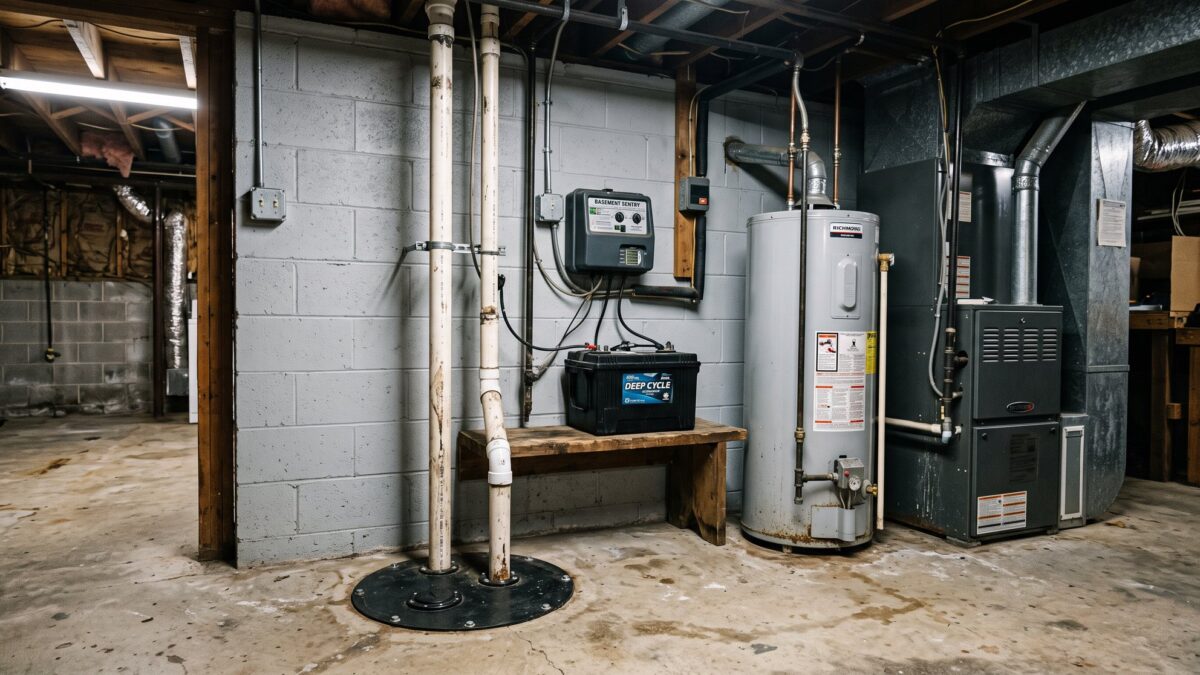
The quick answer
If your sump pump does real work, yes. Illinois storms cut the power and load the water table in the same hour, and a primary pump without electricity is just a hole in your floor. A new pump with battery backup runs $2,800 to $4,500 installed, which is the cheapest insurance in the basement.
What changes the answer is how hard the pump works and what is standing next to it. A crock that cycles twice a spring in an unfinished basement with nothing on the floor carries a different risk than a pump firing every four minutes under a finished lower level with a furnace beside it. Our sump pump installation page covers sizing and the install itself. This page answers the narrower question: who in the Chicago area genuinely needs a backup, what it costs, and what it will and will not do once the lights go out.
Why does the power go out at the exact moment the sump pump matters?
Because one weather system does both jobs. The storm lines that drop two inches on Will and DuPage counties in an afternoon show up with straight-line wind, and most of the older suburbs here still carry their distribution on poles running through a mature tree canopy. One limb takes the block down. Your basement loses its pump and gains its water inside the same twenty minutes.
The timing is worse than most homeowners expect, because groundwater does not spike the second it rains. Rain lands on dense glacial clay that soaks it in slowly, the excess travels sideways through the loose backfill beside your foundation, and it reaches the footing hours after the sky has cleared. The pump’s hardest shift begins after the storm, which is precisely when a long outage is still running. In March the lag disappears entirely: the ground is already saturated from the thaw, so there is no absorption left to buy anyone time. That is the pattern behind most calls we take from basements that flood every spring.
One more local detail matters. Many sump pits in this region are the only drainage the house has left, because the original clay tile at the footing silted shut decades ago. When a pump like that stops, the water has no slower route to take. It comes up through the pit and out across the floor.
What does a battery backup sump pump cost, and how long does the battery run?
Our published price for a sump pump with battery backup is $2,800 to $4,500 installed. That covers the primary pump, the backup pump and its controller, a sealed pit lid, check valves on both lines, the battery, the discharge work inside the house, and a high-water alarm so the system tells you when it is doing something unusual. We publish the range because a pump quote is the easiest place in this trade to pad a number.
What backup protection costs in the Chicago area
- Sump pump with battery backup, installed$2,800 to $4,500
- Full perimeter drain tile and sump system$8,000 to $16,000
- Downspout extensions and regrading$600 to $2,500
- Financing on approved credit0% for 12 months
- Free inspection scheduled within48 hours
These are our published numbers and they hold across all seven counties we serve, Will, Cook, DuPage, Kane, Kendall, DeKalb and Lee.
Runtime is the part nobody should promise you a number for. Any company quoting an exact hour count before looking at your pit is reading off a box, not measuring your house. Three things decide it: how many gallons per hour the pump moves, how far it lifts that water before the discharge leaves the wall, and how old the battery is. A backup handling light inflow at a short lift can idle through an evening outage. The same battery under a pump cycling every two minutes during a thaw drains far faster, because it is doing several times the work.
Batteries also lose capacity quietly as they age. A four-year-old battery can test fine at rest and still collapse under load on the night you need it. That is why we set battery replacement on a calendar instead of waiting for a failure to announce it, and why the alarm matters: it tells you the backup ran at all, which is information you otherwise never get.
Which Chicago-area houses need a backup most?
The honest ranking depends on two things: how much water your pit sees and how expensive the room around it is. Find the house that looks like yours.
Pre-war bungalows and two-flats
These basements were never designed around a sump. The pit was cut in later, usually after the original footing drains gave up, and it now handles everything the walls and floor let through. The lift is long, because the pump pushes water up out of a deep basement and out to a curb line on a narrow lot. Downstairs sits the furnace, the water heater, the laundry, and in a two-flat, the mechanicals for somebody else’s home. When that pump loses power, two households feel it.
Post-war block ranches
Block foundations from the 1950s and 60s let water in along the cove line at the base of the wall, steadily rather than dramatically. The pump in these houses often runs on an outlet added by a previous owner, sometimes shared with a GFCI serving the garage or the workbench. Half our service calls on this vintage are not dead pumps at all, they are live pumps behind a tripped receptacle. A backup on its own circuit removes that shared point of failure along with the outage risk.
1980s and 90s poured walls
Houses from this era usually have working perimeter drainage feeding a single pump, and they are also the era most likely to have a finished basement: carpet, drywall, a family room, a spare bedroom. The pump is not protecting a storage room here, it is protecting a third of the living space. That changes the math. The system costs a fraction of the tear-out, and the tear-out is the thing water actually causes.
Newer subdivision homes
Subdivisions built on former farmland sit low, drain slowly and were engineered with the sump pump as a permanent part of the design rather than an emergency measure. In fields like the ones under many Plainfield and Kendall County neighborhoods, the pit runs for days after a wet week because that is what the builder intended it to do. A single builder-grade pump on a single circuit is the whole flood-control plan for the house, which makes these homes the clearest case for a backup on this page.
When do you not need a battery backup?
We would rather sell nothing than sell the wrong thing, so here are the cases where we tell homeowners to hold off.
You already have an automatic standby generator carrying the sump circuit. If a whole-house unit starts on its own and the transfer panel includes the pump, the outage problem is solved. Go confirm the sump breaker is actually on the transfer panel, because it is skipped more often than owners realize. What you still lack is protection against the pump itself failing, and that is a different question, answered in whether a second sump pump is worth it.
Your pit never runs. Some houses have a crock that has sat dry for years, left over from a previous system or dug on spec. Adding a backup to a pump that has nothing to pump protects nothing. Put the money into gutters, downspout extensions and grading first, and see whether the pit stays dry through a full wet spring.
Your water comes up through the floor drain. Water rising out of a floor drain in heavy rain came from the sewer, not the ground, which is a common story in the older suburbs that still carry storm and sanitary flow in one pipe. No sump pump intercepts that, on battery or otherwise. Start with why water comes up through a floor drain and get a plumber’s opinion before ours.
Your primary pump is already at the end of its life. Hanging a backup behind a failing main pump means the backup becomes the main pump, quietly, and then you have no backup at all. Replace the primary first. If yours is aging or already dead, start with why a sump pump stops working before you shop for anything else.
Battery backup, water-powered backup, or a generator?
There is more than one way to keep water moving without utility power, and they fail in different places. This is the comparison we walk through at the kitchen table.
| The option | What it costs | Where it fits | Where it falls short |
|---|---|---|---|
| Battery backup pump | $2,800 to $4,500 with a new primary pump | Any home where the pit does real work | Runtime is finite and the battery needs replacing on a schedule |
| Water-powered backup | Quoted by a licensed plumber, not part of our pricing | Homes on municipal water with strong pressure | Does nothing on a private well, uses a lot of city water, and some villages restrict them or require backflow protection |
| Portable generator | Homeowner equipment | Households usually home during storms | Someone has to be awake and outside in the weather to start it, and it must never run indoors or in an attached garage |
| Automatic standby generator | Quoted by a licensed electrician | Homes with well pumps, medical equipment or a long outage history | Costs more than the pump system and only helps the basement if the sump circuit is on the transfer panel |
| Second pump on its own circuit | Quoted from our sump pump range | Pits with very heavy inflow | Covers mechanical failure but still goes dark with the power |
Note the pattern. A backup pump protects against no power. A second pump protects against no pump. A generator protects the whole house, but only reaches the basement if somebody wired it that way.
What should you do next?
First, find out what your pump is plugged into. Trace the cord, find the breaker, and label it. If the outlet is a GFCI shared with the garage, the exterior receptacles or a bathroom, you have a failure point that has nothing to do with storms. This costs nothing and takes ten minutes.
Second, time the pit during the next wet week. Watch how often the pump kicks on and how quickly the water comes back after it shuts off. Those two observations tell an installer more about the backup you need than any square-footage rule of thumb. Our walkthrough on testing a sump pump covers how to do it without guessing.
Third, get the pit measured before storm season instead of during it. We will check the lift, the discharge route, the circuit and the inflow rate, then put a backup price on paper inside our published range: schedule the free sump inspection, or call (630) 335-1128 and tell us how often the pump is running right now. If the basement is taking water while you read this, we run 24/7 for active flooding.
Questions homeowners ask before adding a backup pump
Can a battery backup be added to the sump pump I already have?
Often yes, if the existing pump is sound and the pit has room for a second pump and float. The backup sits at a slightly higher level so it only engages when the primary cannot keep up or has no power. What stops the retrofit is usually the pit itself: a narrow or shallow crock leaves no clearance for two floats to swing without tangling. We check that first, because a cramped install creates the exact failure it was bought to prevent.
What maintenance does a battery backup system need?
Very little, and all of it is on your calendar rather than ours. Look at the charge indicator or alarm panel every spring before the thaw, keep the terminals clean and dry, and confirm the fluid level if your battery is the kind that takes water. Then budget for the battery itself as a scheduled item, since capacity fades quietly whether the system ever runs or not. Ten minutes once a year is the whole ask.
Does the backup start on its own, or do I have to switch it over?
It starts on its own, which is the entire point. The backup float sits slightly above the primary float, so when the water climbs past the level the main pump should have handled, the backup takes over without anyone touching anything. That is why these systems protect houses where nobody is home, and why the alarm matters: the first sign the primary has quit is often the alarm telling you the backup did the work last night.
Will a battery backup move as much water as my main pump?
No, and it is not built to. Backup units are designed to keep the water below your floor slab through an outage, not to match the output of a primary running on household current. That is a deliberate trade: a lower flow rate stretches the battery across more hours, which is what actually saves the basement. It also means a backup cannot compensate for an undersized primary. If your main pump already struggles during storms, the pump itself is what needs correcting.
The outage will not check your calendar first. We will look at the pit, the lift and the circuit free within 48 hours and price the backup inside the published range, and the work is warranted: drainage work carries a 5-year warranty, and when the pump goes in as part of a full interior system, that system carries a lifetime, fully transferable warranty. Call (630) 335-1128.


