
The quick answer
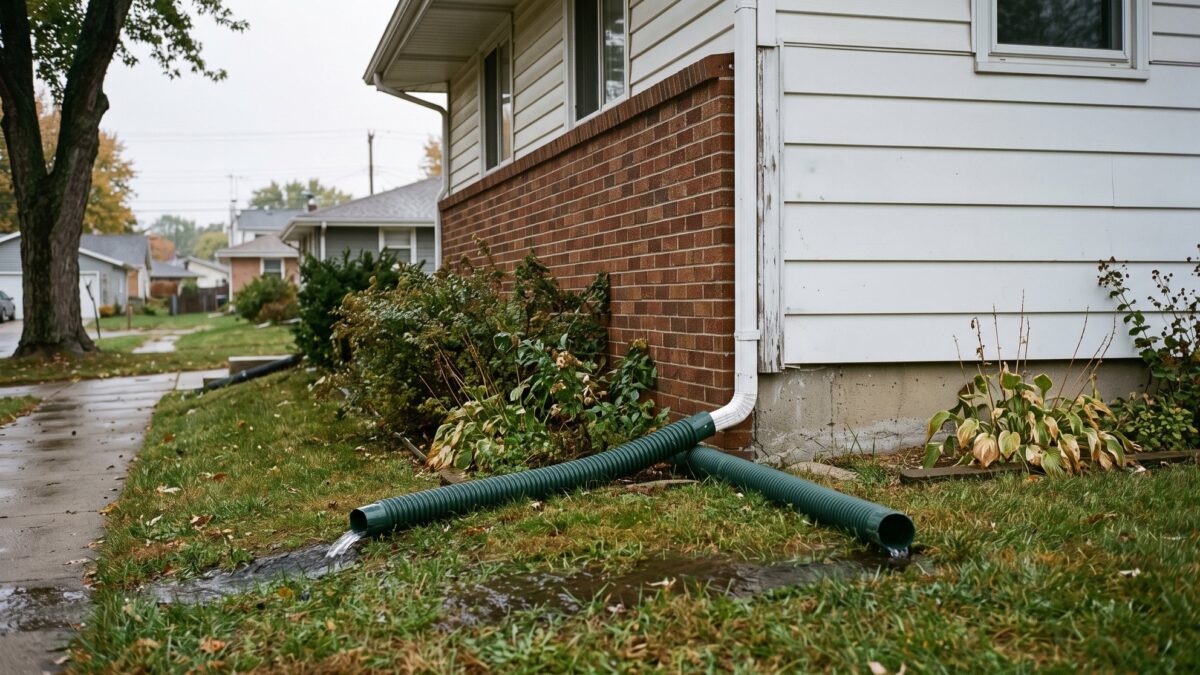
Get roof water at least six feet from the foundation, and ten feet where the yard allows it. Four feet is the bare minimum and it is not enough on Chicago-area clay. The discharge point also has to sit lower than the gutter outlet, or the water simply walks back toward the wall it just left.
Distance alone is not the whole answer, which is why so many homeowners extend a downspout and still get a wet basement. What matters is where the water lands and what the ground does with it after that. Ten feet of pipe emptying into a flat spot that drains back along the foundation is worse than six feet emptying onto ground that falls away. Downspout work is the cheapest and highest-return piece of yard drainage there is, and it is the first thing we check on every inspection. Here are the real distances, why short extensions fail in this region, and what to do when the lot is too narrow to reach ten feet.
How far is far enough?
Six feet is the working minimum we recommend on Illinois clay, ten is better, and past about fifteen feet you are solving a grading problem rather than a downspout problem. Those numbers are not smaller because of the volume involved, which almost nobody pictures accurately.
The numbers behind downspout distance
- Absolute minimum discharge distance4 feet
- What we recommend on clay lots6 to 10 feet
- Fall the extension itself needsAbout 1 inch per 10 feet
- Water from 1 inch of rain on 1,000 square feet of roofAbout 620 gallons
- Downspout extensions and regrading, installed$600 to $2,500
The gallon figure is straight arithmetic: an inch of rain over a square foot is roughly 0.62 gallons. The cost range is our published pricing.
Run that on your own house. A modest 1,500 square foot roof shedding an inch of rain sends roughly 930 gallons to the ground, or about 230 gallons out of each of four downspouts, and a two-inch storm doubles it. That is not a splash landing four feet from your basement wall. It is a bathtub emptied into the exact soil that leads to your footing.
Why does four feet fail on a Chicago-area lot?
Because of what is in the ground beside your house. When your foundation was built, a hole was excavated wider than the walls, the walls went in, and the hole was backfilled with the soil that came out of it. That backfill never recompacts to the density of the undisturbed glacial clay around it. It stays looser and more permeable for the life of the house, which makes the band of soil against your foundation the easiest path water can find. It works like a moat trying to fill.
On most lots that disturbed zone extends several feet out from the wall, so a downspout discharging at four feet is often still dumping directly into it. Once water is in that zone it goes down, reaches the footing, and either loads your drain tile or finds a crack, a cove joint or a block core. Add the freeze-thaw cycle that opens hairline cracks a little more each winter, and a house that handled short extensions for fifteen years starts leaking in a way that feels sudden. If your basement only gets wet during hard rain, this is usually the mechanism: see why a basement leaks only when it rains hard.
Distance is how you get past that trench. Six to ten feet puts the discharge on undisturbed ground that sheds water across the surface instead of funneling it down beside your wall.
Where should the water actually end up?
The end of the extension is the part that decides whether the distance mattered. Three conditions have to hold.
It has to land lower than where it started, on ground that keeps falling. Soil around a foundation should slope away from the house, and the extension should discharge onto that slope, not into a mulch bed rimmed with edging that holds water like a bowl. If you are unsure what your grade is doing, see how much slope the ground should have around a foundation.
It cannot dump onto pavement that runs back to the house. A very common Chicago-area mistake is an extension emptying onto a driveway or a walk that pitches slightly toward the building. The concrete carries the water back faster than soil ever would.
It cannot become your neighbor’s problem. Tight Illinois lots often have nowhere obvious to send water except sideways. Broadly, you are not free to concentrate runoff onto adjoining property in a way that causes harm, but rules vary by municipality and real disputes turn on the specifics of both lots. Check with your village before piping water toward a lot line, and read the plain-language version of the neighbor drainage question first.
When the surface cannot carry the water far enough, the extension goes underground in solid pipe to a pop-up emitter or a dry well at a lower point. That is a real fix rather than a compromise, and it has its own trade-offs, which we cover in whether downspouts should go underground.
| Option | Typical reach | Where it works | Where it fails |
|---|---|---|---|
| Splash block only | 1 to 2 feet | Nowhere near a basement in clay soil | Discharges straight into the backfill zone |
| Roll-out or flip-up sleeve | 4 to 8 feet when deployed | Renters, mowing season, temporary testing | Gets left rolled up, tears, blocks with debris |
| Rigid aluminum or PVC extension | 6 to 10 feet | Most yards with room and a fall away | A mowing obstacle; needs to stay pitched |
| Buried solid pipe to a pop-up | 10 to 40 feet | Flat lots, tight side yards, finished landscapes | Can ice or clog; needs cleanouts and pitch |
| Buried pipe to a dry well | As far as the lot allows | No low point anywhere on the property | Finite storage; clay releases it slowly |
What does this look like at your house?
The right distance is the one your lot can actually deliver, and that changes with how the house was built.
Bungalows, two-flats and other narrow-lot homes
When the gangway is four feet wide, ten feet of extension is not a choice. The honest answer on these houses is to get the rear and front downspouts out to real distance and take the side ones underground in solid pipe, carried front or back to a lower point rather than dumped in the gangway. Nearly every wet basement we look at in older suburbs like Berwyn has at least one side downspout discharging into a strip of clay that two roofs are already draining into.
Post-war ranches on flat blocks
These lots have room for a full ten feet, which is the good news. The bad news is that a flat lot gives water nothing to do once it arrives, so the extension has to end on ground that still falls or the puddle simply relocates. Ranches also tend to have long roof runs feeding few downspouts, so we often add a downspout rather than lengthen one.
1980s and 90s homes with landscaped beds
Thirty years of mulch top-dressing has raised many of these beds above the surrounding lawn, and the edging around them holds water against the house. An extension ending inside the bed is worse than useless. Carry the discharge past the edging, and check whether the bed itself now sits higher than the grass.
Newer subdivision homes
Builders commonly leave short extensions or splash blocks at closing, and the engineered fill under the yard keeps settling for years afterward. The combination is why so many five-year-old houses develop a wet corner. On these lots, extending to ten feet toward the builder swale is usually the entire fix, and it is worth doing before you conclude anything is wrong with the foundation.
When is a longer extension not the fix?
We would rather send you to the hardware store than sell you something you do not need, so here is when extensions are not the answer.
The gutters are the real problem. If water sheets over the front of the gutter in every storm, spills at a seam or backs up behind a clog, it never reaches the downspout. No extension fixes water that leaves the roof at the fascia.
Water is rising through the floor drain. Water appearing at the floor drain during heavy storms is a sewer issue, common in older suburbs with combined sewers, and no amount of roof water management touches it. That belongs to a plumber, and we explain why in why water comes up through a floor drain.
The seepage is constant, not storm-driven. A wall that weeps in dry weeks or a cove joint that stays damp in August points at groundwater, not roof water. Extensions still help, but they will not be the fix.
You already did it and nothing changed. If your downspouts genuinely discharge ten feet out onto falling ground and the basement still takes water, the extensions did their job and the diagnosis moves on. That is a useful result, not a failure.
- Every downspout discharges at least six feet out. Walk the whole house and count. One short spout undoes the other five.
- The end of each extension sits lower than the elbow. Sight down it. A flat or backpitched run holds water and freezes first.
- Nothing discharges onto pavement that leads back to the house. Driveways and walks move water faster than soil does.
- Buried lines have a cleanout and a working pop-up. A pop-up that will not open turns a buried extension into a storage tank.
- The soil beside the house falls away, not toward it. Distance cannot rescue a grade that is pitched at the foundation.
What should you do next?
First, stand outside in the next real storm. Five minutes per downspout, in the rain, with your phone. Watch where the water lands, which way it travels, and whether any turns back toward the house. It costs nothing and it names the culprit at a lot of houses.
Second, fix the cheap ones yourself this weekend. A rigid extension and an elbow cost a few dollars at any hardware store, and taking a spout from two feet to eight is the highest-value hour of home maintenance in this region. Buy longer than you think you need and cut it down. If mowing is the objection, use a hinged elbow that flips up.
Third, get the ones you cannot solve looked at. Side yards with no room, flat lots with no low point and buried lines of unknown condition are where homeowners stall out. We come out free within 48 hours, walk every discharge point, check the grade with a level rather than an opinion, and put the findings in writing whether you hire us or not. Ask us to walk your downspouts on the free estimate request, or call (630) 335-1128 and tell us which corner of the basement gets wet. If the water has to travel farther than the yard allows, a French drain can carry it the rest of the way.
Questions homeowners ask about downspout extensions
Does a splash block count as an extension?
Not for a basement in clay soil. A splash block does one useful thing, which is keeping the discharge from eroding a hole in the soil, and it moves water maybe a foot or two. That is still inside the loose backfill beside your foundation. Keep the block if you like, but put a real extension on top of it that carries the water six feet or more out onto ground that falls away.
Will a longer extension just create a soggy spot in the lawn?
Sometimes, and that is still an improvement over a soggy basement. If the new discharge point puddles, the problem is the grade at that spot, not the length of pipe. The usual fixes are extending farther to ground that drains, splitting one downspout into two discharge points, or piping it underground to a pop-up on lower ground. A wet patch of grass is a lawn issue; water beside the footing is a foundation issue.
Should extensions come off for the winter in Illinois?
No. Winter is when you need them most, because January thaws and February rain put a lot of water onto frozen ground that cannot absorb any of it. What does need attention is ice: keep the outlet end clear, give the run a steep pitch so it drains completely between events, and if a buried line ices up regularly, add a surface bypass at the elbow so water still gets away from the house.
Can a downspout extension be too long?
Practically, yes. Past roughly fifteen feet an above-ground run becomes a tripping and mowing hazard, loses pitch in the middle, and tends to get disconnected and never reattached. If the water has to travel farther than that, the answer is a buried solid pipe to a pop-up or a graded swale rather than more surface pipe. Length is not the goal; getting the water to ground that carries it away is.
Roof water is the one cause of basement leaks a homeowner can often fix in an afternoon, and it is worth ruling out before anybody quotes you a system. If the extensions are already right and the water keeps coming, we will find what is actually letting it in during a free inspection within 48 hours, and any drainage work we do carries a 5-year warranty. Call (630) 335-1128 when the downspouts stop being the explanation.


