
The quick answer
An exterior French drain in Illinois runs $45 to $90 per linear foot installed. A short 40-foot run beside one wet corner lands near $1,800 to $3,600, while 120 feet around two sides of a house reaches $5,400 to $10,800. Depth, digging conditions, restoration and the outlet drive the spread.
That is a range, not a quote, and the distance between the two ends of it is real work. Forty feet of exterior French drain through open turf that daylights at a downhill fence line is a one-day job with a sod repair at the end. The same forty feet squeezed along a gangway, tunneled under a paver walk and terminated in a dry well because the lot has nowhere lower to send water is a different animal. Below is what the per-foot number covers, what pushes a quote toward the top of the range in Illinois clay, and when a trench is the wrong thing to buy.
What does $45 to $90 per linear foot actually buy?
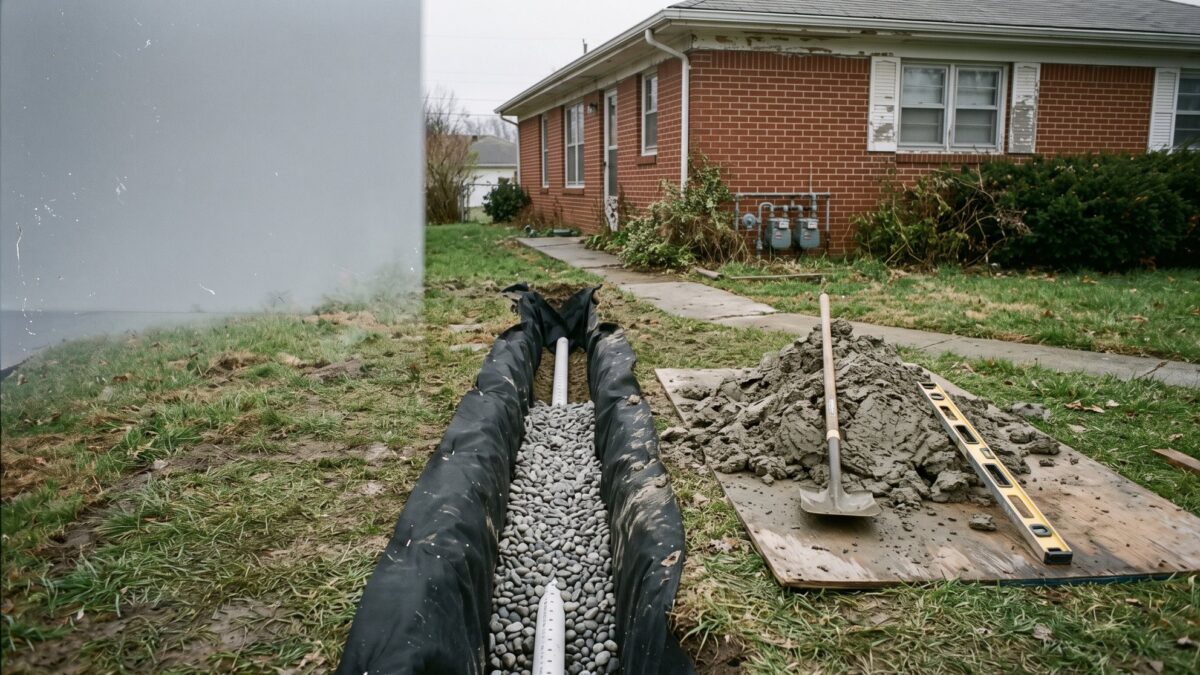
The per-foot price is for a finished assembly, not a length of pipe. A properly built exterior French drain is a trench cut to a consistent fall, lined with filter fabric, bedded with washed stone, fitted with rigid perforated pipe laid holes-down, covered with more stone, wrapped closed and backfilled so the surface looks like a yard again. The pipe is the cheapest thing on that list. You are paying for excavation, stone, and disposal of the clay.
French drain pricing in Illinois
- Exterior French drain, installed$45 to $90 per linear foot
- 40-foot run along one wet side$1,800 to $3,600
- 120-foot run around two sides$5,400 to $10,800
- Downspout extensions and regrading, often tried first$600 to $2,500
- Interior drain tile, for comparison$95 to $160 per linear foot
These are our published ranges across all seven counties we serve. The run totals are simple arithmetic on the per-foot range, not separate quotes.
Why does the same drain cost more in one Illinois yard than the next?
Five things move a French drain quote in this region, and four of them are underground. Understanding them is how you tell a fair number from a padded one.
Depth. A drain catching surface runoff off a soggy lawn is a two-foot trench. One meant to relieve water against a foundation wall has to sit near the footing, which means four feet or more of machine excavation and far more spoil to haul. Depth is the single biggest lever on price, so a quote that does not state a target depth is not a quote yet.
The soil itself. Nearly all of the Chicago area sits on dense glacial clay, which digs like modeling compound when it is wet and like pavement when it is dry. It does not fall off a bucket, and it swells once disturbed, so you haul away more than you took out. Yards with old fill, buried debris or a high water table cost more again, because the trench keeps trying to close itself while the crew works in it.
What the trench has to cross. Driveways, walks, patios, tree roots, gas and irrigation lines and A/C pads all interrupt a straight run, and boring under a walk costs more than trenching open lawn. On tight city lots the machine may not fit through the gangway at all, and hand excavation in clay is where the top of the range comes from.
Where the water is allowed to go. Flat Illinois blocks often have no natural low point, and discharge rules vary from village to village: some regulate what may enter a storm structure, some care where a pipe daylights near a lot line, and neighbor disputes turn on the specifics of both properties. Ask your municipality before you dig. Permit expectations differ too, which we cover in whether Illinois requires a permit for a French drain.
Restoration. Putting the yard back is a real line item: sod, reseeding, resetting pavers, replanting beds, hauling surplus clay. It is also the part homeowners most often discover after the fact, so get it written into the scope rather than implied.
What does a French drain cost on a house like yours?
The era a house was built in predicts both the drainage problem and the digging conditions, which is why the same linear footage lands at different prices across the region.
Chicago bungalows and two-flats on narrow lots
City lots run about 25 feet wide, and the gangway between houses is often too tight for equipment. Hand digging four feet of clay in a three-foot corridor and carrying every bucket out to the street puts these jobs at the upper end of $45 to $90 per linear foot even though the runs are short, and there is usually nowhere downhill to discharge. On many of these houses the honest recommendation is an interior system instead, which is part of why basement waterproofing in Chicago so often happens from the inside.
Post-war ranches on flat suburban blocks
The 1950s and 60s subdivisions across Cook and Will counties were graded flat and stayed flat. Open access for a machine keeps the digging price down, but no fall pushes the outlet cost up, and a 60-foot run at $2,700 to $5,400 can carry another long solid-pipe leg to reach the only low corner on the lot. This is the housing stock where a dry well earns its keep, and where the outlet plan deserves as much scrutiny as the trench itself.
1980s and 90s subdivisions
These houses usually have working foundation drainage feeding a sump pump, so a French drain here solves a yard problem: a low spot that stays wet, a side yard that never dries, water sheeting toward a patio door. Runs are moderate and access is decent, so jobs land mid-range. The trap is buying a foundation-depth trench when a shallow yard drain plus corrected downspouts would have done it for a quarter of the money.
Newer construction on graded fill
Subdivisions built in the last two decades sit on engineered fill that settles for years after closing. Swales flatten, the grade beside the foundation goes level or negative, and water meant for the rear easement stalls against the house. Digging is easy, so the per-foot price sits low, but restoring the grade is frequently cheaper than any trench.
When is a French drain the wrong thing to spend money on?
We turn down trench work regularly, because in a lot of yards the water has a cheaper explanation. Here is when to keep the money.
Your roof water is the problem. A single downspout dumping at the foundation puts more water beside your wall in one storm than any soil condition does. Extending downspouts and fixing the first six feet of grade is a $600 to $2,500 job, and sometimes it is a $30 job with a length of pipe from the hardware store. Do this before you price a drain, always.
The water is coming up, not in. If water appears at the floor drain during heavy storms, especially in older suburbs on combined sewers, no exterior trench will touch it. That is a sewer issue and it belongs to a plumber. We explain the difference in why water comes up through a floor drain, and we say the same thing on inspections when we see it.
The seepage is at the cove. Water arriving where the floor meets the wall is already under the slab, and an exterior drain cannot pull it back out. That is interior drain tile at $95 to $160 per linear foot. Paying for both is a common, avoidable mistake.
It was one storm. A yard that held water once during a stalled thunderstorm is not a drainage failure. Watch a season and decide on a pattern, not a scare.
How does the price compare to the other drainage fixes?
A French drain is rarely the first thing that should be priced. Put the whole menu side by side before you commit to a trench.
| The fix | Published cost | Right when | Its limit |
|---|---|---|---|
| Downspout extensions and regrading | $600 to $2,500 | Water shows up only after roof runoff hits the ground | Cannot move water already sitting in saturated clay |
| Exterior French drain | $45 to $90 per linear foot | Surface and shallow water needs a path off the lot | Needs a real outlet; will not dry a slab from outside |
| Dry well as an outlet | Added to the drain scope | Flat lot with no low point to daylight into | Storage is finite; clay refills it slowly |
| Interior drain tile and sump | $95 to $160 per linear foot | Water entering at the cove or through the slab | Does nothing for a soggy lawn |
| Full perimeter interior system | $8,000 to $16,000 | Recurring basement seepage on multiple walls | Overkill for a yard-only complaint |
If you are weighing the basement side of this decision too, the full cost picture lives on our basement waterproofing cost page. Soil type matters enough to have its own page too, because clay changes how the drain has to be built and what it is capable of: see whether French drains work in clay soil.
- The quote states linear feet and depth. Both numbers, in writing. A lump sum with neither is a guess dressed as a price.
- The outlet is named. Daylight, pop-up, dry well, or pit and pump. If the plan does not say where the water leaves, the drain does not work.
- Stone and pipe are specified. Washed stone, rigid perforated pipe, filter fabric. Pipe buried in native clay will silt shut.
- Restoration is written in. Sod, seed, pavers reset, surplus clay hauled. Otherwise it is your problem in the spring.
- The number sits inside $45 to $90 per linear foot. There are real reasons a job goes higher. Ask what yours is and expect a specific answer.
What should you do next?
First, walk the property during the next real rain. It costs nothing and tells you more than any estimate. Note where water leaves each downspout, which way it runs, where it stands twenty minutes after the rain stops, and how close that is to the foundation.
Second, find your fall before you price anything. Run a string line and a level from the wet area to the lowest point you own. A French drain moves water by gravity, so if there is no fall, the price you are being quoted has to include manufacturing one, and that is worth knowing before the conversation starts. If you are considering doing the digging yourself, read the honest version of a DIY French drain first.
Third, get the run measured instead of estimated. We walk the yard free within 48 hours, tape the actual footage, check the fall, identify the outlet, and hand you a written number built from the published per-foot range whether you hire us or not. Have your yard measured and the footage priced on paper through a free drainage inspection, or describe the wet spot over the phone at (630) 335-1128 and we will tell you if it even sounds like a trench job. If the number lands above what this season allows, financing at 0% for 12 months splits it into monthly.
Questions Illinois homeowners ask about French drain pricing
What is included in a per-foot French drain price?
Excavation to the specified depth, hauling and disposal of the clay spoil, filter fabric, washed stone bedding and cover, rigid perforated pipe, backfill and basic surface restoration. The outlet run, whether that is solid pipe to daylight, a pop-up emitter or a dry well, is usually priced separately because its length depends on your lot. Ask for those items listed individually so you can compare two quotes honestly.
Why do two French drain quotes for the same yard differ by thousands?
Almost always depth and outlet. A two-foot yard drain and a footing-depth relief drain are different jobs with the same name, and a quote that daylights at a fence line costs far less than one that has to build a dry well. Restoration is the third gap: one quote may include sod and hauling while the other leaves you a clay windrow. Compare depth, outlet and restoration before you compare totals.
Does the price change if the drain has to cross a driveway or patio?
Yes, and it is one of the larger add-ons in Illinois yards. Boring beneath a slab, sawcutting and patching concrete, or lifting and resetting pavers all add labor and materials that open-lawn trenching does not. Sometimes rerouting the drain around the obstacle is cheaper than going under it, sometimes the detour adds so much footage that crossing wins. A crew that measures both options is doing it right.
What does a French drain cost to maintain after it is installed?
Almost nothing in dollars, but it is not zero effort. Keep the outlet clear of turf, mulch and leaves, check that the pop-up still opens, and keep gutters clean so roof debris is not washing sediment into the system. A drain with cleanouts can be jetted by a drain contractor if flow slows. Systems that fail early usually failed because roots or silt got in, not because anyone skipped a service visit.
A wet yard does not get cheaper by waiting, and neither does the basement it drains toward. We measure the run free within 48 hours, price it from the published $45 to $90 per foot, and back the drainage work with a 5-year warranty: call (630) 335-1128 and we will tell you what your footage actually costs.


