
The quick answer
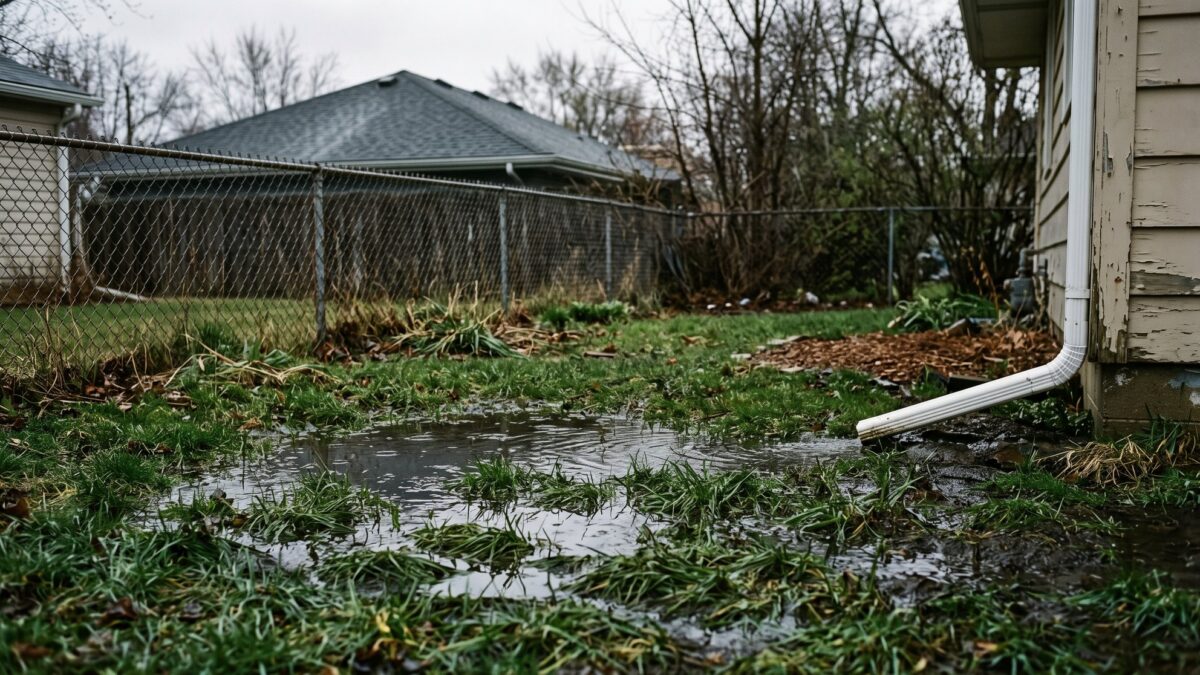
Standing water in your yard means water is arriving faster than the ground can take it in. Around Chicago that usually comes down to dense glacial clay, a low spot where backfill settled, or roof and sump water dumped in one place. If the puddle is still there a day after the rain stops, it is a drainage problem.
That is the diagnosis in one line. The cause behind it matters far more than the puddle, because a yard holds water for three very different reasons: too much water landing in one spot, too little fall to carry it away, or soil that refuses to absorb it. Each has its own fix at its own price, which is why our yard drainage work always starts with finding the source before anybody prices a pipe. Skip that step and you can pay for a trench that solves a problem you never had.
Why does water sit on top of the ground here instead of soaking in?
The soil under almost every yard in this region is glacial till: dense, gray, sticky clay left behind when the ice retreated. Clay particles are packed so tightly that water moves through them at a crawl. Sandy ground swallows a heavy rain in an afternoon. Clay accepts the first part of a storm, saturates, and then rejects everything after that, so the rest of the rain has nowhere to go but sideways across the surface until it finds the lowest point on your lot.
Construction makes it worse. Building a house means scraping the lot, running loaded machines across it for months, then spreading a few inches of black topsoil and rolling out sod. Under that thin dark layer sits clay compacted to something close to a parking lot, so a lawn that looks healthy in June turns into a shallow pond in April.
Then there is the land itself. Will, Cook, DuPage and Kane counties are close to table flat, so water here does not race downhill and disappear. It leaves slowly, through swales and street inlets laid out with a few inches of fall to work with. Add frozen or already saturated subsoil in early spring and the ground stops accepting water at all, which is why yards flood in spring and stay dry through an identical storm in August.
Where is all that water actually coming from?
A puddle is the last stop, not the source. Walk the yard during the next storm with a rain jacket on and you can usually name the culprit in ten minutes.
The roof. Your roof is the biggest hard surface on the property, and gutters hand all of it to three or four downspouts. An elbow emptying within a couple of feet of the wall pours hundreds of gallons into the same square yard of clay every storm. That concentration causes more yard puddles than any soil condition, and it is the cheapest thing here to fix. How far the pipe should run is answered on how far downspouts should extend.
The sump discharge. A pump working through a wet spring moves serious volume, and a discharge line ending four feet off the house returns that water to ground that drains straight back to the pump. You get a permanent wet ring and a pump that never rests.
Ground that used to slope and no longer does. Backfill settles for a decade after a house is built, mulch beds get topped up every spring, a patio gets added. Twenty years later the ground tips gently back toward the house, and the low ring along the wall is where water collects first.
Something leaking. If a spot stays soggy through a dry week in July, that is not drainage. A cracked irrigation line, a leaking hose bib or a failed water service line keeps lawn wet with no rain in the forecast. Shut the irrigation off for a few days and watch. If it stays wet, call a plumber or your village before you call anyone about drainage.
What does a wet yard look like at your kind of house?
The shape of the puddle usually gives away the decade the house went up, because every decade came with its own drainage habits.
Pre-war bungalows and two-flats
On a Chicago city lot the gangway between two houses can be five feet wide, and both roofs drain into it. There is no room to build slope in five feet, so water stands in a strip against the foundation. Grading is not the answer on these lots. Capturing the water is: solid downspout lines run underground to a front curb outlet, sometimes with a narrow channel drain in the walk. Read whether downspouts should go underground before anybody digs.
Post-war block ranches
The 1950s and 60s suburbs were laid out flat, with shallow drainage paths and short downspout elbows. Six decades of settlement, patios, stoops and raised beds later, roof water has no clear route to the street. These yards typically hold water in one broad low area out in the lawn and in a narrow band at the wall, and the two need different fixes.
1980s and 90s subdivisions
Subdivisions of this era were graded with swales, the shallow valleys along lot lines that carry every yard’s runoff to a street or a detention basin. They work until someone builds a raised bed, a shed pad or a berm across one. Block a swale and the water backs up and finds a new low point, often in the yard of whoever blocked it. If the puddle appeared the year after a landscaping project, start there.
Newer subdivision homes
In the first ten years the backfill trench settles several inches, leaving a shallow moat right where you least want one, and new sod over compacted clay compounds it. Most of these yards need no drainage system at all. They need the ring around the house rebuilt with clay-heavy fill and the downspouts run past it, which is the cheapest permanent fix on this page.
The numbers behind a wet yard
- Ground that sheds water away from a house6 inches of fall in the first 10 feet
- Standing water long enough to breed mosquitoesAbout a week
- Downspout extensions and regrading$600 to $2,500
- Exterior French drain$45 to $90 per linear foot
- Sump pump with battery backup$2,800 to $4,500
Prices are from our published list and hold across every county we serve. The slope figure is the long-standing convention in residential construction, not a ProSeal rule.
When is standing water in the yard not worth spending money on?
Plenty of wet yards need nothing. Here is when we tell homeowners to leave it alone.
The puddle is far from the house and clears in a day. Water sitting in a back corner thirty feet out, gone by the next evening, is a lawn inconvenience, not a foundation threat. Core aerate that area in fall, topdress with compost over a few seasons, and mow around it meanwhile.
The water is in a swale during a storm. A swale holding water mid downpour is the swale working. Judge it an hour after the rain ends, not during, and if it drains, resist every suggestion to fill it.
It only happens in March. One saturated spring in an otherwise dry yard is not a system purchase. Photograph it, note the date, and see what next year does.
Water is also coming up inside. If the yard floods and water rises through the basement floor drain in the same storm, the yard is not your main problem. A surcharged main pushes water up the lowest opening in the house, and that fix belongs to a plumber, not to a drainage crew. Start with water coming up through the floor drain, and treat the yard as a separate job.
The water is arriving from somewhere else. If runoff crosses onto your lot from a neighbor, a street or a commercial lot uphill, the fix may not be yours to buy. Illinois generally lets water follow its natural course while limiting what an owner may do to change that flow onto a neighbor, but rules vary by municipality and every dispute turns on the specifics of the two properties. Call your village engineering or public works department first, and talk to an attorney before it becomes a fight. There is more background in draining water onto a neighbor’s property in Illinois.
How do you match the fix to the cause?
Find the pattern in the left column and you have most of your answer before anyone visits.
| What you see | Most likely cause | The honest fix | Published cost |
|---|---|---|---|
| Puddle directly under a downspout | Roof water concentrated at the wall | Extend the discharge past the backfill | $600 to $2,500 with grading |
| Wet ring within a few feet of the foundation | Backfill settled, slope lost | Rebuild grade to 6 inches over 10 feet | $600 to $2,500 |
| Broad low area mid-yard, holds a day or two | Compacted clay on a flat lot | Regrade the low area to a lower outlet | $600 to $2,500 |
| Wet strip along a fence or between houses | Two roofs, no room for slope | Collect and pipe it to the front | $45 to $90 per linear foot |
| Constant wet spot with no rain | Irrigation or water service leak | Plumber or village, not a drainage crew | Not a drainage job |
| Whole yard soaked, spring only | High seasonal water table | Log it one more season before spending | $0 |
Before you accept any quote, spend twenty minutes proving the cause yourself. This list costs nothing and it changes how the conversation goes.
- Stand outside during real rain. Not after. Watch which way sheet flow moves and where it stalls. Five minutes in a downpour beats an hour of guessing on a dry Saturday.
- Mark the puddle edge with landscape flags. Photograph it at one hour, six hours and twenty four hours after the rain stops. A puddle that shrinks steadily is slow soil. One that does not move has nowhere to drain.
- Check the fall from the wall. Drive a stake at the foundation and another 10 feet out, run a string with a line level, and measure down at the far stake. Less than 6 inches of drop is a grading problem you can now put in numbers.
- Count the downspouts discharging within four feet of the house. That number usually predicts where your puddles are.
- Find the low point of the whole lot. Water has to leave somewhere. If the lowest ground on the property is against your foundation, no pipe fixes that permanently until the grade changes.
- Shut the irrigation off for a week. Free, and it rules out the one cause no drainage contractor should be paid to fix.
What should you do next?
First, move the roof water before you spend a dollar on soil. Get every discharge point past the backfill trench. A weekend and a few lengths of pipe resolve a surprising share of standing water complaints outright.
Second, document the pattern with dates. Photos of the same view after three storms tell a drainage contractor more than any description can, and they keep you from buying a system sized to a memory.
Third, have the lot read by someone who digs for a living. We walk the grade, shoot elevations, trace where the water is coming from, and put it in writing free within 48 hours, including the times the honest recommendation is a $40 downspout extension and nothing else. Start it on the free estimate form, or call (630) 335-1128 and describe where the puddle sits relative to the house. Drainage work carries a 5-year warranty when we do it.
Questions homeowners ask about a yard that holds water
How long can water sit in the yard before it is a real problem?
Use a day as the line. Water on the lawn during and just after a storm is normal in clay soil. Water still standing 24 hours after the rain ends means the ground is not moving it, and water that lingers within a few feet of the foundation matters far more than the same puddle out by the fence. Once it holds for roughly a week you also have a mosquito issue on top of a drainage one.
Will dumping topsoil in the low spot fix it?
Sometimes, for a season. Filling a depression works only if the water has somewhere better to go once the hole is gone, so the fill has to be tied into a continuous fall toward a lower outlet. Loose black topsoil also settles and washes, so use clay-heavy fill for structure with soil and seed on top. If the low spot is the lowest ground on the lot, filling it just moves the puddle to your neighbor.
Can standing water in the yard actually damage the foundation?
Yes, when it sits against the house. Saturated clay swells and pushes laterally on foundation walls, and water pooled over the backfill trench travels down beside the wall until it reaches footing depth, which is where seepage starts. A puddle thirty feet away is a lawn problem. A puddle touching the siding is a basement problem that has not shown up inside yet.
Do I need a French drain, or just better grading?
Grading first, always. Regrading moves water before it enters the soil and costs less than trenching, so it is the right first attempt whenever there is room to build 6 inches of fall over 10 feet. A drain earns its place where slope is impossible: tight side yards, ground below a patio, or a low area with no downhill route. In heavy clay, a drain that has no lower outlet to empty into is just an expensive underground puddle.
A yard that holds water is telling you where the next basement problem will start. Have someone read the grade before the water reads it for you: a free inspection within 48 hours settles what the lot is doing, and any drainage we install is backed by a 5-year warranty. Call (630) 335-1128.


