
The quick answer
Your basement leaks only in hard rain because heavy rain delivers water faster than the clay around your foundation can absorb it. The excess collects in the loose backfill against the wall, builds pressure, and pushes through the weakest seam it can find. The wall did not change. The volume did.
The caveat is that “hard rain” is doing two jobs in that sentence, and which one applies to your house decides what the fix costs. Sometimes the trigger is intensity, an inch falling in forty minutes with nowhere to go. Sometimes it is duration, a third straight day of soaking that finally saturates the soil column. Intensity problems usually live above ground and get solved with gutters, extensions and grade. Duration problems live below the floor and are what basement waterproofing is actually for. Below is how to tell yours apart before anybody quotes you anything.
Why does heavy rain get in when light rain never does?
Soil has a speed limit, and Chicago-area soil has a low one. Almost every house from Cook out through Will, DuPage, Kane, Kendall, DeKalb and Lee County sits on dense glacial clay that takes water in slowly and holds it once it does. Light rain lands at a rate the clay and your lawn can handle. A downpour lands faster than the ground can swallow, and everything above that limit has to go somewhere.
Where it goes is the easiest path down, which is almost never the middle of your yard. When your house was built, a trench was dug around the foundation and refilled with loosened soil. That backfill ring stays fluffier than the undisturbed clay beside it for the life of the house. Water runs to it, sinks through it, and hits the tight clay below like a bathtub with no drain. Now a column of standing water is pressed against your basement wall, and every inch of it adds pressure. That is hydrostatic pressure, and it will push water through a crack the width of a business card for as long as the storm keeps feeding it.
Roof area is what turns an ordinary storm into a hard one at your foundation specifically. A downspout that dumps at the wall delivers hundreds of gallons to the one spot you least want them. The arithmetic is unforgiving.
The numbers behind a hard-rain leak
- One inch of rain landing on 1,000 square feet of roofAbout 620 gallons
- Downspout extensions and regrading$600 to $2,500
- Urethane crack injection$450 to $900 per crack
- Interior drain tile$95 to $160 per linear foot
- Sump pump with battery backup$2,800 to $4,500
- Full perimeter system, average Chicago basement$8,000 to $16,000
The gallon figure is straight volume math, not an estimate. Every price is from our published list and applies across all seven counties we work in.
Freeze-thaw is why this gets worse instead of staying the same. Water sitting in a hairline crack expands when it freezes and leaves the crack a little wider each spring, so a house that shrugged off a storm ten years ago can leak in a smaller one now with nothing else changed.
Where is the water actually getting in?
Water almost never enters where you find the puddle, because concrete floors are rarely flat. Chase it upstream to the wall, and it will be one of six places.
The cove joint. The seam where the floor slab meets the wall is a cold joint, not a bond, and it is the lowest point of the pressurized water column outside. Wet floor edges with dry walls above them is the signature, and it points at drainage under the slab rather than anything wrong with the wall.
A crack in a poured wall. A vertical or diagonal line that darkens partway through a storm and dries days later. The cheapest real leak to fix, and the most common call we take from 1980s and 90s houses.
Block cores and mortar joints. Concrete block walls are hollow. Water gets into the cores, fills them from the bottom up during a long storm, and weeps out through joints or through the bleeder holes at the base. Damp patches that spread sideways along a mortar line are the tell.
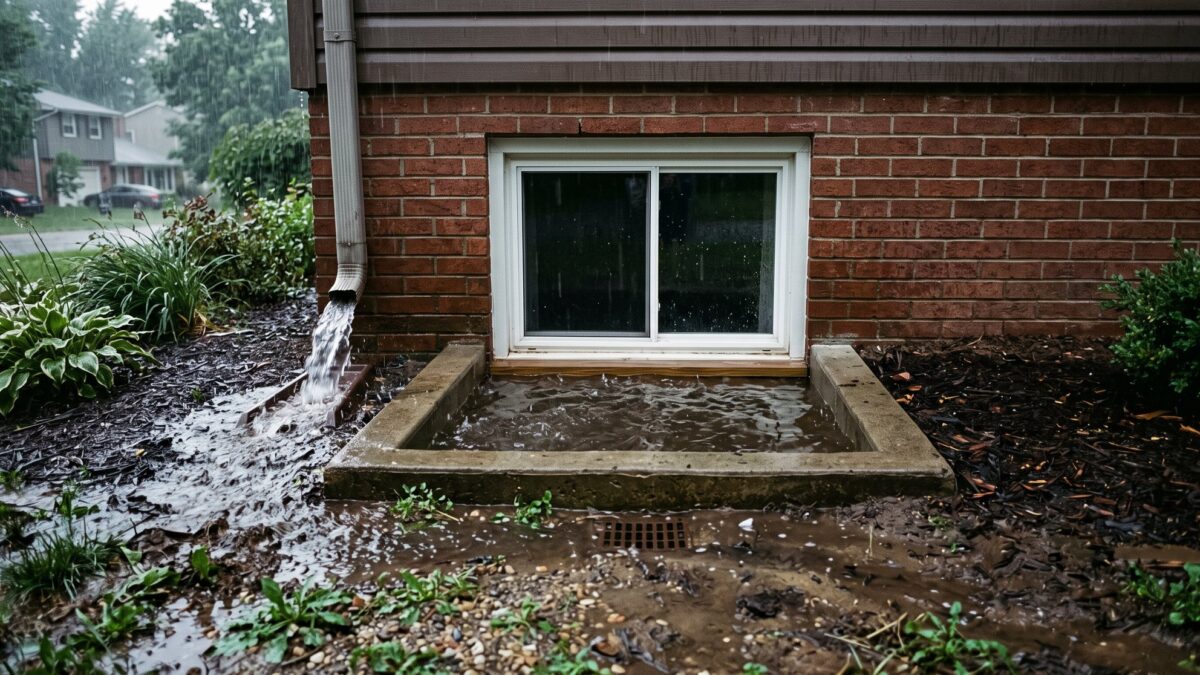
Window wells. A well is a hole in the ground beside your foundation with a drain that silts shut quietly over about a decade. Then it fills, the water climbs to the frame and comes over the sill. A leak under a window in serious rain only: look here first, because this one is often free to fix.
Over the top of the wall. Where the grade has settled or a patio slopes back at the house, surface water runs over the foundation and down the inside face. It starts high, which no groundwater problem ever does.
Up through the floor drain. This one is not seepage at all. If water rises out of the drain in the middle of your floor during the storm and drops back after, you are looking at a sewer issue, and we explain the whole test in why water comes up through a floor drain. No amount of waterproofing addresses it, and any quote that says otherwise is the wrong quote.
What does a hard-rain leak look like in your kind of house?
The era a house was built in narrows the answer faster than anything else we look at.
Pre-war bungalows and two-flats
Stone, brick and early concrete foundations from the 1910s through the 1940s were never waterproofed in any modern sense. They shed light rain through sheer mass and fail in heavy rain at the mortar. Narrow lots put the neighbor’s downspout eight feet from your wall, and gangways funnel storm water down a concrete chute aimed at both foundations. A hard-rain leak here is usually multi-point: two or three damp areas that arrive together and dry together.
Post-war block ranches and Georgians
The 1950s and 60s subdivisions of the south and west suburbs are concrete block on a shallow footing, and block is the material most sensitive to storm duration. One hard hour may not reach you; a two-day soaker fills the cores and you get cove seepage along an entire wall. Watch these walls for a second symptom, because block that saturates repeatedly eventually bows, and then the water fix and the structural fix arrive together.
1980s and 90s poured walls
Poured concrete shrinks as it cures, and a shrinkage crack that behaves for twenty years starts weeping once freeze-thaw has widened it and the grade has settled toward the house. This is the era where a single leak really is a single leak, and urethane crack injection at $450 to $900 per crack ends it in an afternoon with a 10-year warranty behind it. Confirm it is one crack and not the first of several.
Newer subdivision homes
Houses built since the late 1990s in Plainfield, Oswego, Shorewood and the newer parts of Joliet have working perimeter drain tile feeding a builder-grade pump. A hard-rain leak here is usually a pump that cannot keep pace, a discharge line that dumps six feet from the house and comes right back, or first-decade grade settlement. The fix is rarely a full system.
When is this a $30 fix instead of a $10,000 one?
Plenty of hard-rain leaks are not waterproofing jobs, and we would rather say so here than in your driveway.
The gutters are the problem. A clogged gutter does not overflow into the yard, it overflows straight down the wall and into the backfill trench. An hour on a ladder and a $20 extension can end a leak that has bothered you for three summers. Start here every time: we cover the chain in whether fixing your gutters fixes a wet basement.
The window well drain is packed. Pull the gravel, clear the leaf mat, and see whether the well drains. A well cover is under $50. This is the single most common leak we diagnose and decline to sell anything for.
It happened once, in a storm the whole county talked about. A downpour that overwhelmed streets and yards for miles is not proof your foundation failed. Fix any obvious cause, dry it out, and watch the next few storms. One event with an explanation is data, not a diagnosis.
The wet is not water from outside. Walls that feel damp in July on days it did not rain are usually condensation. Warm humid air meeting cold concrete leaves the same dark patches seepage does, and the fix is a dehumidifier, not a contractor. Telling condensation from seepage takes two days and a piece of foil.
How do you figure out which cause is yours?
The storm itself is the diagnostic tool. What you see during the rain, not the mop-up afterward, tells you which column you are in.
| What you see during the storm | What it usually means | The fix | Published cost |
|---|---|---|---|
| Water enters within an hour, at one wall, near a downspout | Surface water reaching the backfill | Extensions, grading, gutter repair | $600 to $2,500 |
| A dark line on a poured wall darkens and weeps | A single active crack | Urethane crack injection | $450 to $900 per crack |
| Water appears under a window only | Blocked or missing window well drain | Clear the drain, add a cover | Often under $50 |
| Floor edges wet along a whole wall, hours in | Failed footing drainage, hydrostatic pressure | Interior drain tile and sump | $95 to $160 per linear foot |
| Pump running nonstop, water still rising | Undersized or unbacked pump | Sump pump with battery backup | $2,800 to $4,500 |
| Water rises from the floor drain, then recedes | Sewer surcharge, not seepage | Licensed plumber, backflow prevention | Not a waterproofing job |
Two details separate the cheap column from the expensive one. Timing: water inside twenty minutes of the rain starting came from the surface, while water that appears four hours in, or the morning after, came up through the ground. Location: one spot points at one defect, while damp along the base of a whole wall points at the drainage under your floor.
What should you do next?
First, put on a coat and watch the next storm. Ten minutes outside during real rain beats an hour of guessing. Look for gutters spilling at a corner, downspouts ending at the wall, wells holding water, and any place the ground slopes back toward the house. This costs nothing and it is the same walk we do on arrival.
Second, keep a storm log. Date, roughly how hard it rained, where water appeared, how long it took to show and how long to dry. Three entries turn “it leaks sometimes” into a pattern anyone can diagnose, and they keep every contractor honest about what needs doing.
Third, have the wall read by someone who has to stand behind the answer. Our inspection is free and we are out within 48 hours with measurements and published-range pricing in writing, including the days we tell you to buy a downspout instead of a system. Try to schedule it near a wet stretch if you can: pick a slot on our free estimate page, or call (630) 335-1128 while the stain on the floor is still fresh enough to photograph.
Questions Chicago homeowners ask about rain-driven leaks
How much rain does it take before a basement leaks?
There is no universal number, because the threshold is set by your soil, your roof area and how well your drainage still works. What matters is that your house has a threshold and you can learn it. Homeowners who log a few storms usually find their leak has a repeatable trigger, often a heavy hour or a second consecutive wet day, and that trigger drops lower every year the drainage keeps degrading.
Why does the water show up hours after the rain stops?
Because it traveled through soil instead of over it. Rain that soaks into clay moves slowly toward your footing, and the water table around the foundation can keep rising well after the sky clears. A delayed leak is strong evidence you are dealing with groundwater and failed footing drainage rather than a gutter or grading problem, which is the more expensive of the two diagnoses.
Why did the water come in at a different spot this time?
Wall defects stay put; water pressure moves. As the backfill saturates from different directions in different storms, the highest pressure lands at different points along the wall, and it exits wherever the concrete is weakest that day. A leak that has migrated to two or three locations over a few seasons has effectively stopped being a patchable defect and started being a perimeter drainage problem.
Can I just wait and see if it stops on its own?
It will stop between storms, which is not the same thing. In this region drainage only degrades: clay tile silts further shut, cracks widen each freeze, and grade continues to settle toward the house. Waiting is a reasonable choice after one explained event in a long-dry basement. It is an expensive choice once the same wall has wet three times, because concrete, mechanicals and stored belongings all pay the interest.
A leak that only appears in hard rain is the easiest kind to diagnose and the easiest kind to ignore, because the evidence dries before anyone shows up. We can get eyes on it free within 48 hours, and whatever we install, from a single injected crack under a 10-year warranty to a full interior system under a lifetime, fully transferable warranty, goes in writing before a tool comes off the truck. Reach us at (630) 335-1128.


