Foundation Repair in Wheaton, Illinois
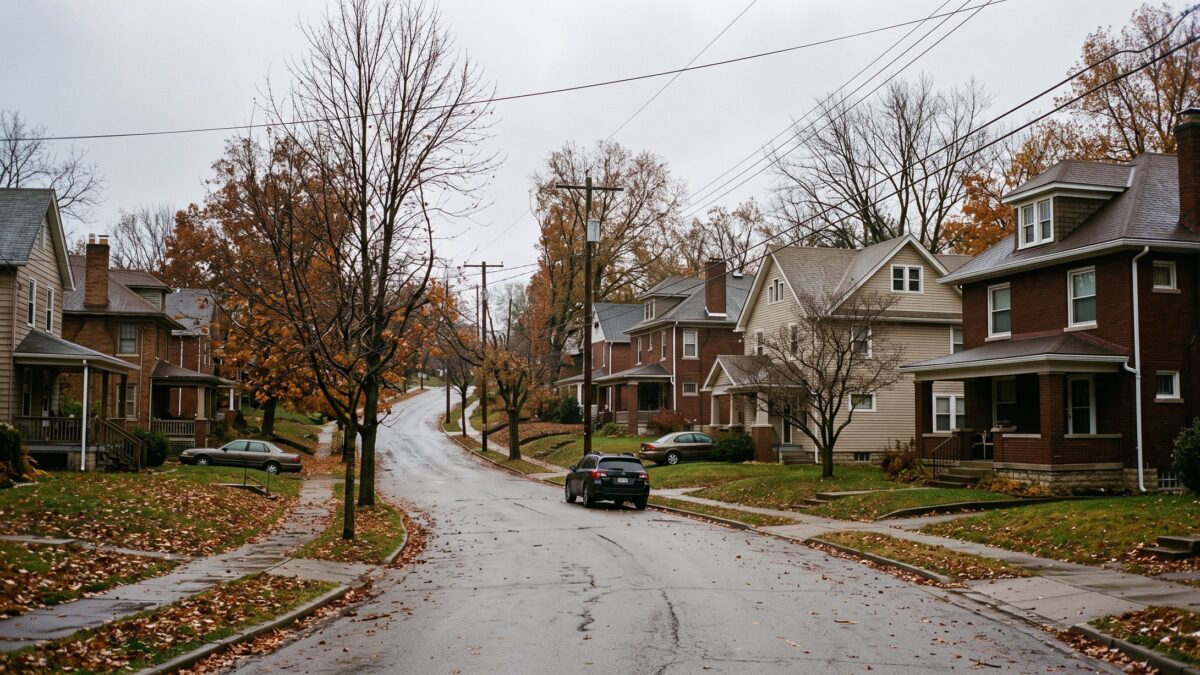
Movement is Wheaton's recurring theme. Hilly ground, clay that swells in April and shrinks in August, a heavy canopy drinking from it, and a core of brick and stone that has ridden those cycles for a century. We measure first, repair what the numbers show, and register the 25-year transferable warranty to the address.
- Injection from $450, piers from $1,600, all published
- 25-year transferable warranty on structural work
- Free measured inspection within 48 hours
 25-year transferable structural warranty
Who does foundation repair in Wheaton?
ProSeal Basement Waterproofing repairs foundations across Wheaton from a base in the Joliet and New Lenox corridor, with central DuPage scheduled in weekly route blocks. Urethane crack injection runs $450 to $900, carbon fiber straps $600 to $1,000 each, steel beams $900 to $1,500, and settlement piers $1,600 to $3,000, every range published before an estimator sees the wall and every repair carried by a 25-year transferable warranty.
Wheaton asks more of a structural contractor than most of DuPage. The core around downtown and the college holds brick and stone foundations dating before 1930, the ring around it is mid-century block, many of those walls retain a grade on a hillside, and the whole town sits under mature trees on clay. Diagnosis here means separating a century of stable history from movement that is actually running.
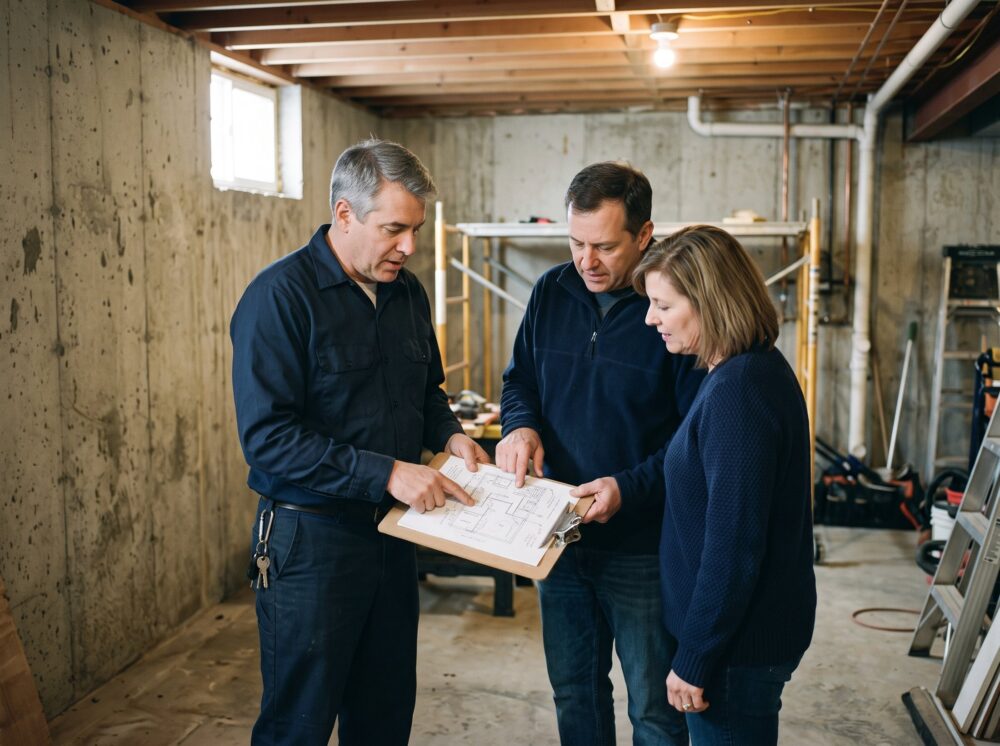 The diagnosis comes with numbers, and the numbers come before the quote.
What does foundation repair in Wheaton include?
Wheaton's three housing eras break in different ways, and these six tools cover all of them. The estimate starts from the least invasive fix that truly solves the problem, and the written plan explains why anything bigger earned its place.
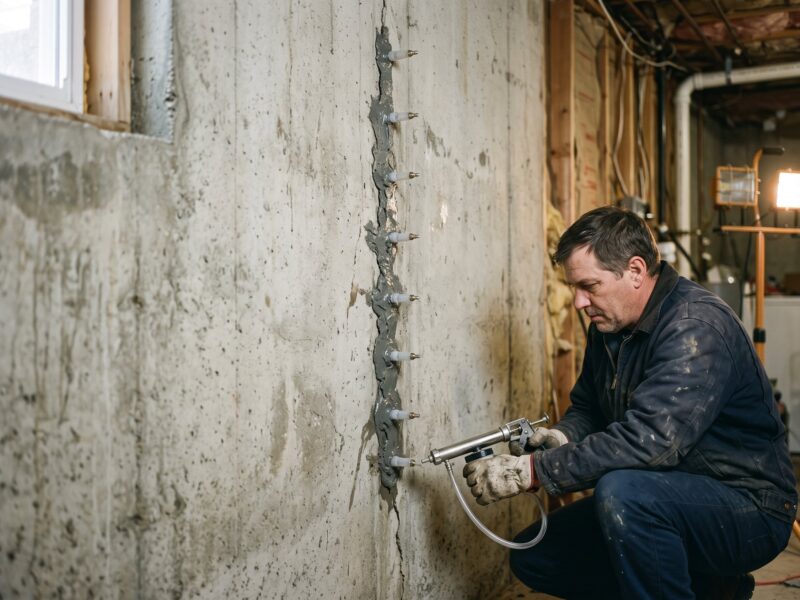 Urethane crack injection
Leaking poured-wall cracks sealed full depth for $450 to $900.
Learn more
Urethane crack injection
Leaking poured-wall cracks sealed full depth for $450 to $900.
Learn more
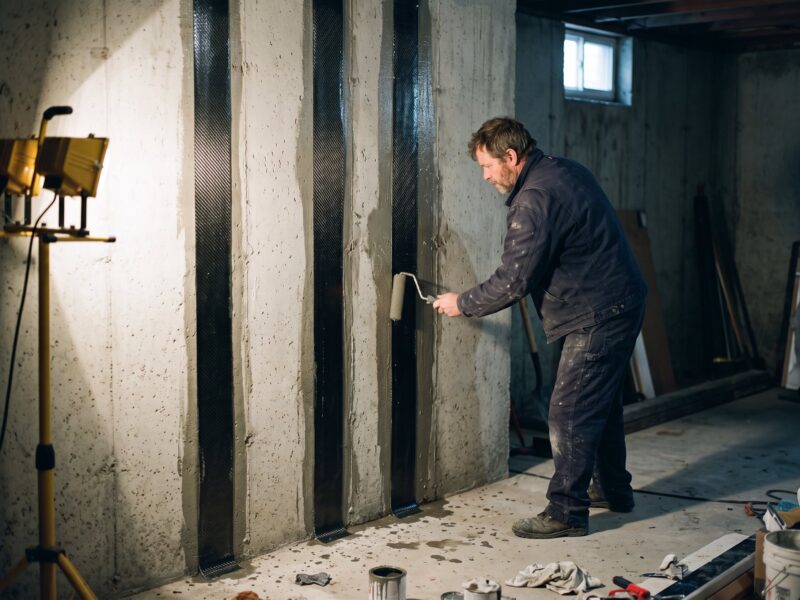 Carbon fiber straps
For block walls on the hillsides, caught while the bow is still small.
Learn more
Carbon fiber straps
For block walls on the hillsides, caught while the bow is still small.
Learn more
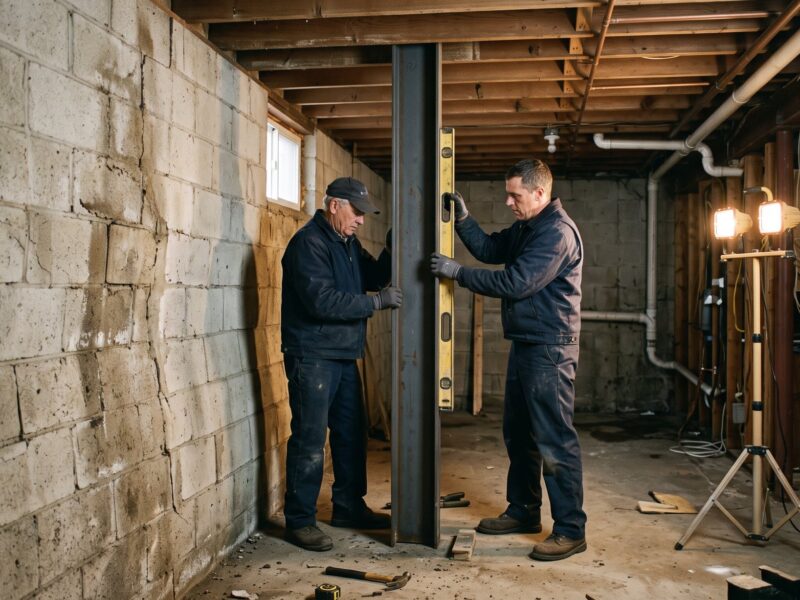 Steel I-beams & wall anchors
For walls retaining a grade that have moved past the carbon stage.
Learn more
Steel I-beams & wall anchors
For walls retaining a grade that have moved past the carbon stage.
Learn more
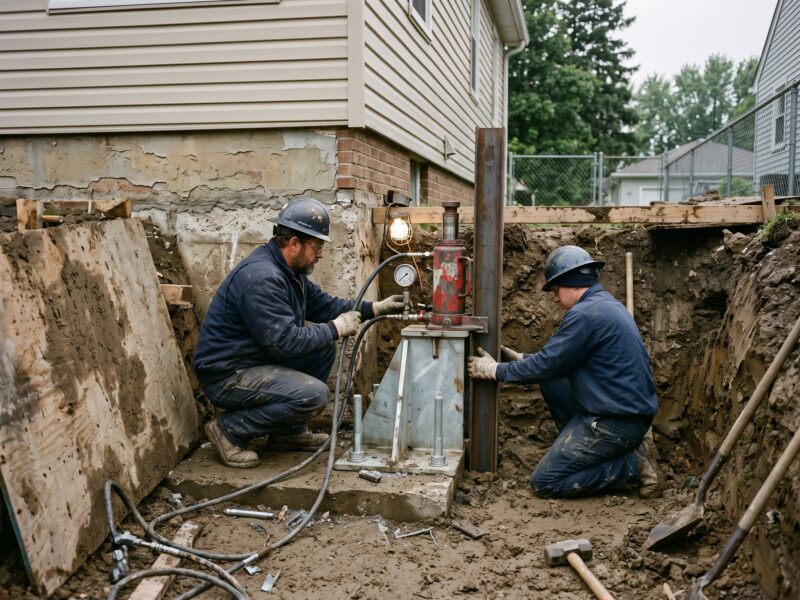 Push & helical piers
For footings dropped by shrinking clay under the canopy.
Learn more
Push & helical piers
For footings dropped by shrinking clay under the canopy.
Learn more
 House leveling
Beams, columns and footings under the old core's sagging floors.
Learn more
House leveling
Beams, columns and footings under the old core's sagging floors.
Learn more
 Not sure what you have?
Read the symptom guide before anyone quotes you steel; a good share of Wheaton's scary cracks are historic and stable.
Learn more
Not sure what you have?
Read the symptom guide before anyone quotes you steel; a good share of Wheaton's scary cracks are historic and stable.
Learn more
Why do Wheaton foundations crack and settle?
Wheaton foundations move for three reasons that rarely share a house: old masonry aging through its mortar, block walls holding back a hillside, and clay shrinking under a mature canopy in late summer.

Brick and stone before 1930
DuPage has few cores this old. Around downtown and Wheaton College, brick and stone foundations fail through mortar loss and moisture cycling rather than dramatic cracking, and they reward patient repointing and drainage relief over any aggressive intervention.

Block walls on the grade
The mid-century ring climbed Wheaton's hills, so thousands of block walls retain earth on their uphill side. Sixty years of lateral clay pressure shows up as horizontal cracking at mid-height, and the earlier it is caught, the cheaper the carbon or steel answer.

Settlement under the canopy
Wheaton's mature trees are half the town's charm and a real structural factor. In a dry August a big root system pulls enough moisture from the clay to drop the nearest footing, and late-summer settlement calls here rival the spring pressure calls.
What makes Wheaton ground move?
Wheaton foundations sit on clay with more relief than nearly any town in DuPage County, and slope multiplies what clay already does. Spring saturation swells the soil and pushes laterally on every wall holding back a grade; August drought shrinks it and lets footings settle, hardest wherever a mature tree draws from the same soil. A single Wheaton block can show both failure modes across four houses.
Era decides the failure vocabulary. The pre-1930 brick and stone of the core moves slowly and speaks through mortar: stair-step lines, dusting joints, a gentle bulge. Mid-century block announces pressure with a horizontal crack. Newer poured walls crack from curing and settlement, and most of those cracks are sealable rather than structural. The inspection reads each wall in its own language and puts numbers on the movement before naming a fix.
 Reading a floor with the laser: movement in numbers, not impressions.
Signs you need foundation repair in Wheaton
Six symptoms bring Wheaton owners to the phone, and the inspection's first job is sorting live movement from a century of settled history. None of the six improves on its own.

A horizontal crack in a wall holding the hill
On a Wheaton grade this means lateral clay pressure is winning. Caught under two inches of bow it is carbon fiber money; ignored, it graduates to steel, anchors and eventually rebuild territory.

Stair-step cracks in brick or block
Cracks that climb the mortar joints map differential movement between one part of the footing and another. Many in the old core stopped moving decades ago; measurement is how you find out.

Sloping floors and doors that quit latching
In the pre-1930 stock this is often a tired beam or column rather than the foundation itself, a repair priced at $1,500 to $3,200 per column instead of five figures.
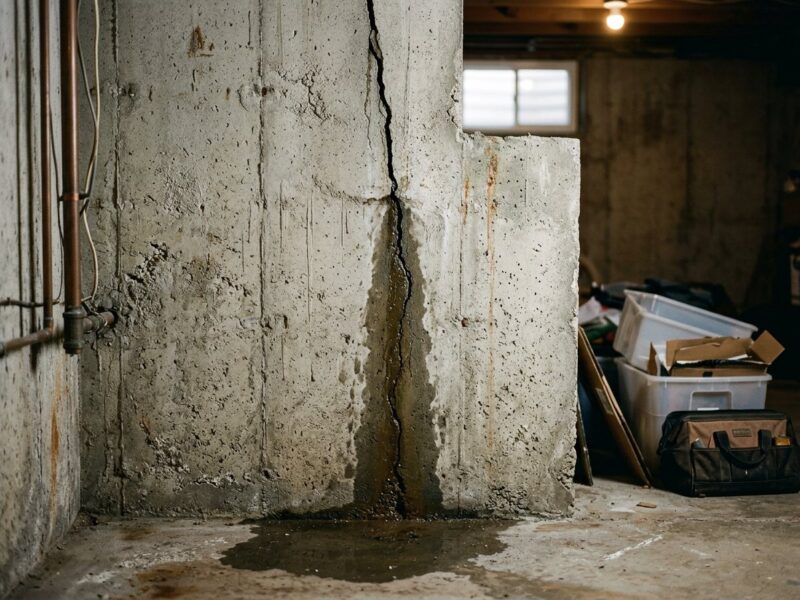
A crack that leaks in spring rain
Poured-wall cracks that run water are usually stable shrinkage cracks with a moisture problem. Injection seals them full depth for $450 to $900 once the inspection confirms nothing structural.

Dusting mortar and soft joint lines
Old masonry sheds its mortar before it sheds its shape. Powder at the joints and a screwdriver that sinks in mean the wall is asking for repointing while repointing is still enough.

A gap opening after a dry summer
A stoop, garage or addition pulling away in September points at clay shrinkage under its footing, often with a nearby tree in the story. Elevations tell whether it is still moving.
Stair-step crack above the sill getting longer? Get numbers on it before spring swells the clay again. The measured inspection is free.
How does foundation repair work in Wheaton?
A Wheaton foundation repair runs four steps: read the era, measure the movement, match the method, verify the result. Most repairs finish in one to three days on site.
Read the era, then the wall
Brick, stone, block or poured changes the whole diagnosis, so the inspection identifies the construction first, then records crack widths, bow and floor elevations. Free, scheduled within 48 hours.
Day 0Separate live movement from history
Wheaton walls carry a century of old, finished movement. Where the numbers are ambiguous we would rather set a monitoring baseline than sell steel to a stable wall.
Day 0, same visitRepair and re-measure
Straps, beams, piers or masonry work go in to spec, and the crew re-checks against the day-zero numbers before leaving. Pier installs log depth and pressure at every bracket.
Days 1 to 3Warranty registered to the address
The 25-year transferable warranty follows the house rather than the owner, and the measurement packet goes in your closing file for the day a buyer's inspector asks.
On completionReinforce or rebuild: what do Wheaton walls really need?
Most Wheaton walls that worry their owners can be reinforced where they stand, and the town's own features argue for it: hillside lots complicate excavation, the canopy is worth protecting, and the old core's masonry deserves gentler hands than a demolition crew.
| Reinforce in place | Excavate and rebuild | |
|---|---|---|
| Best for | Bowing, cracked or settling walls still intact, the large majority | Sheared, collapsing or fully failed walls, a small minority |
| On pre-1930 masonry | Repointing, relief and reinforcement work with the wall | Excavation beside old brick and stone risks the wall being saved |
| On a hillside lot | Interior work and small pier pits ignore the slope | Machine access on a grade is slow, destructive and priced that way |
| Under mature trees | No excavation in the root zone the canopy depends on | Trenching a root zone can cost the tree along with the yard |
| Cost | From $450 injections to $3,000 piers, published | Tens of thousands per wall before the landscaping bill |
| Warranty | 25-year transferable, registered to the address | Scope-dependent; insist on it in writing before signing |
When a wall is genuinely past reinforcement we say so with the measurements that prove it, and we price the rebuild honestly.
When do Wheaton foundations move?
Wheaton foundation movement runs on the clay's calendar, and slope and canopy sharpen both ends of it. Every season has a cheapest moment to act.
Spring: push season
Saturated clay swells and shoves on every wall retaining a grade, which in hilly Wheaton is a lot of walls. Horizontal cracks widen, bows advance, and measurements taken now catch movement at its most visible.
March to MaySummer: shrink season
Drought pulls moisture out of the clay, the canopy pulls harder, and footings drop. Gaps open at stoops and additions, doors stick upstairs, and the settlement side of Wheaton's ledger does most of its yearly business.
June to AugustFall: measurement season
The clay goes quiet, the weather cooperates, and repairs booked now finish before frost. The best months of the year to brace a hillside wall or drive piers without the calendar pushing.
September to NovemberWinter: indoor season
Frost locks the top of the ground, but injection, carbon fiber, steel bracing and column work all happen inside the basement at full speed. Winter scheduling in the DuPage block is the fastest of the year.
December to FebruaryHow much does foundation repair cost in Wheaton?
Foundation repair in Wheaton costs $450 to $900 per injected crack, $600 to $1,000 per carbon fiber strap, $900 to $1,500 per steel beam, and $1,600 to $3,000 per pier, the same ranges we publish for every town we serve. Repointing on the old core's brick and stone is scoped at the free inspection, because masonry hours depend on the wall.
| Work | Range | What moves the number |
|---|---|---|
| Urethane crack injectionper crack | $450–$900 | Crack length and width, access to the full height |
| Carbon fiber strapsper strap | $600–$1,000 | Wall height, spacing the deflection requires |
| Steel I-beam wall bracingper beam | $900–$1,500 | Ceiling height, footing condition at the base |
| Push or helical piersper pier | $1,600–$3,000 | Depth to load-bearing strata, access for equipment |
The full structural table sits on the pricing page, and a written Wheaton quote always lands inside it.
Where we repair foundations in Wheaton
The structural calls track Wheaton's map cleanly. The downtown historic core and the college blocks send mortar questions on brick and stone. The mid-century streets around Northside Park and the hillier ground send block walls retaining a grade, carbon fiber and steel work. The Roosevelt Road and Gary Avenue corridors mix the eras, the newer edges send settlement checks and injections, and both ZIPs, 60187 and 60189, sit in our second ring.
Monitoring still works at this distance because central DuPage runs as a standing block: when a wall earns watching rather than steel, the re-measure folds into a scheduled Wheaton route day. The drive is forty-five minutes to an hour from our base, and we make it constantly.
 Wheaton stock spans a century; the diagnosis has to know which one it is looking at.
Wheaton foundation repair questions, answered straight
What does a stair-step crack in my Wheaton brick foundation mean?
It means differential movement. Mortar is weaker than brick, so the crack follows the joints when one part of the footing moves relative to another. The cause can be a settled footing, clay shrinkage under a nearby tree, or movement that finished decades ago, and a good share of the old core's stair-steps are historic and stable. That is exactly what the measurement determines.
Is repointing enough for my old foundation, or does it need underpinning?
Repointing fixes the crack; it does not fix the reason the crack exists. If the movement has stopped, repointing is the complete and honest answer. If it is ongoing, new mortar will crack again within a few years and underpinning becomes the real recommendation. Telling those apart takes measurements across a season, and we show you how to read them.
How much does foundation repair cost in Wheaton?
Published, and identical to every town on our map: injection $450 to $900 per crack, carbon fiber $600 to $1,000 per strap, steel beams $900 to $1,500, wall anchors $1,000 to $1,800, piers $1,600 to $3,000 each. Masonry restoration on pre-1930 walls is quoted after the inspection because no two old walls carry the same scope.
Can a mature tree really damage my foundation?
Not by pushing on it, but by drinking near it. A large tree in a dry Wheaton August pulls serious moisture from the clay, the soil shrinks, and the closest footing settles a little more each drought year. We do not tell people to cut beloved trees; we measure, and where the movement is real, piers carry the footing below the root zone's influence.
My basement wall holds back the hill behind the house. Should I worry?
Not automatically, but that wall works harder than the other three, so its cracks deserve attention sooner. A horizontal line at mid-height means the clay is winning and the wall should be measured now, while the fix is $600 to $1,000 straps rather than anchors and excavation. Vertical hairlines are usually just concrete being concrete.
Does past foundation repair hurt resale in Wheaton?
A documented repair usually beats an undiagnosed crack in a buyer's eyes, especially in a town full of century-old foundations. Our repairs close with measurements, photos and a 25-year transferable warranty registered to the address, which gives the listing agent a folder instead of an apology.
Do I need a permit for foundation repair in Wheaton?
It depends on the scope, and requirements vary by municipality. Cosmetic and minor repairs often need none, while structural work such as piers or wall reinforcement frequently does. Where a permit is required we pull it as part of the job, and the paperwork lands in the same closing file as the warranty.
You are based near Joliet. Can you actually monitor a Wheaton wall over time?
Yes, because central DuPage runs as a standing route block rather than a one-off trip. A monitoring baseline gets set at the free inspection, and re-measures fold into scheduled Wheaton days. The drive is forty-five minutes to an hour, and it happens constantly either way.
Is the cracked wall also wet in spring?
On Wheaton's grades the same lateral flow that loads a wall with water is the pressure moving it, and old mortar that weeps is old mortar dissolving. When a stair-step line and a damp floor edge show up together, one visit scopes both trades and sequences the fixes in the right order.
Basement Waterproofing in Wheaton
Foundation repair near Wheaton

Get the Wheaton wall measured before the clay moves again
A free structural inspection within 48 hours, a repair matched to brick, block or poured, and a 25-year transferable warranty that follows the house.
Or talk to a human right now
(630) 335-1128
Request your free estimate
Tell us what you're seeing. We'll call back fast and be out within 48 hours.