
Foundation Repair in Frankfort, Illinois
Frankfort builds tall walls and buries them deep, then asks heavy clay to behave. When it does not, we measure the movement, match the repair to the wall, and back it with a 25-year transferable warranty. Injection from $450, piers from $1,600, all published.
- Structural warranty: 25-year transferable
- Published pricing: injection from $450, piers from $1,600
- Free structural inspection within 48 hours
 25-year transferable warranty
Who does foundation repair in Frankfort?
ProSeal Basement Waterproofing repairs Frankfort foundations from a base in the Joliet and New Lenox corridor, fifteen to twenty-five minutes away. Crack injection runs $450 to $900, carbon fiber straps $600 to $1,000 each, steel beams $900 to $1,500, and settlement piers $1,600 to $3,000, every number published before an estimator sees your wall, every repair backed by a 25-year transferable warranty.
The Frankfort house asks more of its foundation than most. A deep pour holds back two extra feet of clay along its whole length, a walkout carries full lateral load on one elevation and almost none on the opposite one, and both conditions concentrate stress in ways a shallow tract basement never sees. Diagnosing that correctly is the job; the invoice follows the measurement, not the other way around.
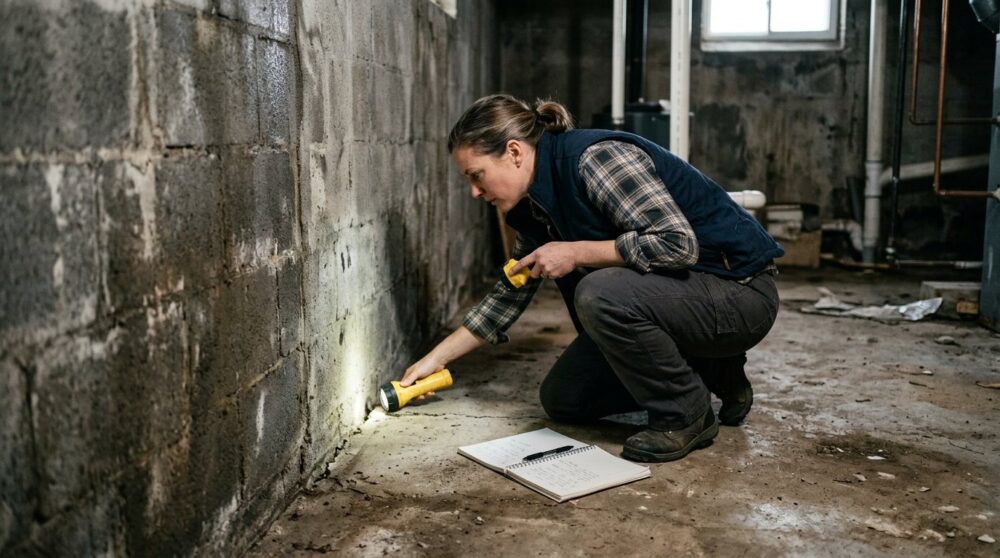 Numbers before steel: every Frankfort repair starts with a measured wall.
What does foundation repair in Frankfort include?
Six structural tools handle what Frankfort clay and Frankfort construction produce, and the written plan always starts from the cheapest fix that actually solves it.
 Urethane crack injection
Curing and settling cracks in tall pours, sealed in a morning.
Learn more
Urethane crack injection
Curing and settling cracks in tall pours, sealed in a morning.
Learn more
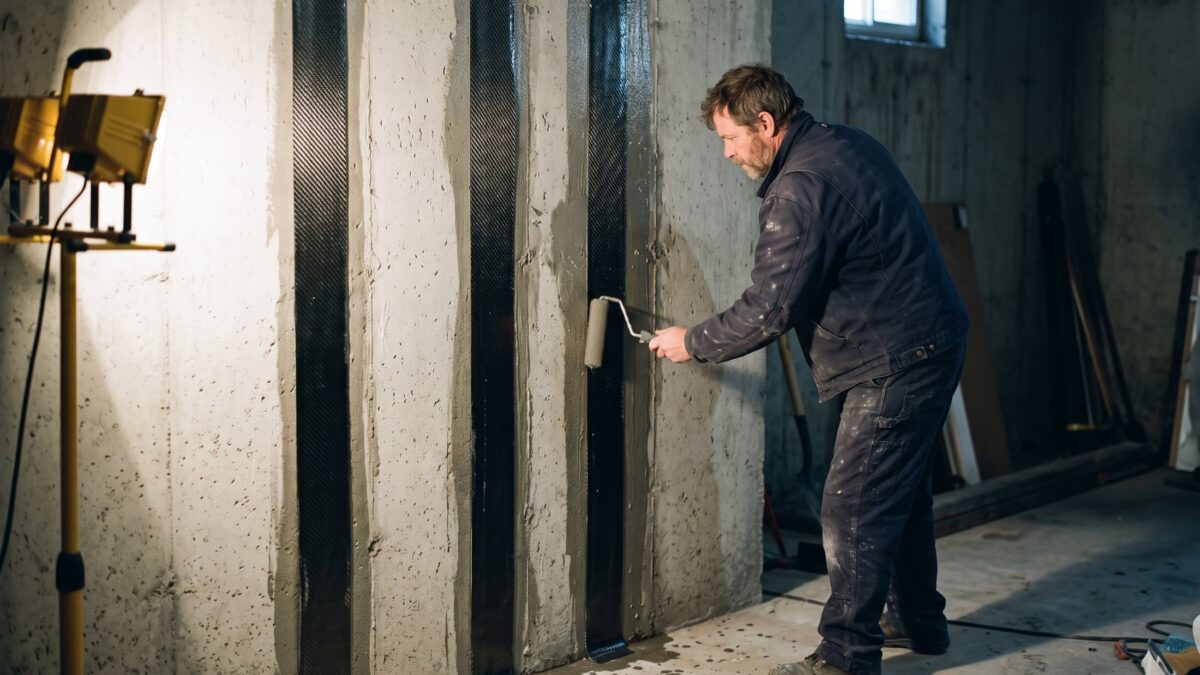
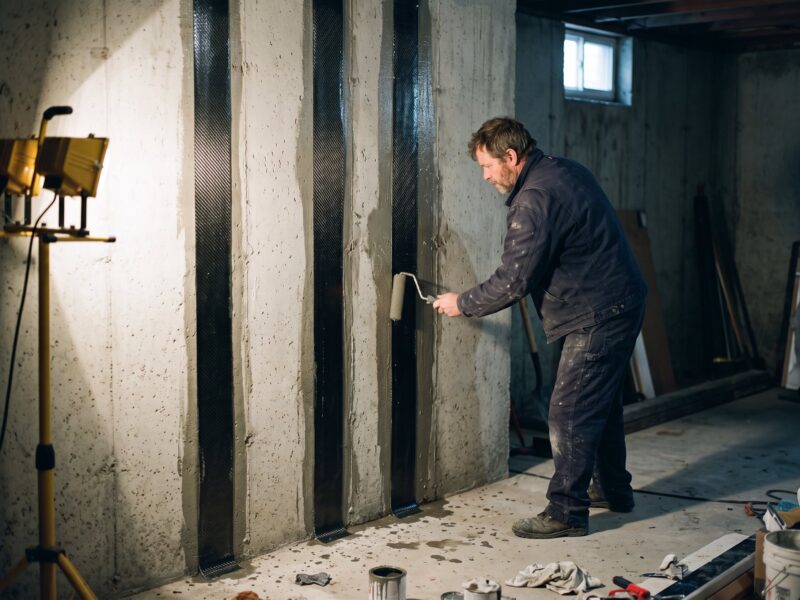 Carbon fiber straps
For deep walls caught while the deflection is still small.
Learn more
Carbon fiber straps
For deep walls caught while the deflection is still small.
Learn more
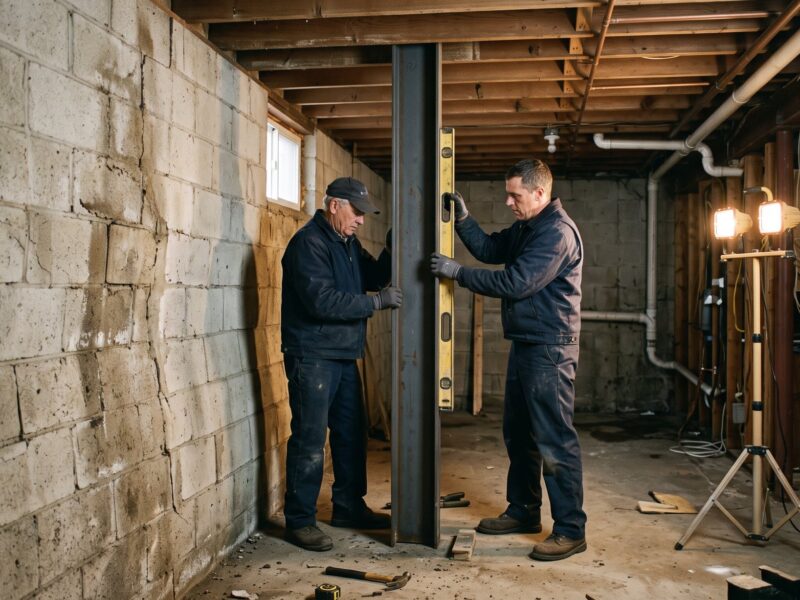 Steel I-beams & wall anchors
For walls the clay has pushed past the carbon fiber stage.
Learn more
Steel I-beams & wall anchors
For walls the clay has pushed past the carbon fiber stage.
Learn more
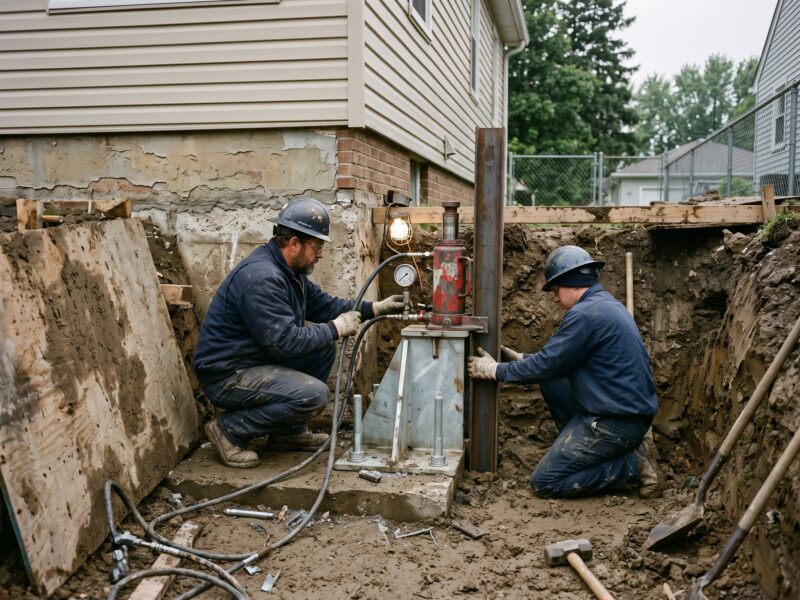 Push & helical piers
For settlement in the engineered clay under the newer streets.
Learn more
Push & helical piers
For settlement in the engineered clay under the newer streets.
Learn more
 House leveling
Beams and columns under long spans and sagging older floors.
Learn more
House leveling
Beams and columns under long spans and sagging older floors.
Learn more
 Not sure what you have?
Check what deep-basement cracks mean before the estimate visit.
Learn more
Not sure what you have?
Check what deep-basement cracks mean before the estimate visit.
Learn more
Why do Frankfort foundations crack?
Frankfort foundations crack because of how they were built: taller walls carrying more clay load, walkout and lookout designs loaded unevenly by intent, and an older downtown stock on the low ground that has been settling longest. Each failure mode has its own correct repair.
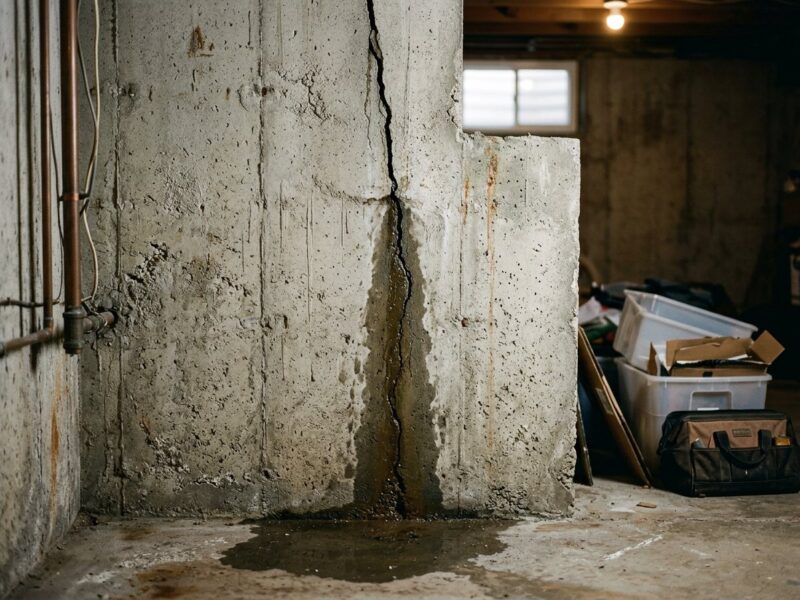
The deep pours
A nine-foot wall carries measurably more lateral soil load than a standard one, along every foot of its run. Heavy clay swelling against that height finds shrinkage cracks first and mid-height weaknesses second, which is why deep walls reward early measurement.

Walkouts and lookouts
A walkout foundation is deliberately unbalanced: one elevation buried and loaded, the opposite one open at grade. The stress collects at the stepped transition corners, and that is where these homes crack, right where the tall wall meets the short one.

The old town on the low ground
Around Breidert Green and along the Old Plank Road Trail corridor, older foundations sit in the wettest soil in the village. Decades of moisture cycling show up as stair-step cracks, tired beams and floors that have drifted out of level.
What makes Frankfort ground move?
Frankfort sits on heavy clay, and heavy clay is a material with moods: it swells hard against basement walls in wet springs and shrinks away from footings in dry summers. The deep basements common here reach further into that clay than most Chicago-area foundations do, so they collect more of both behaviors, more push against the wall face in April and more risk of a dropping footing in August.
The newer subdivisions add a second variable: they stand on ground that was graded and filled when the streets went in, and engineered fill keeps adjusting under load for years. Most of that movement is small and finished; some of it is active, and active is what piers are for. An elevation survey tells the difference in an afternoon, which beats guessing with either your money or your house.
 Graded clay and engineered fill: the ground most of new Frankfort stands on.
Signs you need foundation repair in Frankfort
Six symptoms account for most Frankfort structural calls, and every one is cheapest at the moment it first appears. None of them is improved by another winter.

A horizontal crack at mid-height
The one that matters most: clay pressure actively deflecting the wall inward, and taller walls give it more leverage. Early it is carbon fiber money; late it is steel and anchors.

Stair-step cracks near a corner
On walkouts these cluster at the stepped transition where tall wall meets short. The pattern records differential movement, and its width and direction tell us how much.

Doors out of square, floors off level
When interior doors stop latching and trim gaps open upstairs, something below has moved. Often it is a beam or column rather than the foundation, a far cheaper repair.
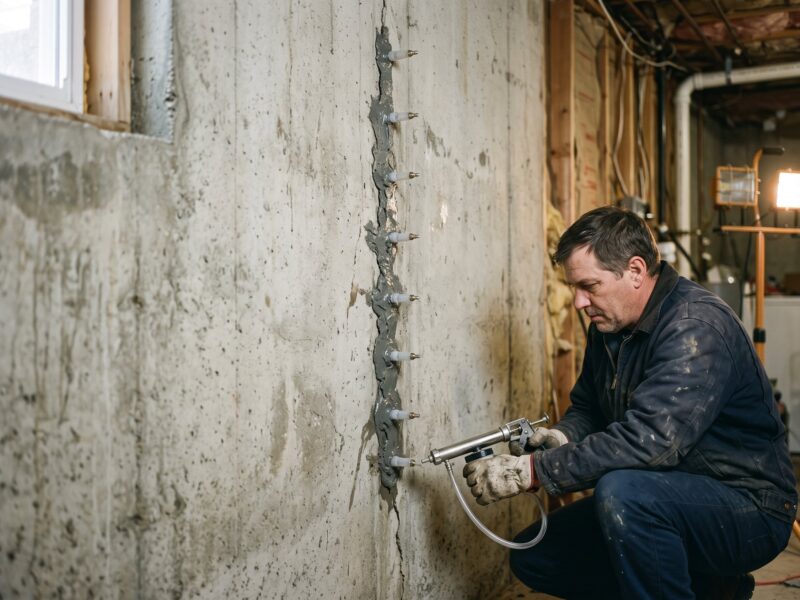
A vertical crack that widens
Vertical cracks in poured walls start as curing shrinkage and are usually $450 to $900 injection work. The measurement matters because a widening crack is telling a different story.

Bounce or sag over long spans
Big Frankfort floor plans mean long joist spans and hardworking beams. A bouncy great-room floor is usually a support problem solved with columns and steel, not a foundation crisis.
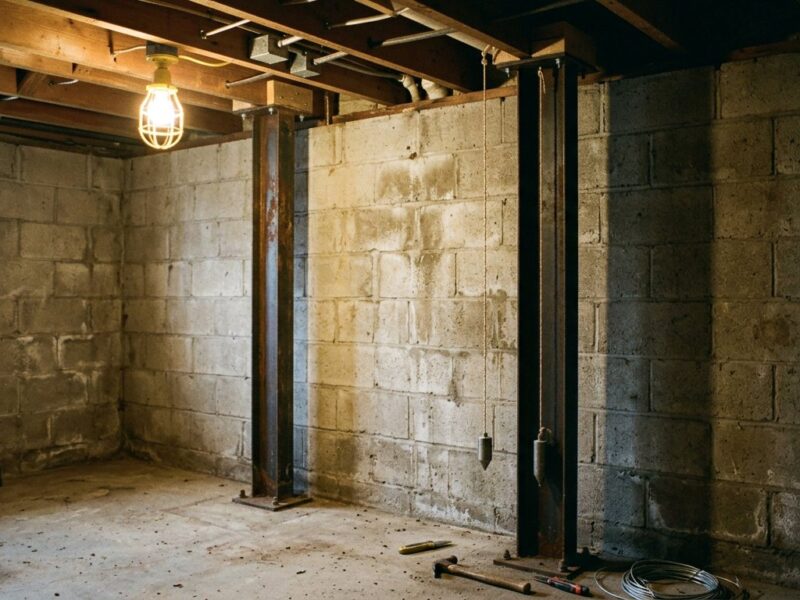
A gap at a stoop, garage or addition
When an attached slab or addition pulls away from the house, its footing is settling separately. Active separation is pier territory; the elevation survey proves it either way.
Crack at the walkout corner growing each season? Get numbers on it before the clay moves again. The structural inspection is free.
How does foundation repair work in Frankfort?
Four steps carry a Frankfort repair from phone call to warranty, and most jobs finish inside three days. First-ring scheduling keeps every step short.
Measure the whole elevation
Deep walls and walkout steps hide stress a glance misses, so we map crack widths, wall deflection and floor elevations in numbers, not adjectives. Free, within 48 hours.
Day 0Match the repair to the load
Injection for stable cracks, carbon fiber for early deflection, steel or anchors past that, piers where the survey shows active settlement. The plan states the reasoning and the published price.
Day 0, same visitInstall and re-measure
The crew installs, torques to specification and checks the finished work against the day-zero numbers before leaving. Pier work logs drive pressure at every bracket.
Days 1 to 3Paper the repair
The 25-year transferable warranty registers to the address with the measurements and photos behind it, a file that follows the house through any future Frankfort closing.
On completionReinforce or rebuild: what do Frankfort walls actually need?
Almost every moving Frankfort wall can be reinforced where it stands, and the local construction argues for it: excavating a nine-foot wall or a walkout elevation buried under a deck is a far bigger undertaking here than in a shallow-basement town.
| Reinforce in place | Excavate and rebuild | |
|---|---|---|
| Best for | Cracked, deflecting or settling walls still structurally sound, the large majority | Walls sheared, collapsing or beyond reinforcement, a rarity |
| On deep pours | Carbon fiber and steel work at any wall height from inside | Every extra foot of depth adds excavation, shoring and cost |
| On walkouts | Interior methods leave the patio, deck and stairs untouched | The loaded wall usually sits directly under the hardscape |
| Finished basements | Targeted access through the affected wall sections only | Outside work spares drywall but consumes the landscaping |
| Cost | $450 injections to $3,000 piers, per published ranges | Tens of thousands per wall before the yard goes back together |
| Warranty | 25-year transferable, registered to the house | Varies with scope; insist on it in writing first |
A rebuild quote without deflection numbers behind it deserves a second opinion. Ours is free and arrives with the measurements.
When do Frankfort foundations move?
The clay under Frankfort runs on a seasonal cycle, and each quarter of it has a smartest move. Getting ahead of the calendar is the cheapest structural decision available.
Spring: load season
Saturated clay swells against every buried wall, and deep pours take the most force. Horizontal cracks announce themselves now, which makes spring the season measurements are most revealing.
March to MaySummer: drop season
Drought shrinks the clay away from footings, and the filled ground under the newer streets does its settling. Cracks over windows and sticking doors are summer's signature here.
June to AugustFall: repair season
Stable soil, dry sites and open calendars make fall the ideal window to strap a wall or drive piers, with the work verified before the ground freezes.
September to NovemberWinter: indoor season
Injection, carbon fiber, bracing and column work all happen inside the basement at full speed, whatever the frost is doing. Winter is the quiet-calendar bargain for interior structural work.
December to FebruaryHow much does foundation repair cost in Frankfort?
Foundation repair in Frankfort costs $450 to $900 per injected crack, $600 to $1,000 per carbon fiber strap, $900 to $1,500 per steel beam, and $1,600 to $3,000 per pier, the identical published ranges we hold in every town we serve. Deep walls sometimes need more straps or beams per run, and the written plan counts them in front of you.
| Work | Range | What moves the number |
|---|---|---|
| Urethane crack injectionper crack | $450–$900 | Crack length and width, access to the full height |
| Carbon fiber strapsper strap | $600–$1,000 | Wall height, spacing the deflection requires |
| Steel I-beam wall bracingper beam | $900–$1,500 | Ceiling height, footing condition at the base |
| Push or helical piersper pier | $1,600–$3,000 | Depth to load-bearing strata, access for equipment |
The full structural table lives on the pricing page; your written Frankfort quote lands inside it.
Where we repair foundations in Frankfort
Structural calls across ZIP 60423 sort by construction era. The newer subdivisions in the Lincoln-Way East area and off Wolf Road and Harlem Avenue send deep-wall cracks, walkout corner movement and settlement questions about filled ground. The historic blocks around Breidert Green and the Old Plank Road Trail corridor send stair-step cracks, beam and column work and the patient judgment older low-ground foundations deserve. The Route 30 corridor splits the difference.
First-ring distance changes structural work in a specific way: monitoring is real. When a wall deserves watching before it deserves steel, we return and re-measure it on schedule, because Frankfort is fifteen to twenty-five minutes from the shop and we pass through constantly.
 Close enough to come back: monitoring visits are the first-ring advantage.
Frankfort foundation repair questions, answered straight
Why do walkout basements crack at the corners?
Because the design loads them unevenly on purpose. One elevation carries full clay pressure, the opposite one carries almost none, and the stepped walls between them absorb the difference. Stress concentrates at those transitions, so that is where cracks appear. Repair usually means reinforcing the transition, not rebuilding the wall.
Are deep basement walls more likely to bow?
They face more force. Lateral soil pressure increases with depth, so a nine-foot wall carries a heavier push at mid-height than a standard pour in the same clay. Deep walls are also built stronger, so most never move; the point is that when one does, it deserves prompt measurement rather than another season of waiting.
My newer Frankfort house has cracks over the windows. Should I worry?
Measure before worrying. The newer streets stand on graded and filled clay that commonly adjusts through a house's first decades, and most of those cracks are finished moving. An elevation survey shows whether settlement is active; if it is, piers at $1,600 to $3,000 each end it, and if not, sealing the cracks is the honest answer.
How much does foundation repair cost in Frankfort?
The published structural ranges apply unchanged: $450 to $900 per injected crack, $600 to $1,000 per carbon strap, $900 to $1,500 per steel beam, $1,000 to $1,800 for wall anchors and $1,600 to $3,000 per pier. What varies in Frankfort is quantity, since taller walls and bigger footprints can need more units per run.
Will a repaired foundation hurt my Frankfort resale?
Documented repair typically helps it. Frankfort buyers pay for finished basements and their inspectors look hard at the walls behind them; a 25-year transferable warranty registered to the address, with measurements and photos attached, converts a scary line item into a closed file. An unexplained crack is what stalls a deal.
Does homeowners insurance cover foundation repair in Frankfort?
Rarely. Standard Illinois policies exclude soil movement and hydrostatic pressure, which between them cause nearly all foundation damage. Budget as if insurance will not participate, which is the strongest argument for catching a deflecting wall at the $600 carbon fiber stage rather than the steel and anchor stage.
Do I need a permit for foundation repair in Frankfort?
Structural work generally involves the village building department, and requirements depend on the method and scope. We handle the paperwork conversation as part of the job rather than leaving it on your desk, and the plan we file is the same measured plan you approved.
Can you keep an eye on a crack instead of repairing it now?
Yes, and in Frankfort we genuinely do it. Not every crack earns immediate steel; some earn gauges and a return visit after the next wet season. Because the village is in our first ring, scheduled re-measurement is a real service here, and plenty of monitored walls never need more than the monitoring.
Is the cracked wall also wet?
The clay pushing a Frankfort wall inward is the same clay holding groundwater against it, so cracks and seepage tend to arrive as a pair, especially on deep pours and walkout elevations. If the wall that moved also leaks in spring, one free inspection scopes both trades and sequences the fixes correctly.
Basement Waterproofing in Frankfort
Foundation repair near Frankfort

Get the Frankfort wall measured before the clay moves again
A free structural inspection within 48 hours, a repair matched to deep pours, walkout corners or settling fill, and a 25-year transferable warranty that transfers with the house.
Or talk to a human right now
(630) 335-1128
Request your free estimate
Tell us what you're seeing. We'll call back fast and be out within 48 hours.