Foundation Repair in Oswego, Illinois
One of the fastest-growing towns in Illinois built almost all of its houses on former farmland in under two decades, and that clay is still finishing the job of carrying them. Consolidation settlement, dropped stoops and teenage shrinkage cracks are Oswego's structural signature, and measuring them is where every honest repair starts.
- Free structural inspection within 48 hours
- Published pricing: injection from $450, piers from $1,600
- Repairs registered with a 25-year transferable warranty
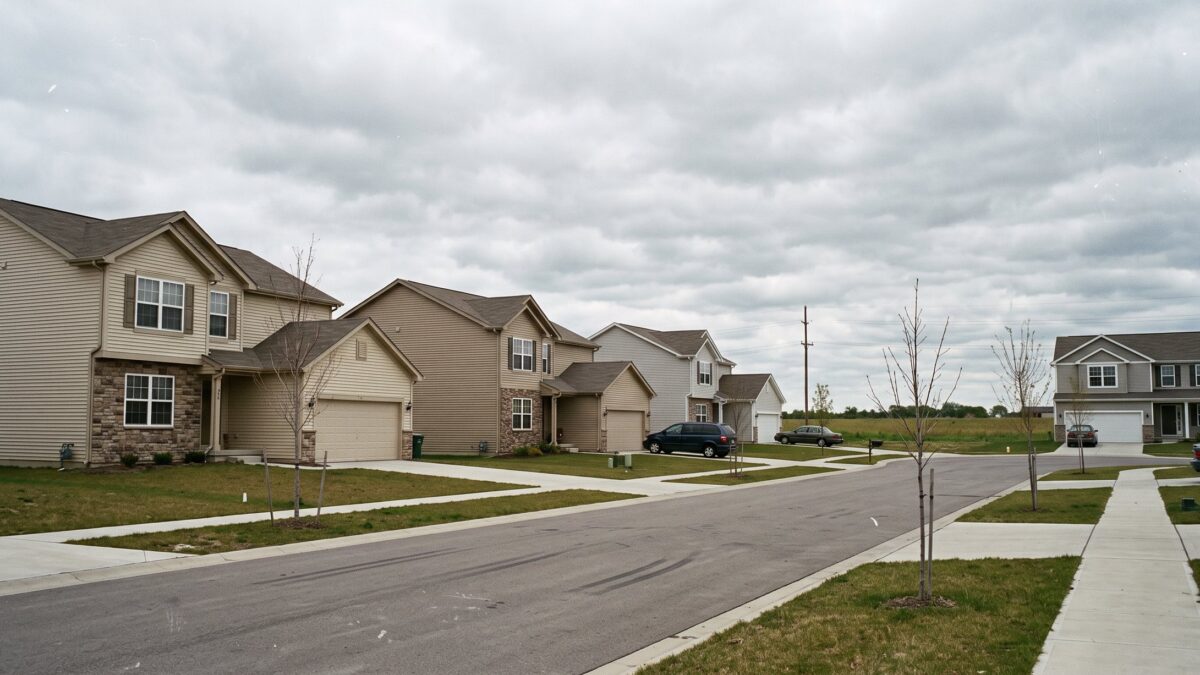 Structural work warrantied 25-year transferable
Who does foundation repair in Oswego?
ProSeal Basement Waterproofing provides foundation repair across Oswego, with urethane crack injection at $450 to $900, carbon fiber reinforcement at $600 to $1,000 per strap, and push or helical piers at $1,600 to $3,000 each, every price published before the first measurement is taken. Structural work carries a 25-year transferable warranty registered to the house.
The expertise Oswego needs is young-house expertise. A town that added most of its housing between about 1998 and 2015 produces a specific caseload: consolidation settlement in graded farm clay, shrinkage cracks reaching the age where they leak, and stoops and garages drifting away from foundations that are themselves fine. Telling the cosmetic from the structural in a fifteen-year-old house is a measuring job, and the measurement is what we sell first.
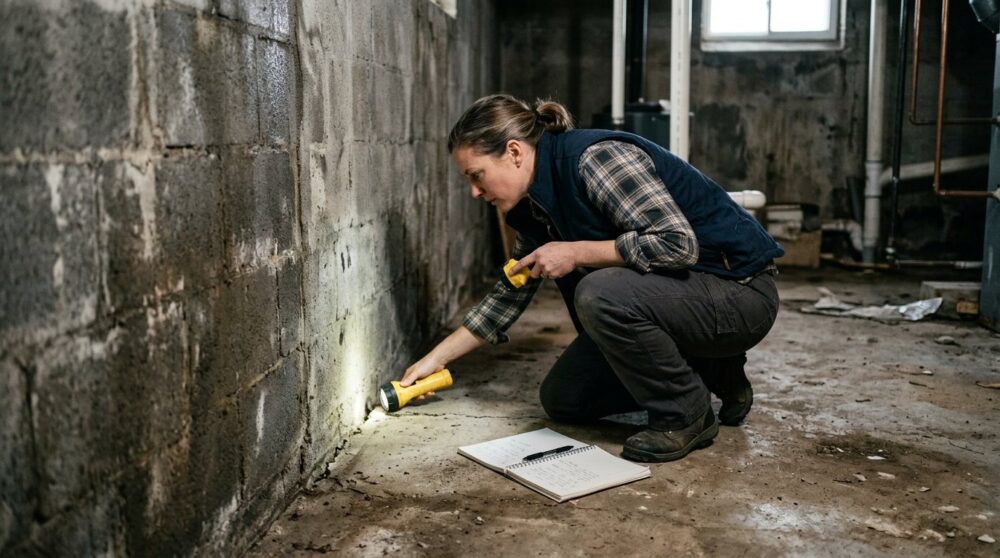 Elevations first: young houses earn a verdict in numbers, not adjectives.
What does foundation repair in Oswego include?
Six structural tools cover what Oswego's housing stock actually breaks, and the written plan always reaches for the cheapest one that holds. In a young town, that is often an injection or a pier or two, not a whole-wall campaign.
 Urethane crack injection
Teenage shrinkage cracks sealed full depth for $450 to $900, in a morning.
Learn more
Urethane crack injection
Teenage shrinkage cracks sealed full depth for $450 to $900, in a morning.
Learn more
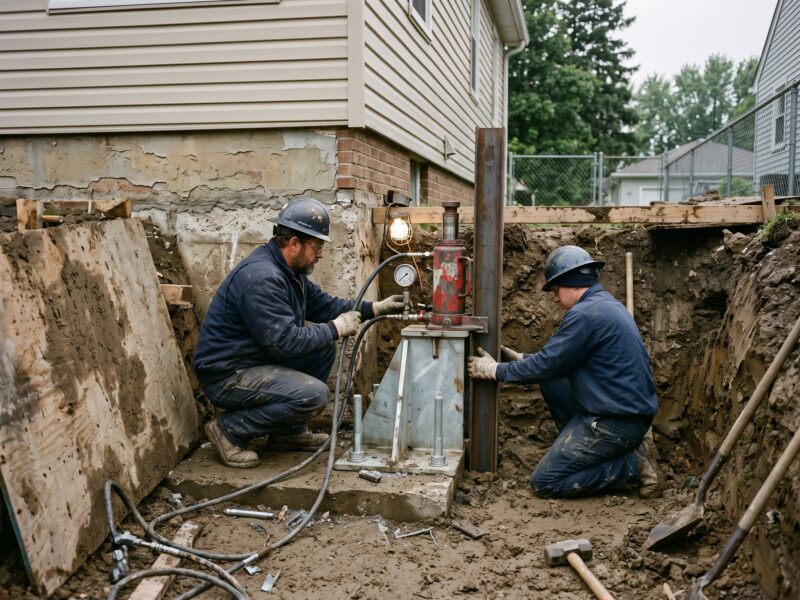 Push & helical piers
The permanent answer when farm-clay settlement is still active.
Learn more
Push & helical piers
The permanent answer when farm-clay settlement is still active.
Learn more
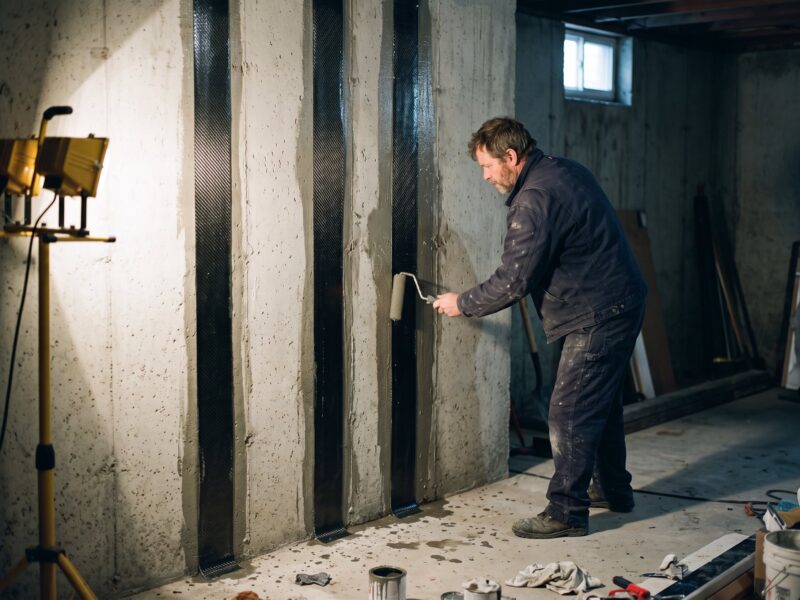 Carbon fiber straps
Reinforcement for the rare Oswego wall showing inward movement.
Learn more
Carbon fiber straps
Reinforcement for the rare Oswego wall showing inward movement.
Learn more
 House leveling
Beams, columns and footings under floors that have drifted out of plane.
Learn more
House leveling
Beams, columns and footings under floors that have drifted out of plane.
Learn more
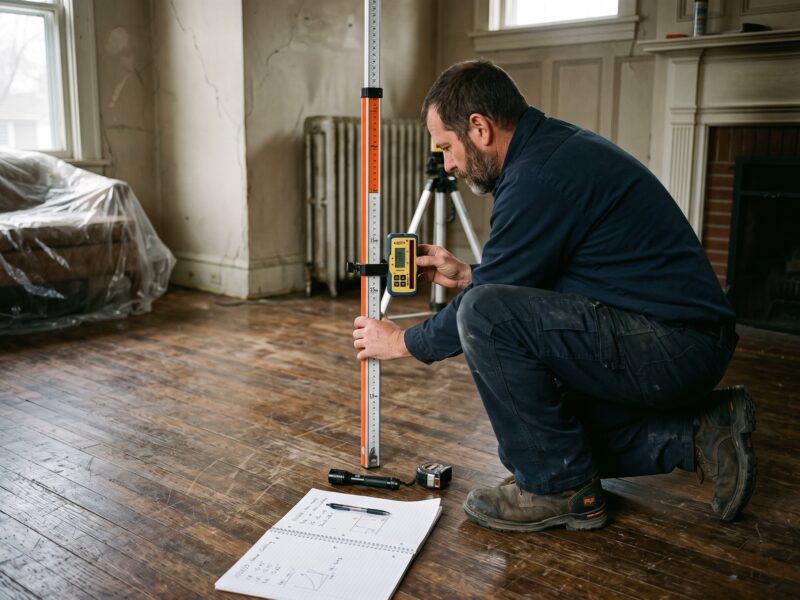 Elevation surveys
The laser map that proves whether a boom-era house is still moving.
Learn more
Elevation surveys
The laser map that proves whether a boom-era house is still moving.
Learn more
 Not sure what you have?
A plain-language guide to what each Oswego symptom usually means and costs.
Learn more
Not sure what you have?
A plain-language guide to what each Oswego symptom usually means and costs.
Learn more
Why do Oswego foundations settle?
Oswego foundations settle because the town outran its soil: fields that carried crops for a century were graded, filled and built on inside a few construction seasons, and clay placed that quickly keeps consolidating under load for years afterward.

Poured walls of the boom years
The 1998 to 2015 wave gave Oswego strong, young poured walls sitting on reworked farm clay that is still tightening. The walls crack over openings and drop at corners not from weakness but from the ground finishing its consolidation beneath them.

Stoops, garages and porches
The classic Oswego symptom is the dropped stoop: concrete on its own shallow footing settling faster than the house beside it. The gap alarms owners, but it usually indicts the fill under the stoop, not the foundation.

The stone walls near the river
The small historic core along Main Street stands on stone and early foundations that answer to a different craft entirely. They want repointing, moisture relief and patient hands, and we bring that playbook only where it belongs.
What makes Oswego ground move?
Oswego's ground moves because nearly all of it was rebuilt by machines within living memory. Subdivision grading cut the high spots of the old farms, filled the low ones and compacted the result to spec, but clay fill keeps consolidating under the weight of a house for a decade or more after the certificate of occupancy. Add the shrink-swell cycle every Illinois clay runs between wet springs and drought summers, and a fifteen-year-old house can still be writing its settlement story.
The good news is that young movement is legible. A boom-era house has square door frames and flat slabs as its baseline, so an elevation survey shows exactly how far each corner has traveled and a return visit shows whether it is still traveling. Stable history gets sealed and monitored; active movement gets piers that carry the footing past the fill to soil that has already finished compressing.
 The elevation report: where the house has moved, in tenths of an inch.
Signs you need foundation repair in Oswego
Six symptoms drive Oswego's structural calls, and most of them are the vocabulary of a young house on young fill. Their price tags run from a $450 injection to pier work, which is exactly why each one deserves a measurement before a quote.

Cracks over windows and doors
Diagonal cracks radiating from the corners of openings are the signature of differential settlement. In boom-era Oswego they are common; whether they are finished moving is the question the survey answers.
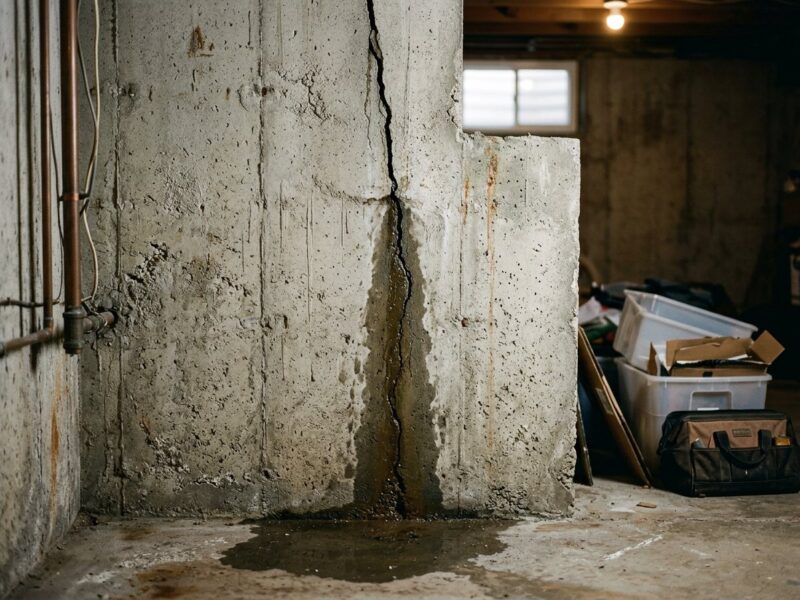
A vertical crack that now leaks
Poured walls crack as the concrete cures, and by year twelve or fifteen those hairlines often start passing water. Usually not structural, always annoying, and sealable for $450 to $900.

Sloping floors, sticking doors
When upstairs doors stop latching, the cause is often a beam or column in the basement rather than the foundation, and that distinction can be a four-figure difference in the repair.

A stoop pulling away from the house
The front stoop rides its own footing in fill that settles faster than the foundation's. A widening gap at the door is Oswego's most common structural call and rarely its most expensive.

Stair-step cracks near the core
In the older masonry around Main Street, cracks stepping through mortar joints map real differential movement. Age changes the toolkit here: relief and repointing before anything aggressive.

A horizontal crack at mid-height
The rarest item on this list in Oswego, and the one we treat most seriously. Inward pressure on a wall gets same-week attention, measured deflection, and reinforcement matched to the numbers.
Crack over the patio door in a 2007 build? Get elevations on it before the next dry summer moves it again. The structural inspection is free.
How does foundation repair work in Oswego?
An Oswego foundation repair runs four steps built around one idea: prove the movement before paying to stop it. Most repairs here finish in one to three days once the plan is set.
Survey before diagnosis
We shoot elevations through the house, map every crack with width and direction, and note the lot's grading, because in Oswego settlement and drainage usually arrive together. Free, within 48 hours.
Day 0Separate active from historic
A crack that moved in 2015 and stopped needs sealing; a corner still dropping needs piers. The written plan states which your house is, in numbers, priced from the published ranges.
Day 0, same visitRepair on the Kendall block
Your install joins our grouped Oswego and Yorkville scheduling, so the crew arrives once and completes the scope in one to three days, logging drive pressures at every pier bracket.
Days 1 to 3Verify and warranty
Post-repair elevations get checked against the day-zero survey before we leave, and the 25-year transferable warranty is registered to the address, ready for any future buyer's inspector.
On completionPush piers or helical piers: which does an Oswego house need?
When Oswego settlement is active, piers are the fix, and the town's graded farm clay makes the choice between push and helical piers a genuine engineering decision rather than a brand preference. Both carry the footing past the fill; they get there differently.
| Push piers | Helical piers | |
|---|---|---|
| How they reach depth | Driven hydraulically using the house's own weight until refusal | Screwed to a torque target that correlates to capacity |
| Best for | Full two-story homes heavy enough to drive against | Lighter structures: stoops, porches, garages, additions |
| In graded farm clay | Push through the fill to strata that finished compressing long ago | Torque readings confirm competent soil below the reworked layer |
| Typical Oswego use | A settling corner or wall line on the main foundation | The dropped stoop and garage calls this town is known for |
| Proof it worked | Drive pressure logs at every bracket | Installation torque logs at every pier |
| Cost | $1,600 to $3,000 per pier, published | $1,600 to $3,000 per pier, published |
The structure's weight picks the pier, not the salesman. Either way the logs come with the invoice and the 25-year transferable warranty covers the work.
When do Oswego foundations move?
Oswego's clay runs the same annual shrink and swell as the rest of northern Illinois, but young fill amplifies it, so boom-era houses feel the seasons more sharply than their age suggests.
Spring: swell season
Saturated clay expands and the ground carries differently than it did in February. Cracks that close now are cycling with moisture, and noting which ones do is free diagnostic data for the survey.
March to MaySummer: drop season
Drought pulls water out of the fill and footings settle into the shrinkage. This is when Oswego's cracks over windows lengthen and stoops take their next step down, and when most of our pier calls originate.
June to AugustFall: proving season
With the clay calm between extremes, fall elevations give the cleanest read on whether summer movement was a one-time event or a trend. Repairs booked now are done before the freeze.
September to NovemberWinter: indoor season
Injection, beam and column work, and interior reinforcement run all winter at full pace, and pier work continues in most conditions. A February repair is tested by the spring swell within weeks.
December to FebruaryHow much does foundation repair cost in Oswego?
Foundation repair in Oswego costs $450 to $900 for an injected crack, $600 to $1,000 per carbon fiber strap, and $1,600 to $3,000 per pier for active settlement, the same ranges we publish for every town on the schedule. Because so much Oswego work is a couple of piers under a stoop or a single sealed crack, many jobs here land at the small end of the table.
| Work | Range | What moves the number |
|---|---|---|
| Urethane crack injectionper crack | $450–$900 | Crack length and width, access to the full height |
| Carbon fiber strapsper strap | $600–$1,000 | Wall height, spacing the deflection requires |
| Push or helical piersper pier | $1,600–$3,000 | Depth to load-bearing strata, access for equipment |
| Steel I-beam wall bracingper beam | $900–$1,500 | Ceiling height, footing condition at the base |
The full structural table lives on the pricing page; your written Oswego quote lands inside it.
Where we repair foundations in Oswego
Structural calls in ZIP 60543 follow the construction map. The Wolf's Crossing Road area and the Douglas Road corridor, the heart of the boom, send settlement cracks, dropped stoops and elevation-survey requests. Boulder Hill and the Route 34 corridor send mixed-era work from beam and column jobs to injections. The village core along Main Street sends the stone-foundation questions that need a mason's judgment, and the Fox River and Waubonsie Creek corridors add the occasional moisture-driven movement case.
Honestly, Oswego is a drive for us, forty-five minutes to an hour each way, and we built the schedule around that fact instead of pretending otherwise: Kendall County work runs in blocks, with Oswego, Yorkville and the Fox Valley grouped so crews are out here on regular runs. Inspections hold to 48 hours, monitoring re-checks ride along on the next block, and there is no trip charge.
 Loading out for the Kendall County run: Oswego, Yorkville, the Fox Valley.
Oswego foundation repair questions, answered straight
My twelve-year-old Oswego house has a basement wall crack. Is the builder liable?
At twelve years, probably not: most builder structural warranties run ten. Read your closing paperwork before assuming, but here is the more useful fact: a vertical or diagonal crack in a poured wall of that age is nearly always shrinkage, common and non-structural. Its real offense is leaking, and urethane injection ends that for $450 to $900 with a 10-year warranty.
Is my 2008 house done settling, or is this going to continue?
That is precisely what an elevation survey answers. Graded farm clay does most of its consolidating in a house's first decade or two, so many boom-era Oswego homes are settling less each year, but "most" is not "yours." One survey establishes the baseline; a re-check on a later Kendall run shows the trend. Stable gets sealed, active gets piers.
My front stoop has dropped and pulled away from the door. Is my foundation failing?
Almost never. The stoop sits on its own shallow footing in backfill that compresses faster than the soil under the house, so it sinks alone and the gap at the door is the evidence. Helical piers at $1,600 to $3,000 each carry it to competent soil. Your foundation usually just watched it happen.
How deep do piers have to go in Oswego's clay?
As deep as it takes to get past the reworked layer, and we do not know that number until the drive. Subdivision grading means the fill thickness varies lot to lot, so push piers drive to refusal and helicals turn to a torque target, with logs recording the proof at every location. Depth costs us effort, not you extra: the per-pier price is published.
How much does foundation repair cost in Oswego?
From the published ranges: $450 to $900 per injected crack, $600 to $1,000 per carbon strap, $900 to $1,500 per steel beam, $1,600 to $3,000 per pier, and $1,500 to $3,200 per support column. Oswego's typical scopes are small, a sealed crack or a few piers, so the written quote is often shorter than owners fear.
Will my homeowners policy pay for settlement repair?
Almost certainly not: standard Illinois homeowners policies exclude earth movement and settling, which is most of what happens to foundations here. Budget as if it is out of pocket, and let that argue for catching movement at the injection stage rather than the pier stage.
Will a repaired foundation hurt my Oswego home's resale?
Handled our way, it usually helps. Buyers in a young market get nervous about unexplained cracks; they relax when the listing includes an elevation survey, photos, the repair scope and a 25-year transferable warranty that transfers to them. Documentation turns a red flag into a closed question before the inspector arrives.
You are based near Joliet. Can you really monitor a crack from out there?
Yes, because monitoring rides the schedule we already run. Kendall County work happens in grouped blocks, so a re-measurement in Oswego attaches to the next run rather than requiring a special trip. When a wall deserves watching instead of steel, we say so, and the follow-up visit actually happens.
Is the settling house also a wet one?
In Oswego the two trades chase the same water: a flattened grade soaks the clay, the soaked clay settles, and the crack the settlement opened becomes the leak. If your structural symptom has a damp partner, one inspection covers both and the drainage fix often protects the structural one.
Basement Waterproofing in Oswego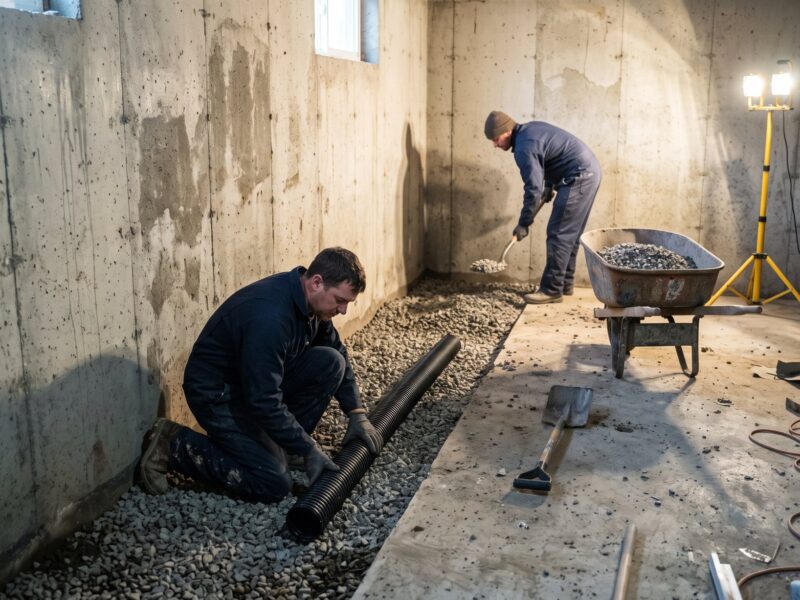
Foundation repair near Oswego

Put numbers on the crack before it grows
A free structural inspection within 48 hours, an elevation survey that separates settled from settling, and a 25-year transferable warranty registered to the house.
Or talk to a human right now
(630) 335-1128
Request your free estimate
Tell us what you're seeing. We'll call back fast and be out within 48 hours.