Foundation Repair in Evergreen Park, Illinois
Nearly every foundation in Evergreen Park is the same age, the same block, on the same flat lakebed clay, and at seventy years old they are failing on schedule. We measure the wall before we name the fix, work from inside lots no machine can enter, and warranty the result for 25-year transferable.
- Structural warranty: 25-year transferable
- Published pricing: injection from $450, piers from $1,600
- Free structural inspection within 48 hours
 25-year transferable warranty
Who does foundation repair in Evergreen Park?
ProSeal Basement Waterproofing repairs Evergreen Park foundations at prices published before anyone measures your wall: urethane crack injection at $450 to $900, carbon fiber straps at $600 to $1,000, steel I-beams at $900 to $1,500, wall anchors at $1,000 to $1,800, and settlement piers at $1,600 to $3,000 each, all backed by a 25-year transferable warranty.
This village is unusually uniform: block foundations poured and laid in one post-war building boom, now roughly seventy years old together. That uniformity cuts both ways. The failure patterns are predictable, which makes honest diagnosis easier, but the lots are so tight that repair methods needing excavation or machine access are frequently off the table. The contractor you hire needs a full interior toolbox, not one product.
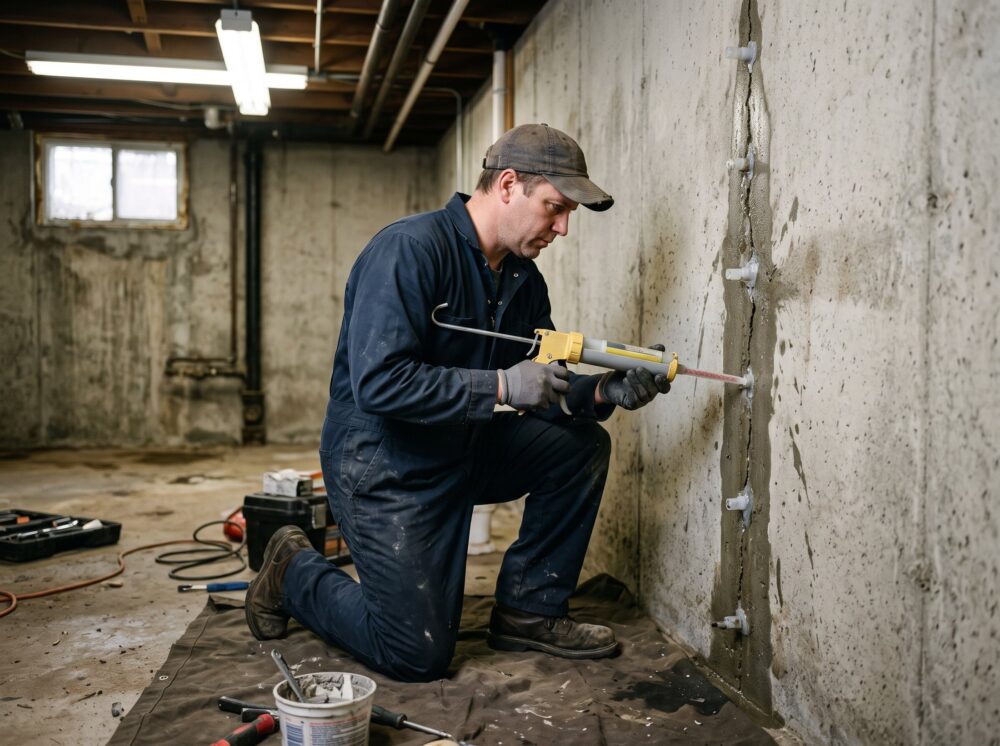 Working from the inside: how structural repair gets done on a thirty-foot lot.
What does foundation repair in Evergreen Park include?
Six structural tools handle what seventy-year-old block does on lakebed clay, and the written plan always starts with the cheapest fix that is actually adequate. Every method below works within the access these narrow lots allow.
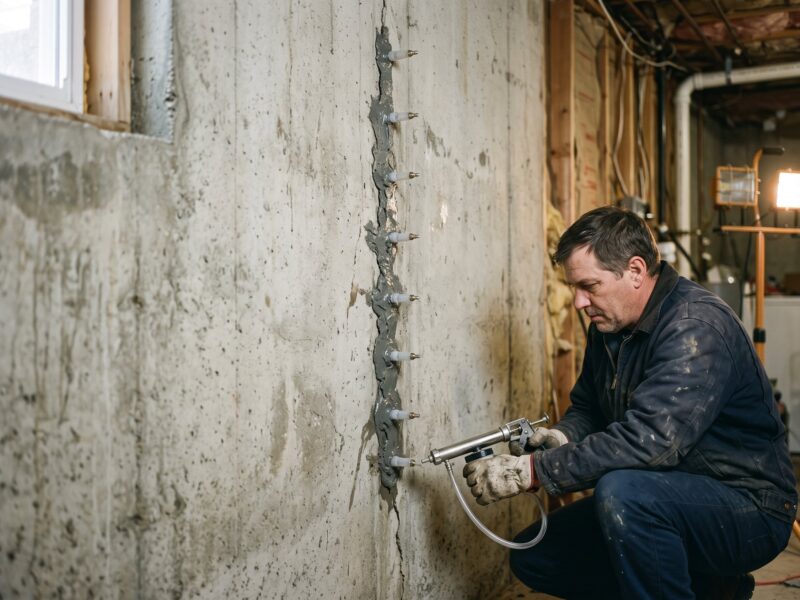 Urethane crack injection
Leaking cracks sealed full depth from $450, finished in a morning.
Learn more
Urethane crack injection
Leaking cracks sealed full depth from $450, finished in a morning.
Learn more
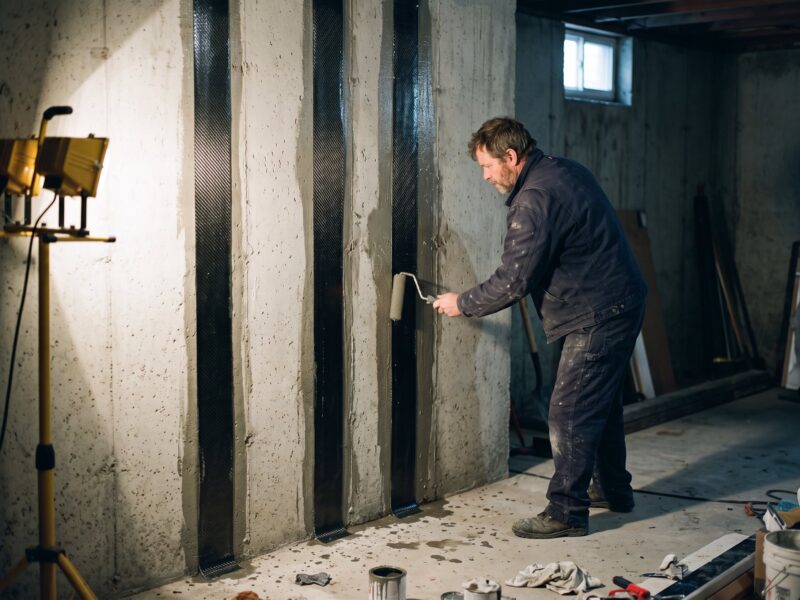 Carbon fiber straps
For block bowing under clay pressure, caught before two inches of deflection.
Learn more
Carbon fiber straps
For block bowing under clay pressure, caught before two inches of deflection.
Learn more
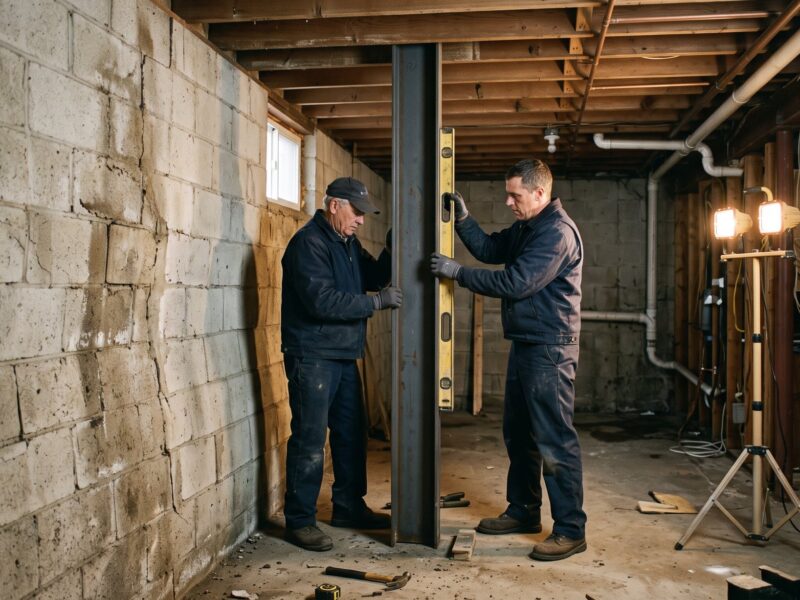 Steel I-beams & wall anchors
For walls past the carbon fiber stage, installed from inside.
Learn more
Steel I-beams & wall anchors
For walls past the carbon fiber stage, installed from inside.
Learn more
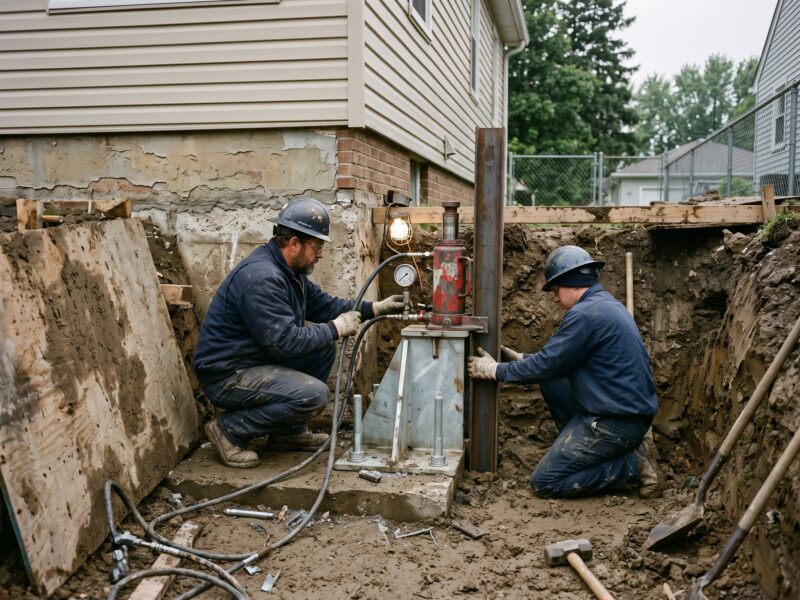 Push & helical piers
Set from compact pits where no excavator could ever reach.
Learn more
Push & helical piers
Set from compact pits where no excavator could ever reach.
Learn more
 House leveling
Columns, beams and footings under sagging mid-century floor framing.
Learn more
House leveling
Columns, beams and footings under sagging mid-century floor framing.
Learn more
 Not sure what you have?
A plain-language guide to what seventy-year-old block walls do and which repairs answer each symptom.
Learn more
Not sure what you have?
A plain-language guide to what seventy-year-old block walls do and which repairs answer each symptom.
Learn more
Why do Evergreen Park foundations crack and bow?
Evergreen Park foundations fail in predictable ways because they share one story: block walls laid in the 1950s, flat lakebed clay that swells against them every wet season, and mortar joints that have spent seventy years absorbing both.

The bungalow and Georgian blocks
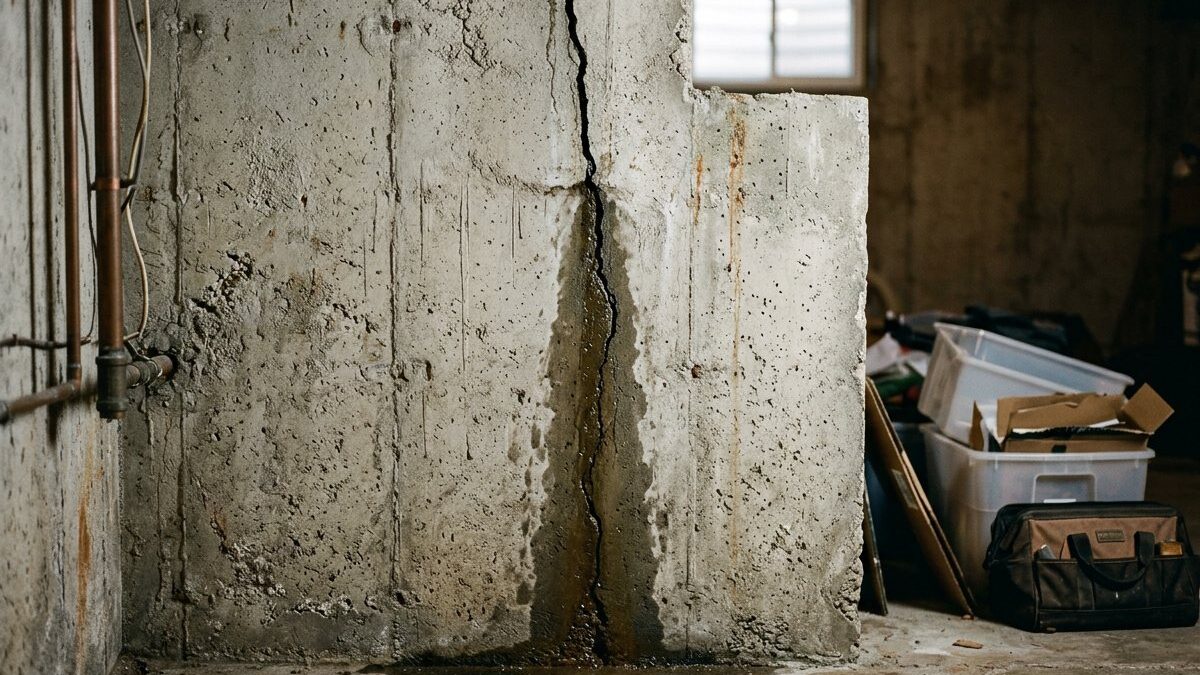
Off 95th Street and the Kedzie corridor, the brick above grade hides block below it that has carried lateral clay pressure since the fifties. Horizontal cracking at mid-height is the signature failure, and catching it early is the entire cost difference.

Ranches near Yukon Woods
The ranch streets toward Yukon Woods and the 99th Street area put long, low walls against the same clay. Longer spans bow sooner for a given pressure, so these walls deserve a deflection measurement even when the crack looks minor.

Under the first floor
Not every sloping Evergreen Park floor is a foundation problem. Mid-century beams, columns and joists sag on their own schedule, and correcting them costs a fraction of structural wall work. The inspection separates the two before anyone quotes.
What makes Evergreen Park ground move?
Evergreen Park sits flat on lakebed clay, and that clay is the engine of nearly every structural problem in the village. It swells hard against block walls in wet springs and shrinks away from footings in drought summers, and because the ground is level, storm water soaks in place instead of running off, keeping the pressure cycle loaded. Seventy years of those cycles is what aging mortar joints have been keeping score of.
The lots decide the repair math. With houses set a few steps apart, excavating a wall from outside is rarely realistic, and heavy equipment cannot reach most back yards at all. So the methods that matter here work from within: injection from the interior face, carbon fiber and steel set against the inside of the wall, and piers driven from compact hand-dug pits. Every one of them is a standard tool for us, not a workaround.
 The elevations tell the truth: measurement first, method second.
Signs you need foundation repair in Evergreen Park
Six symptoms account for most structural calls in the village, and on block this age none of them should be watched without at least one real measurement on record.

A horizontal crack at mid-height
The serious one on seventy-year-old block: clay pressure actively bowing the wall. Early, this is carbon fiber money; late, it is steel and anchor money.

Stair-step cracks in block or brick
Cracks tracking the mortar joints map differential movement, one section of foundation shifting against the rest. Width and direction tell us how much and which way.

Doors sticking, floors off level
When bedroom doors stop latching and the floor tips toward one corner, something below has moved. Often it is a beam or column rather than the foundation, which costs far less.
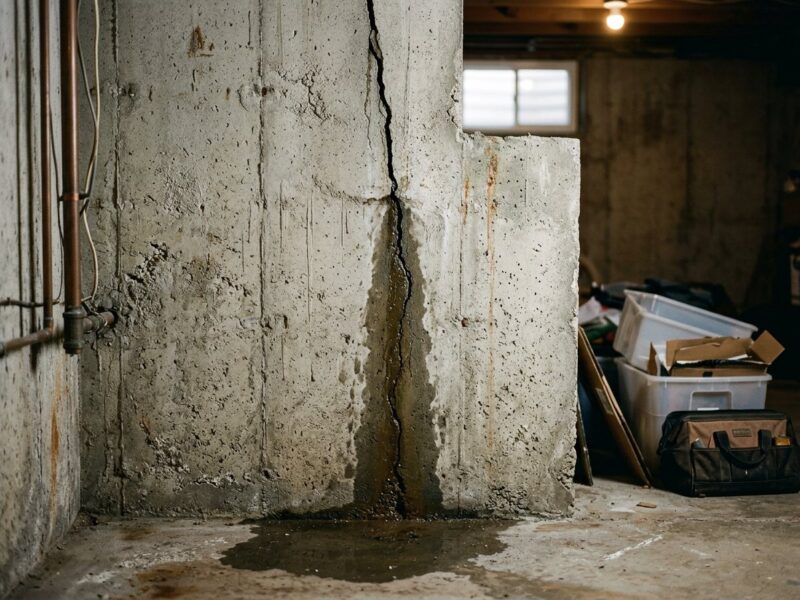
A crack that leaks in spring
A wet crack is usually a $450 to $900 injection, provided the wall around it is stable. The inspection verifies stability before anyone proposes more.

Sandy, powdering mortar joints
Seventy years of moisture cycling washes the binder out of mortar. Joints that scratch away by hand mean the wall is aging faster than the house, worth a look now.

The crack you have watched for years
Every bungalow block has one. Without a baseline measurement, nobody knows if it is moving; with one, a five-minute recheck settles the question for good.
Horizontal crack in a wall as old as the village? Seventy-year-old block has no reserve to waste. The structural measurement is free.
How does foundation repair work in Evergreen Park?
An Evergreen Park structural repair runs four steps: measure the wall, match the method to the movement, install from the inside, and prove the result. Most jobs finish in one to three days.
Measure the movement
Deflection, crack width and floor elevations go into a written baseline, and we separate foundation movement from ordinary mid-century beam sag while we are at it. Free, within 48 hours.
Day 0Match the method to the lot
The plan uses what a narrow Evergreen Park parcel actually permits: injection, carbon fiber, steel and pier pits, all working from inside or from a few square feet of yard. Priced from the published ranges.
Day 0, same visitInstall and re-measure
The crew installs, torques to spec, and checks the finished wall against the day-zero numbers before packing up. Pier work logs drive pressure at every bracket.
Days 1 to 3Warranty to the address
The 25-year transferable warranty registers to the house, not to you, so it survives a closing and answers a buyer's inspector years from now.
On completionReinforce or rebuild: what do Evergreen Park block walls need?
Almost every bowing wall in Evergreen Park can be reinforced in place for a fraction of rebuild money, and here the geometry closes the argument: a rebuild means excavation, and excavation means machine access these lots simply do not have, a few steps from a neighbor's footing.
| Reinforce in place | Excavate and rebuild | |
|---|---|---|
| Best for | Bowed or cracked walls still structurally intact, which is most of the village | Walls sheared or collapsing, a small minority |
| On 1950s block | Carbon fiber early, steel or anchors later, matched to measured deflection | Ends the wall's problems by ending the wall, at a price |
| Lot access | Everything works from the basement or a compact pit | Needs an excavator these lots cannot admit |
| The neighbor's house | Untouched and unbothered | Open excavation near a close-set footing is a genuine hazard |
| Cost | $450 injections to $3,000 piers, per published ranges | Tens of thousands per wall, plus shoring and restoration |
| Time | One to three days for most repairs | Weeks, with the yard and gangway wrecked throughout |
If an estimator proposes rebuilding an Evergreen Park wall without a deflection number, get a second opinion. Ours is free and arrives with a tape measure.
When do Evergreen Park foundations move?
The lakebed clay under Evergreen Park runs the structural calendar, and each season has a cheapest moment to act on what it does.
Spring: push season
Saturated clay swells against every block wall in the village at once. Horizontal cracks widen, bows advance measurably, and this is when walls announce themselves. A measurement taken now catches movement at its most honest.
March to MaySummer: shrink season
Drought pulls water out of the clay and footings settle after it. Doors start sticking, cracks open over windows, and settlement calls replace bowing calls on the schedule.
June to AugustFall: measurement season
The clay goes quiet between swelling and freezing, which makes fall the best season to establish baselines and book repairs that finish before frost, at an unhurried pace.
September to NovemberWinter: interior season
Frost locks the top of the soil, but injection, carbon fiber, bracing and column work all happen indoors at full speed. On lots where everything works from inside anyway, winter costs this village nothing.
December to FebruaryHow much does foundation repair cost in Evergreen Park?
Foundation repair in Evergreen Park costs $450 to $900 per injected crack, $600 to $1,000 per carbon fiber strap, $900 to $1,500 per steel beam, $1,000 to $1,800 per wall anchor and $1,600 to $3,000 per pier, the identical published ranges we hold in every town we serve. The tight access here changes the method chosen, never the price of it.
| Work | Range | What moves the number |
|---|---|---|
| Urethane crack injectionper crack | $450–$900 | Crack length and width, access to the full height |
| Carbon fiber strapsper strap | $600–$1,000 | Wall height, spacing the deflection requires |
| Steel I-beam wall bracingper beam | $900–$1,500 | Ceiling height, footing condition at the base |
| Push or helical piersper pier | $1,600–$3,000 | Depth to load-bearing strata, access for equipment |
The full structural table lives on the pricing page; your written Evergreen Park quote lands inside it.
Where we repair foundations in Evergreen Park
One ZIP, 60805, covers the whole village, and the structural calls track its one building era. The bungalow and Georgian blocks off 95th Street and the Western Avenue corridor send horizontal cracking and bowing block. The ranch streets near Yukon Woods and the 99th Street area send long-wall deflection and settlement questions. Around Village Square and along the Kedzie corridor, we field the sloping-floor calls that turn out to be tired beams and columns as often as foundations, and we price whichever one it truly is.
Scheduling is honest ring-two logistics: crews based in the Joliet and New Lenox corridor, a thirty-five to forty-five minute drive we make constantly, inspections within 48 hours, and monitoring recheck visits folded into the Evergreen Park days we already run.
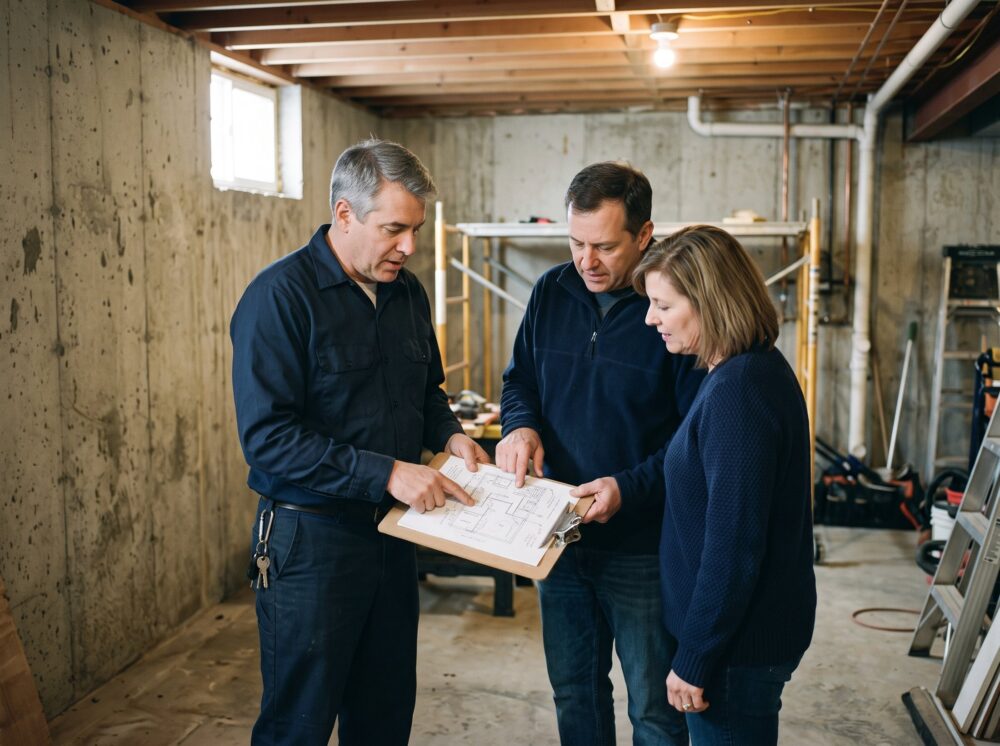 The written baseline: numbers today so next spring's question has an answer.
Evergreen Park foundation repair questions, answered straight
Do you charge for coming out to look at a foundation in Evergreen Park?
No. The structural inspection and the written diagnosis are free, we aim to be on site within 48 hours, and the report with its measurements is yours to keep whether you hire us or not. It is a real baseline, not a sales visit.
Is a horizontal crack in my seventy-year-old block wall serious?
Yes. Horizontal at mid-height means the lakebed clay is actively bowing the wall inward, and block this age has no strength in reserve. Caught early it is carbon fiber at $600 to $1,000 per strap; left alone it graduates to steel, anchors, and eventually rebuild conversations. Measure it now.
Can you install piers when there is no room for equipment between the houses?
Yes, and in Evergreen Park we assume it. Push and helical piers install from compact pits dug at the footing, reached through a gangway or from inside where needed, with no excavator involved. Drive logs record the depth and pressure at every bracket, so the proof does not depend on access either.
How much does foundation repair cost in Evergreen Park?
The published ranges: $450 to $900 per injected crack, $600 to $1,000 per carbon strap, $900 to $1,500 per steel beam, $1,000 to $1,800 per wall anchor, $1,600 to $3,000 per pier, and $1,500 to $3,200 per support column when the sag is framing rather than foundation. The narrow lots change methods, not prices.
Does homeowners insurance cover foundation repair in Evergreen Park?
Usually not. Standard Illinois policies exclude damage from soil movement and hydrostatic pressure, which is precisely what lakebed clay does to a block wall. That exclusion is the financial argument for catching a bow at the $600-per-strap stage instead of the five-figure stage.
Do I need a permit for foundation repair in Evergreen Park?
It varies by municipality and by scope; minor work often needs none while structural repairs frequently do. Where a permit is required for your job, we pull it as part of the work, and the written plan says so before anything starts. You never chase the paperwork yourself.
My floors slope but my walls look fine. Is my Evergreen Park foundation failing?
Quite possibly not. In mid-century houses a sloping floor is often a tired beam, an undersized column or a sagging joist line, and correcting that runs $1,500 to $3,200 per support column instead of structural wall money. The elevation survey tells us which story your house is telling before anyone quotes.
The crack in my basement has looked the same for years. Should I still have it measured?
Yes, once, because "looks the same" is not data on a wall this age. A free baseline takes minutes, and since our crews are in Evergreen Park constantly, a recheck rides along with a future village visit. If it is stable, you get proof and peace; if it is creeping, you catch it at the cheap stage.
Is the cracked wall also wet?
On these blocks the structural problem and the water problem are the same clay wearing two hats: the pressure bowing an Evergreen Park wall is also driving groundwater through its aging joints. If the crack you found seeps every spring, one inspection covers both trades and sequences the repairs so each protects the other.
Basement Waterproofing in Evergreen Park
Foundation repair near Evergreen Park

Put a number on the wall before the clay moves it again
A free structural inspection within 48 hours, methods that work on lots no machine can enter, and a 25-year transferable warranty registered to the address.
Or talk to a human right now
(630) 335-1128
Request your free estimate
Tell us what you're seeing. We'll call back fast and be out within 48 hours.