Foundation Repair in Joliet, Illinois
A city built on limestone has foundations built of it. From rubble walls in the Cathedral Area to bowing block in Marycrest and young settlement west of Route 59, we repair what each era actually breaks, measured first, warrantied after.
- Structural warranty: 25-year transferable
- Published pricing: injection from $450, piers from $1,600
- Free structural inspection within 48 hours
 25-year transferable warranty
Who does foundation repair in Joliet?
ProSeal Basement Waterproofing is a foundation repair contractor working across Joliet from a base in the Joliet and New Lenox corridor. Crack injection runs $450 to $900, bowing-wall reinforcement $600 to $1,800 per strap, beam or anchor, and settlement piers $1,600 to $3,000 each, all published before anyone measures your wall, all covered by a 25-year transferable warranty.
Joliet is the hardest city on our map to fake expertise in, because it holds three structural eras at once. A contractor whose only tool is the poured-wall playbook will mis-repair a Cathedral Area rubble wall, and one who treats every crack as a crisis will oversell a Wesmere settling crack that a $450 injection ends. The estimator who measures your wall is paid for the diagnosis, not the invoice.
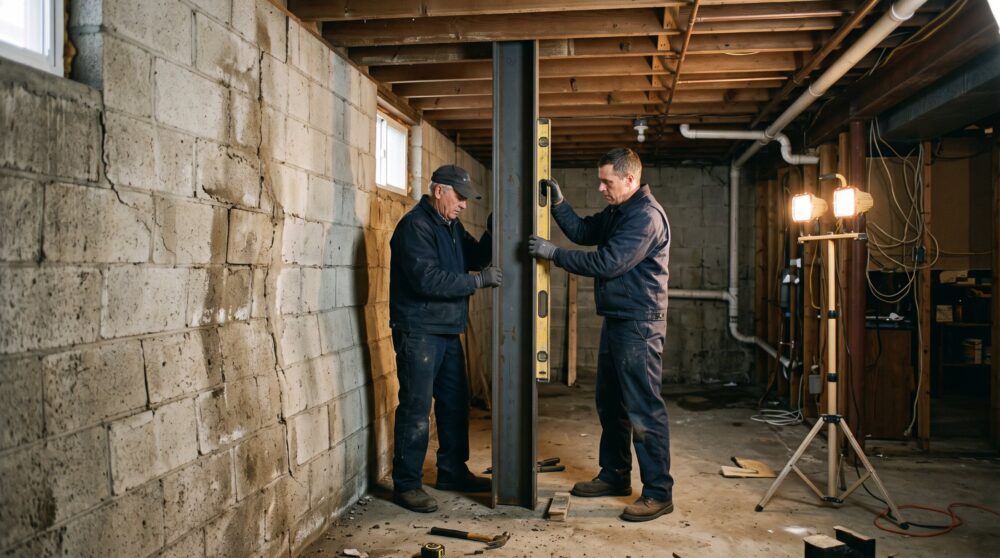 Steel going up against a bowing block wall: measured, matched, warrantied.
What does foundation repair in Joliet include?
Six structural tools cover everything Joliet housing breaks, cheapest adequate fix first, always. A $450 injection beats a $6,000 brace when injection is what the crack needs, and the written plan shows the reasoning.
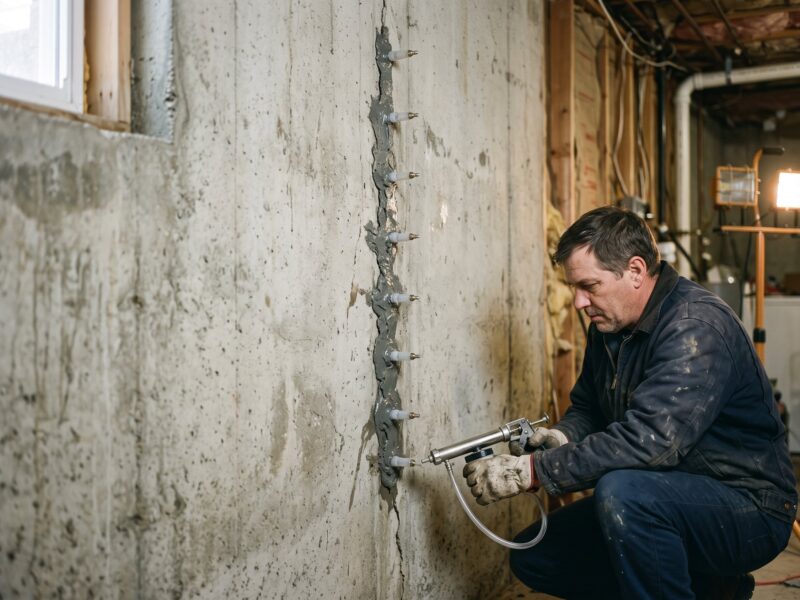 Urethane crack injection
Leaking poured-wall cracks sealed full depth, done in a morning.
Learn more
Urethane crack injection
Leaking poured-wall cracks sealed full depth, done in a morning.
Learn more
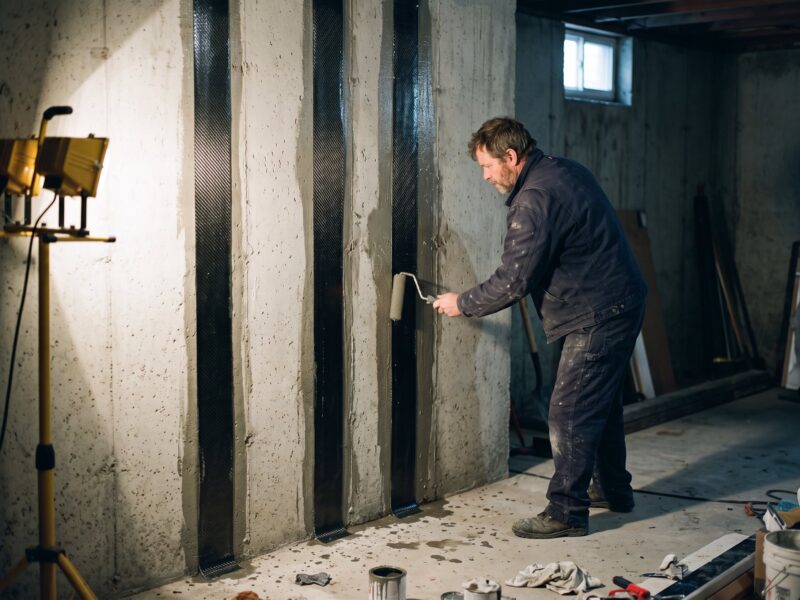 Carbon fiber straps
For Marycrest-era block caught while the bow is under two inches.
Learn more
Carbon fiber straps
For Marycrest-era block caught while the bow is under two inches.
Learn more
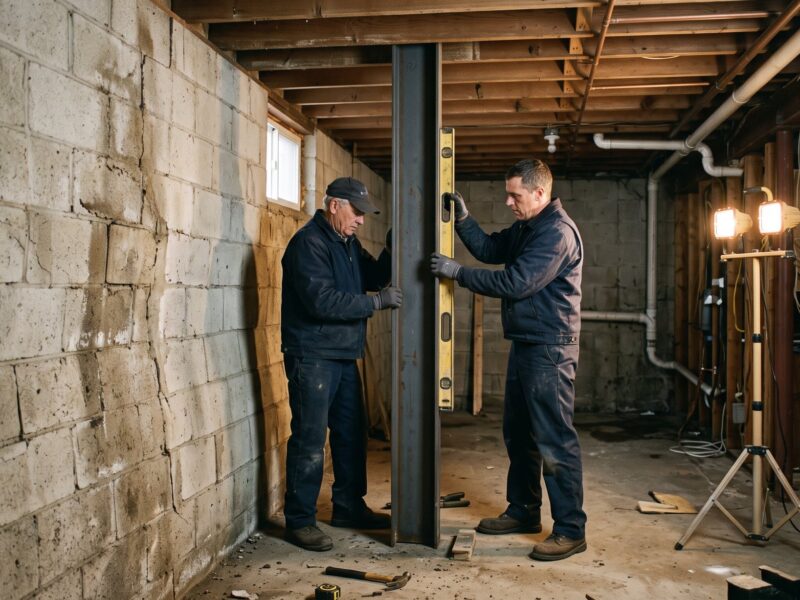 Steel I-beams & wall anchors
For block walls past the carbon fiber stage.
Learn more
Steel I-beams & wall anchors
For block walls past the carbon fiber stage.
Learn more
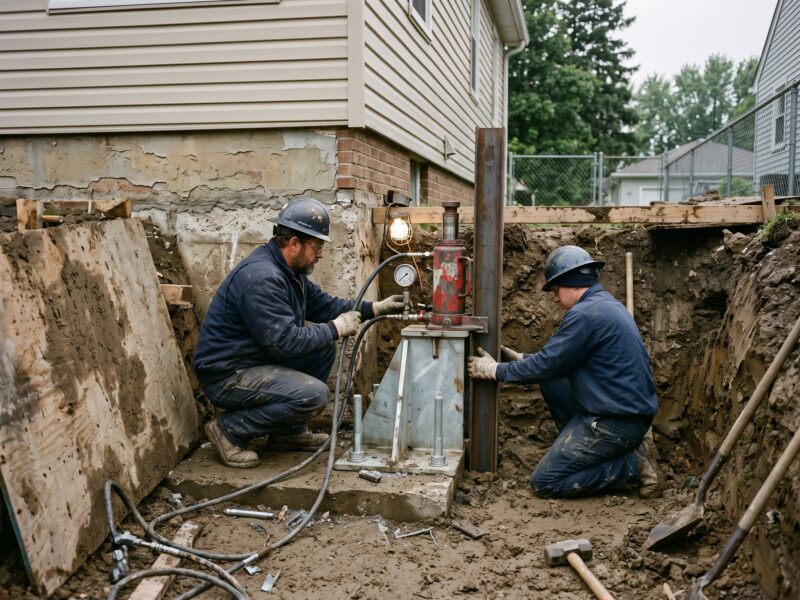 Push & helical piers
For settlement on the graded farm clay west of Route 59.
Learn more
Push & helical piers
For settlement on the graded farm clay west of Route 59.
Learn more
 House leveling
Columns, footings and beams under the older stock's sagging floors.
Learn more
House leveling
Columns, footings and beams under the older stock's sagging floors.
Learn more
 Not sure what you have?
Start with the symptom guide and match your crack pattern.
Learn more
Not sure what you have?
Start with the symptom guide and match your crack pattern.
Learn more
Why do Joliet foundations crack and settle?
Joliet foundations fail three different ways because the city was built in three different eras: limestone that loses mortar, block that bows under clay pressure, and young poured walls settling into graded farmland. The repair that saves one would be malpractice on another.

Limestone and rubble walls
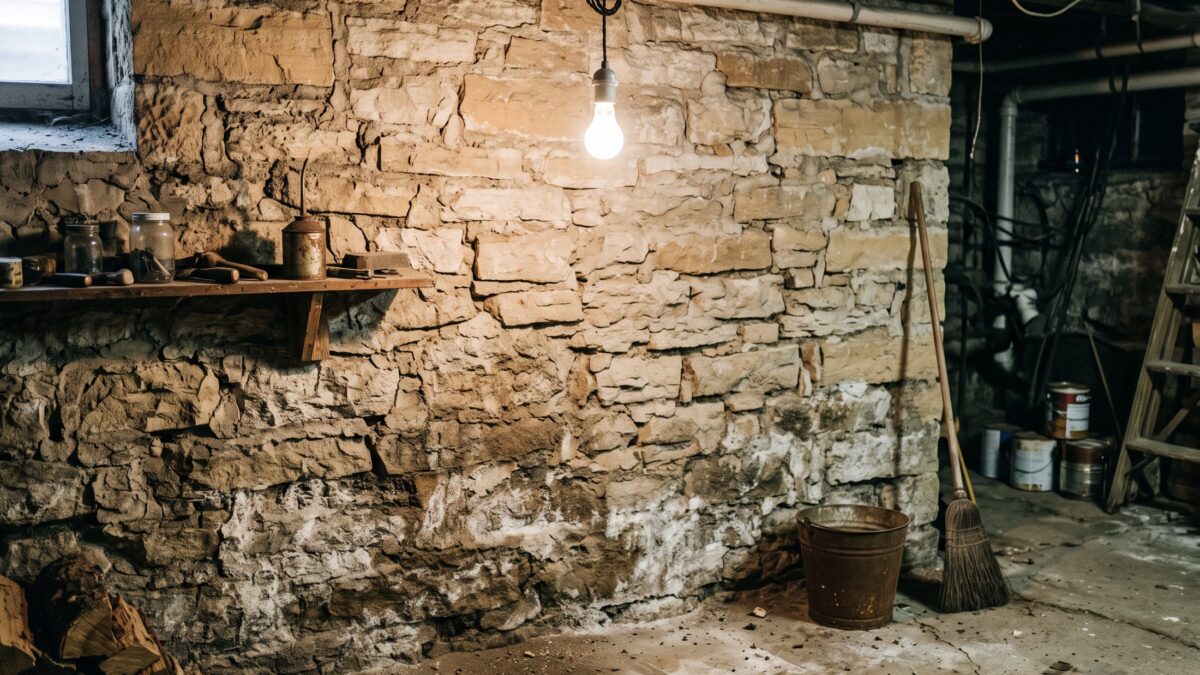
The pre-1920 stock holds itself up by weight and friction. It fails through mortar loss, bulging faces and moisture cycling, and it wants repointing, drainage relief and gentle handling, never aggressive excavation.

Annexation-era block
Sixty-year-old block in Marycrest and Ridgewood is at the age where clay pressure wins: horizontal cracks at mid-height, stair-steps at the corners. Carbon fiber early, steel or anchors later.
Poured walls on farm clay
West of Route 59 the walls are young and strong but the graded farmland under them keeps adjusting. Settlement cracks over doors and windows, a low corner, a garage pulling away: pier territory when it is active.
What makes Joliet ground move?
Joliet foundations sit on a difficult sandwich: clay that swells and shrinks with the weather on top, and in the older city, shallow dolomite bedrock underneath that traps water in the layer between. Wet years push walls inward; drought summers shrink the clay and let footings drop. The movement is slow, seasonal and cumulative, which is why a crack that "has always been there" still deserves a measurement.
The bedrock changes the repair math too. Deep exterior excavation is genuinely harder in parts of the old city, which is one more reason interior reinforcement, injection from inside and pier systems that work from small pits are the tools we reach for first. On the west side the story is simpler: graded farm clay settling under subdivisions that are barely thirty years old, which piers solve permanently.
 A stair-step crack: the wall documenting exactly how the corner moved.
Signs you need foundation repair in Joliet
Six symptoms account for most Joliet structural calls, and their urgency ranges from "schedule a measurement" to "call this week." None of them improves by itself.

A horizontal crack at mid-height
The serious one: clay pressure actively bowing the wall inward. In Marycrest-age block, this is carbon fiber money early and anchor money late.
Stair-step cracks in block or brick
The mortar joints map differential settlement: one part of the foundation moving relative to the rest. Direction and width tell the story; we measure both.
Doors sticking, floors sloping
When upstairs doors quit latching and a marble rolls on its own, something below moved. Sometimes it is the foundation; often it is a beam or column, which costs far less.
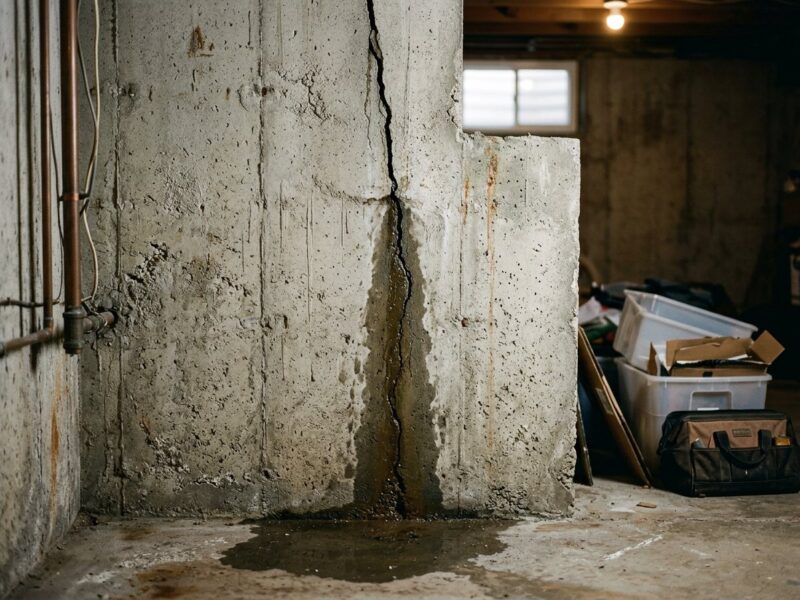
A crack that leaks when it rains
Wet cracks in poured walls are usually sealable for $450 to $900. The inspection confirms the crack is stable before anyone sells you more than an injection.
Bulging or shedding limestone
Rubble walls telegraph trouble through mortar dust, bulges and stones proud of the wall face. This is craft territory: repointing and relief, not jackhammers.
A corner or addition pulling away
A gap opening at a garage, stoop or addition means its footing is settling separately from the house. Active movement is pier territory; the elevations prove it either way.
Crack over the patio door getting longer? Get it measured before the next season moves it again. The structural inspection is free.
How does foundation repair work in Joliet?
A Joliet foundation repair runs four steps: identify the era, measure the movement, match the method, verify the result. Most repairs finish in one to three days.
Identify the era, measure the movement
Limestone, block or poured changes everything, so the inspection starts there, then maps cracks and deflection in numbers. Free, within 48 hours.
Day 0Match the method
Repointing and relief for stone, carbon or steel for block, injection or piers for poured: the written plan pairs the fix to the failure, priced from published ranges.
Day 0, same visitInstall and verify
The crew installs, torques to spec and re-measures against the day-zero numbers before leaving. Pier jobs log drive pressures at every bracket.
Days 1 to 3Warranty to the address
Structural work carries the 25-year transferable warranty, registered to the house so it survives your closing and answers the buyer's inspector.
On completionReinforce or rebuild: what do Joliet walls actually need?
Nearly every failing Joliet wall can be reinforced in place for a fraction of rebuild cost, and the city's geology strengthens the case: shallow bedrock and tight old-city lots make the excavate-and-rebuild route harder here than almost anywhere we work.
| Reinforce in place | Excavate and rebuild | |
|---|---|---|
| Best for | Bowing, cracked or settling walls still structurally intact, which is most of them | Walls sheared or collapsing, a small minority |
| On limestone walls | Repointing, relief and careful reinforcement respect a gravity wall | Excavating beside rubble stone risks the wall you're saving |
| Where bedrock is shallow | Interior methods and small pier pits are unaffected | Dig depth is genuinely limited in parts of the old city |
| Cost | $450 injections to $3,000 piers, per published ranges | Tens of thousands per wall, plus excavation and landscaping |
| Time | One to three days for most repairs | Weeks, with shoring, machines and a wrecked yard |
| Warranty | 25-year transferable, registered to the house | Varies by scope; get it in writing before signing |
If an estimator quotes a rebuild without measuring deflection, get a second opinion. Ours is free and comes with the numbers.
When do Joliet foundations move?
Joliet foundation movement follows the clay's calendar, and the smart money gets ahead of it: every season has a cheapest moment to act.
Spring: push season
Saturated clay swells and shoves walls inward. Horizontal cracks widen, bows advance and this is when block walls announce themselves. Measurements taken now catch movement at its most visible.
March to MaySummer: shrink season
Drought pulls moisture from the clay and lets footings drop. Settlement cracks open over windows, doors start sticking, and the west-side subdivisions do most of their moving.
June to AugustFall: measurement season
The clay is calm, the weather cooperates, and repairs booked now finish before frost. The best time of year to brace a wall or drive piers at an unhurried pace.
September to NovemberWinter: interior season
Frost grips the top of every wall through a 42-inch freeze depth, but injection, carbon fiber, bracing and column work all happen indoors, full speed, all winter.
December to FebruaryHow much does foundation repair cost in Joliet?
Foundation repair in Joliet costs $450 to $900 for crack injection, $600 to $1,800 per strap, beam or anchor for bowing walls, and $1,600 to $3,000 per pier for settlement, the same published ranges we hold across every town. Limestone repointing is masonry craft, scoped at the free inspection.
| Work | Range | What moves the number |
|---|---|---|
| Urethane crack injectionper crack | $450–$900 | Crack length and width, access to the full height |
| Carbon fiber strapsper strap | $600–$1,000 | Wall height, spacing the deflection requires |
| Steel I-beam wall bracingper beam | $900–$1,500 | Ceiling height, footing condition at the base |
| Push or helical piersper pier | $1,600–$3,000 | Depth to load-bearing strata, access for equipment |
The full structural table lives on the pricing page; your written Joliet quote lands inside it.
Where we repair foundations in Joliet
The structural map of Joliet reads like its construction history. The Cathedral Area, Upper Bluff and the East Side send us limestone: repointing, bulge relief and the careful judgment gravity walls demand. Marycrest, Ridgewood and the annexation-era streets send bowing block, carbon fiber and steel. The Route 59 corridor and Wesmere send settlement calls, elevation surveys and piers into graded farm clay. ZIPs 60431 through 60436 all sit in our first ring.
Being based in the Joliet and New Lenox corridor changes what monitoring means: when a wall deserves watching rather than immediate steel, we can actually come back and re-measure it, because the drive is fifteen minutes and we are in the city most days of the week anyway.
 The old city: brick above grade, limestone and judgment below it.
Joliet foundation repair questions, answered straight
Who repairs stone foundations in Joliet?
We do, and the old city keeps us busy at it. Rubble and quarried-limestone walls want repointing, moisture relief and careful structural judgment rather than the standard poured-wall playbook. If a contractor quotes your stone wall the same fix as a subdivision basement, get a second opinion; ours is free.
Is a horizontal crack in my Marycrest block wall serious?
Yes. Horizontal at mid-height means clay pressure is actively bowing the wall, and block of that age has no reserve to spare. Caught early it is carbon fiber at $600 to $1,000 per strap; ignored, it graduates to steel, anchors or rebuild money. Measure it now.
My newer house west of Route 59 has cracks over the windows. Is it settling?
Probably, and the question is whether it is finished settling. Subdivisions on graded farm clay commonly move in their first decades. We measure elevations, and if the movement is active, piers stop it permanently; if it is old and stable, sealing the cracks is the honest whole answer.
How much does foundation repair cost in Joliet?
Same published ranges as everywhere we work: $450 to $900 per injected crack, $600 to $1,000 per carbon strap, $900 to $1,500 per steel beam, $1,600 to $3,000 per pier. Stone-wall masonry is scoped at the free inspection because rubble walls are their own craft.
Do piers work where Joliet's bedrock is shallow?
Yes, often better than usual: piers drive until they refuse at load-bearing strata, and where dolomite sits shallow, refusal comes fast and solid. The engineering call between push and helical piers depends on the structure's weight, and the drive logs prove the depth either way.
Can I sell a Joliet house that has had foundation repair?
Documented repair usually reads better to buyers than an unexplained crack. Our work comes with the measurements, photos, scope and a 25-year transferable warranty registered to the address, a packet your listing agent hands the buyer's inspector instead of an awkward conversation.
Does homeowners insurance cover foundation repair in Illinois?
Usually not. Standard Illinois policies exclude damage from soil movement and hydrostatic pressure, which covers most foundation problems. That is one more reason to catch a bowing wall at the $600-per-strap stage instead of the five-figure stage.
Do you excavate foundations in the older parts of Joliet?
Only when the wall truly demands it. Shallow bedrock makes deep digs genuinely harder in parts of the old city, which is one more reason we lead with interior reinforcement, injection and pier systems that work from small pits. Less yard destroyed, same result, warrantied either way.
Is the moving wall also wet?
In Joliet the two problems share a cause: the clay pushing your wall inward is the same clay holding water against it, and weeping mortar is often the first symptom of both. If the cracked wall also seeps in spring, one inspection covers both trades and the fixes get sequenced properly.
Basement Waterproofing in Joliet
Foundation repair near Joliet

Get the Joliet wall measured, whatever era built it
A free structural inspection within 48 hours, a method matched to limestone, block or poured, and a 25-year transferable warranty that transfers with the house.
Or talk to a human right now
(630) 335-1128
Request your free estimate
Tell us what you're seeing. We'll call back fast and be out within 48 hours.