
Basement Waterproofing in Sycamore, Illinois
Sycamore splits neatly in two: an old town sitting on high ground where dampness usually means mortar, and newer streets built out over flat, tile-drained farmland where the sump does real work. We tell you which half your basement lives in, then fix it with a lifetime, fully transferable warranty.
- Every DeKalb County system priced from the same published ranges
- Interior systems warrantied: lifetime, fully transferable
- Free written inspection within 48 hours
 Sycamore and DeKalb scheduled together
Who does basement waterproofing in Sycamore?
ProSeal Basement Waterproofing serves Sycamore with interior drain tile at $95 to $160 per linear foot, full perimeter systems with a sump and battery backup at $8,000 to $16,000 on most homes, and yard drainage work from $600. We are based in the Joliet and New Lenox corridor, the pricing is published before anyone visits, and DeKalb County trips get scheduled as a batch so the drive never pads your quote.
The useful thing to know before hiring anyone here is that Sycamore water is not one problem. The old town near State Street stands on slightly higher ground, which is a large part of why those houses are still standing, and their dampness questions are usually masonry questions. The Kishwaukee side and the newer corridors sit over flat farmland whose water table is managed by agricultural tile, and out there a sump and drainage are earning their keep.
See the full basement waterproofing system, wall to discharge
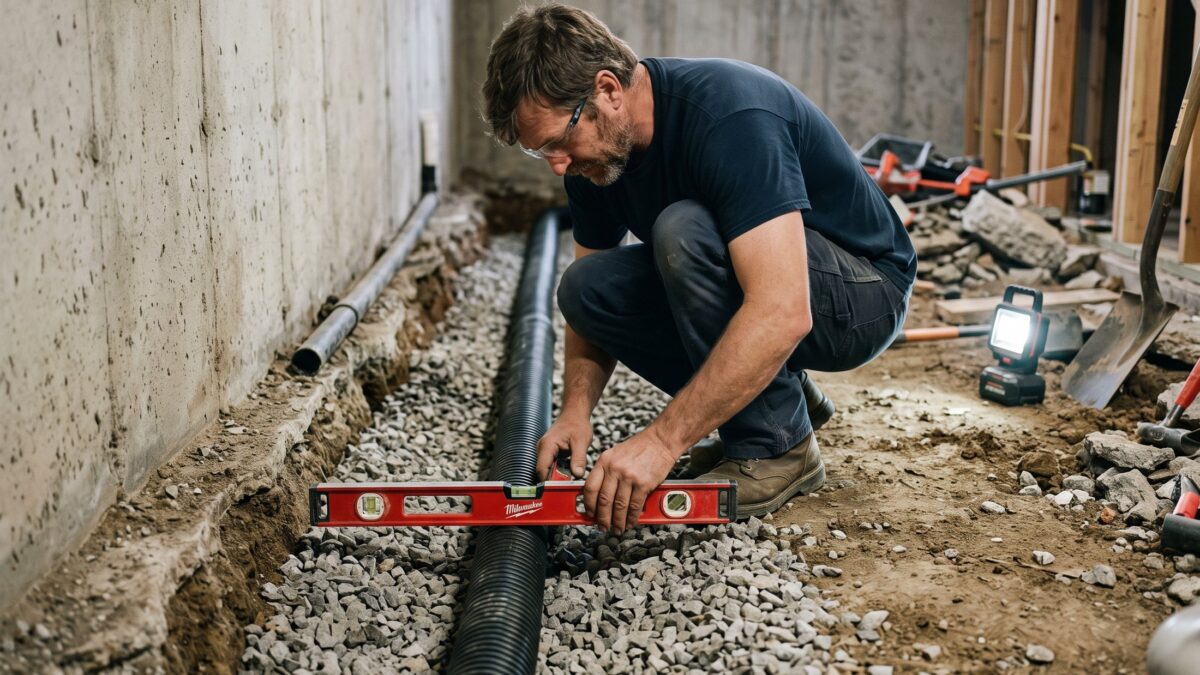
 Washed gravel over new tile: the drainage detail flat-ground basements rely on.
What does basement waterproofing in Sycamore include?
A Sycamore waterproofing job draws from six systems, and the free inspection prices only what your side of town actually needs. High-ground houses often leave with a short list; flat-ground houses get the full drainage conversation.
 Interior drain tile
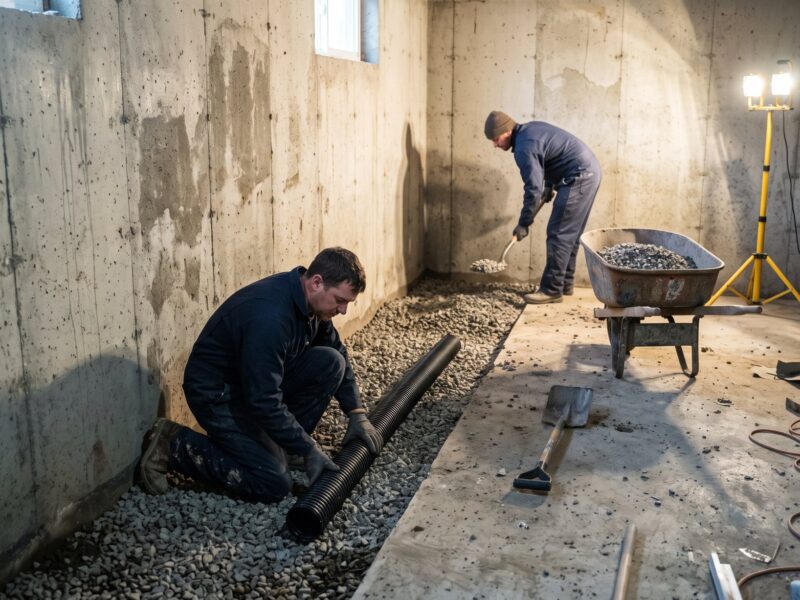
Perforated pipe at the footing, the standing answer to a farmland water table that never drops far.
Learn more
Interior drain tile
Perforated pipe at the footing, the standing answer to a farmland water table that never drops far.
Learn more
 Sump pumps & battery backup
Sized for long-duration storms and the rural outages that follow them.
Learn more
Sump pumps & battery backup
Sized for long-duration storms and the rural outages that follow them.
Learn more
 Yard drainage & catch basins
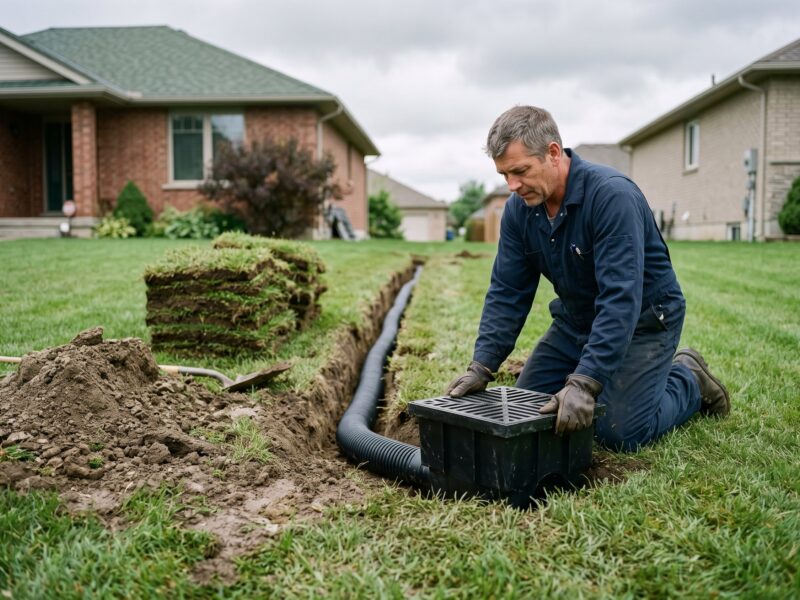
For flat lots where storm water has nowhere obvious to go on its own.
Learn more
Yard drainage & catch basins
For flat lots where storm water has nowhere obvious to go on its own.
Learn more
 French drains
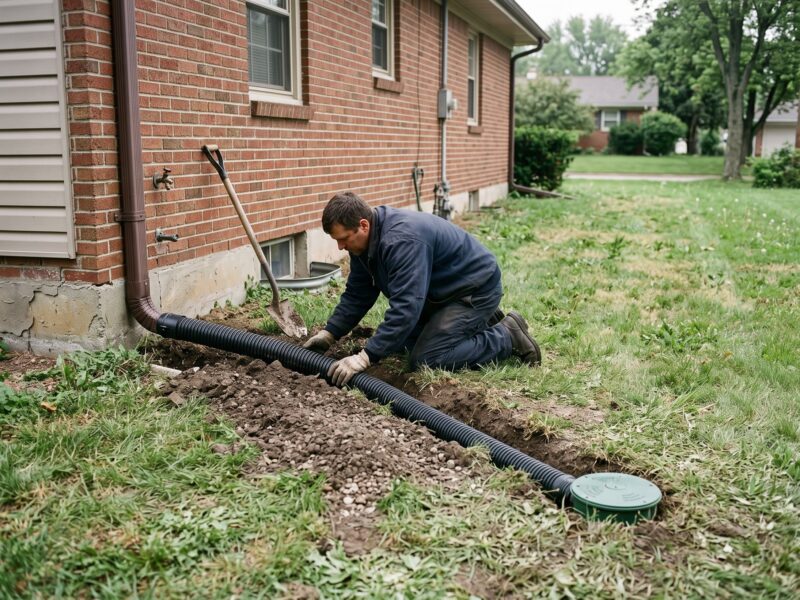
Intercepts surface flow before it settles against a slab or wall on level ground.
Learn more
French drains
Intercepts surface flow before it settles against a slab or wall on level ground.
Learn more
 Crawl space encapsulation
For additions and older cottages riding on dirt-floor crawls.
Learn more
Crawl space encapsulation
For additions and older cottages riding on dirt-floor crawls.
Learn more
 Leaking crack injection
Poured-wall cracks in the newer corridors sealed full depth from $450.
Learn more
Leaking crack injection
Poured-wall cracks in the newer corridors sealed full depth from $450.
Learn more
Why do Sycamore basements get wet?
Sycamore basements get wet for reasons that map to elevation and era: the historic core mostly stays out of the groundwater and shows moisture through old masonry, while the flat newer edges of town inherit a farmland water table that field tile has managed for a century.

The historic district
Limestone, rubble and early brick walls on high ground rarely sit in groundwater, but they wick moisture through mortar and show it as bloom and damp patches. The honest fix is usually masonry and grading, not an interior system nobody needed.
The Peace Road and Route 64 corridors
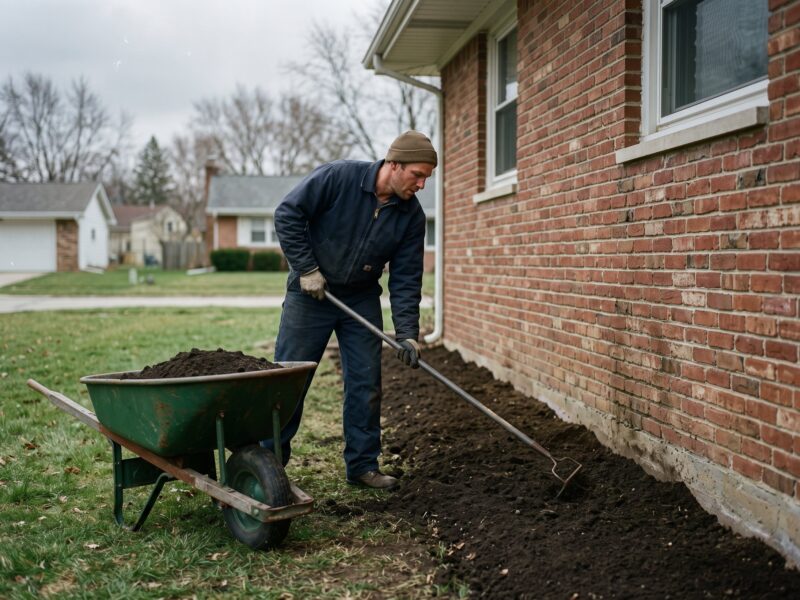
The newer subdivisions were built out over level, tile-drained fields. Water arrives slowly, leaves slowly, and leans on the sump. Grading that settled after the builder left is a frequent and cheap culprit.

The Kishwaukee corridor
Near the East Branch the ground runs lower and wetter, and sumps here cycle hardest in spring. Pump capacity, a battery backup and disciplined discharge matter more on these blocks than anywhere else in town.
What makes Sycamore groundwater different?
Sycamore groundwater is largely an agricultural artefact: the East Branch of the Kishwaukee River passes the town through flat farmland that has been drained by field tile for generations, so the regional water table sits where a century of tile has put it rather than where nature would. Basements built out into that landscape inherit ground that saturates broadly in a wet spring, with no slope to carry the water anywhere.
The old town is the exception, and it is a happy one. Those nineteenth-century houses were sited on the higher ground, so their basements mostly stay above the seasonal saturation, and the moisture they do show tends to travel through hundred-and-forty-year-old mortar rather than up from below. When an inspection there points at repointing and downspouts instead of drain tile, that is the finding, and the quote reflects it.
 Fabric-lined drain trench: giving level ground the slope it never had.
Signs your Sycamore basement needs waterproofing
Six symptoms cover most Sycamore water calls, and which side of town you are on changes what each one probably means. The free inspection sorts symptom from cause before anything gets priced.

Water at the floor-wall joint
On the flat side of town this is the saturated-ground signature: hydrostatic pressure pushing water under the footing. Drain tile territory, priced by the foot.

A sump that runs for days after rain
Level, tile-drained ground releases water slowly, so long run times can be normal here. Constant cycling in dry weather is not, and the inspection finds out which you have.

White bloom on old stone or brick
In the historic district this usually means moisture wicking through soft mortar, a masonry and grading conversation before it is ever a drainage one.

A yard that ponds after storms
Flat lots hold water because nothing tells it to leave. Catch basins, swales and regrading from $600 to $2,500 move it out before it finds the foundation.

Musty rooms over a crawl space
Older cottages and additions on dirt crawls feed damp air to the whole house. Encapsulation at $7 to $14 per square foot closes the source.
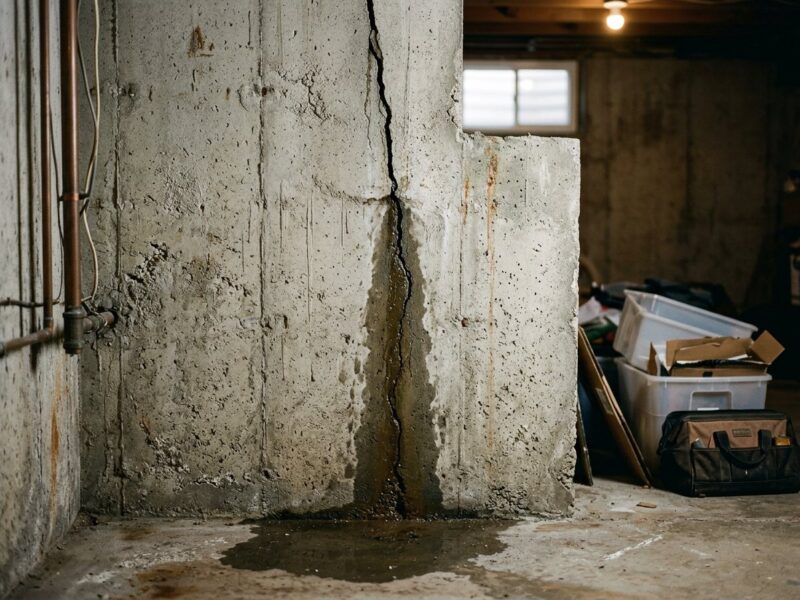
A poured-wall crack that weeps
In the newer corridors a leaking crack is usually a $450 to $900 injection, done in a morning, not a reason to buy a perimeter system.
Sump running around the clock this spring? Tell us the street. Old town or new corridor changes the answer, and we know the difference before we arrive.
How does basement waterproofing work in Sycamore?
A Sycamore waterproofing job runs four steps from call to warranty, and because DeKalb County work is batched, the visit is planned rather than squeezed in.
Inspect both sides of the water
We trace the moisture indoors and walk the lot outside, paying particular attention to grading on flat ground, because on level Sycamore lots the yard is a suspect in most cases. Free, scheduled within 48 hours.
Day 0Match the fix to the ground
High-ground masonry moisture, flat-ground saturation and simple surface water each get a different written plan, priced from the published ranges. Nobody is commissioned to upsell the big system.
Day 0, same visitInstall and flood test
Trench, tile, gravel, sump with battery backup, fresh concrete, then a flood test you watch before we load the vans. Most full systems finish in two to four days.
Days 1 to 4Register the warranty
Interior systems carry the lifetime, fully transferable warranty, registered to the address and fully transferable, which matters as much in Sycamore as anywhere.
On completionInterior or exterior waterproofing: which works in Sycamore?
Interior drain tile is the right first answer for most wet Sycamore basements, because on flat, tile-drained farmland the water table is broad and patient, and it is far cheaper to collect that water at the footing than to try to hold it out of saturated level ground from outside.
| Interior drain tile | Exterior excavation | |
|---|---|---|
| Best for | Broad seasonal saturation under flat ground, the common Sycamore case | Walls deteriorating from the outside face |
| On historic walls | Rarely needed on high-ground stock; scoped carefully when it is | Digging against a rubble or stone wall is a last resort |
| On level lots | Works regardless of slope; the sump provides the exit | Discharge has to be engineered because gravity offers no help |
| Season | Installs year-round, entirely indoors | Saturated farm clay limits digging for much of spring |
| Cost | $95 to $160 per linear foot | Several times interior cost; priced per wall after inspection |
| Disruption | No landscaping touched | Full-depth trench along every treated wall |
Where a wall genuinely needs exterior work, the exterior French drain range of $45 to $90 per linear foot goes in the written quote. The system serves the house, not the other way round.
When do Sycamore basements flood?
Sycamore water keeps a farm calendar: the same seasonal rhythm that governs the fields around town governs the ground under the newer subdivisions built on them.
Spring: saturation season
Snowmelt and rain load flat ground that drains slowly by design, the East Branch runs high, and sumps across the newer corridors work their hardest weeks of the year. The busiest stretch for our DeKalb County batch runs.
March to MaySummer: the outage test
Hard summer storms drop inches fast and can take rural power lines with them. A primary-only sump fails exactly then, which is why every system we install here includes the battery backup.
June to AugustFall: the yard-work window
Firm, dry ground makes fall the season for regrading, downspout burials and catch basins, the $600 to $2,500 fixes that keep spring water off the foundation entirely.
September to NovemberWinter: the indoor season
Interior drain tile installs full speed with the ground frozen, because the whole job happens inside. Winter booking is the least contested slot on the Sycamore schedule.
December to FebruaryHow much does basement waterproofing cost in Sycamore?
Basement waterproofing in Sycamore costs $95 to $160 per linear foot for interior drain tile, and a full perimeter system with a sump and battery backup lands between $8,000 and $16,000 on most homes. Sycamore pays the same published ranges as every town on our map, and the drive out never appears on the invoice.
| Work | Range | What moves the number |
|---|---|---|
| Interior drain tileper linear foot | $95–$160 | Length of the run, slab thickness, what has to be moved off the walls |
| Sump pump with battery backupinstalled | $2,800–$4,500 | Pit condition, backup capacity, discharge routing |
| Exterior French drainper linear foot | $45–$90 | Trench depth, where the water can legally go |
| Downspout extensions and regradingtypical job | $600–$2,500 | Feet of grade to rebuild, soil hauling |
Every range lives on the pricing page, and your written Sycamore quote lands inside it.
Where we waterproof in Sycamore
All of Sycamore sits in ZIP 60178, and the water calls sort by ground. The Kishwaukee River corridor and the flat newer streets off Peace Road and Route 64 send us hard-working sumps, ponding yards and cove-joint seepage. The historic district, the blocks around State Street and the Somonauk Street area send damp-masonry questions that as often as not resolve into grading, gutters or a foundation conversation rather than a drainage system.
We will be straight about the distance: Sycamore is an hour and a half or so from our base in the Joliet and New Lenox corridor, and we make the drive by batching DeKalb County work, so Sycamore and DeKalb visits get scheduled together. Inspections still land within 48 hours, planned rather than improvised, and standing-water emergencies are answered 24/7.
 Discharge run to daylight: on flat ground, where the water exits is half the design.
Sycamore basement waterproofing questions, answered straight
Why does my newer Sycamore basement have water when the old houses downtown seem dry?
Elevation, mostly. The nineteenth-century builders put the town on the higher ground, and those basements ride above the seasonal saturation. The newer corridors were built out over flat, tile-drained farmland, so their footings sit closer to a water table that a wet spring raises across the whole landscape at once.
My sump runs for two or three days after every big rain. Is that normal in Sycamore?
On flat, tile-drained ground it can be. Level farmland sheds water slowly by design, so a sump that works steadily after a storm and then rests is doing its job. A sump that cycles in dry weather, or that cannot keep the floor dry while running, is a different story, and the inspection separates the two for free.
Does the Kishwaukee River flood Sycamore basements?
The East Branch runs by the town, and the blocks nearest it sit on the lowest, wettest ground in Sycamore. Before quoting anything near the river we check the address against the FEMA flood map, because mapped floodplain changes the honest order of operations: insurance and elevation questions first, drainage second.
How much does a full waterproofing system cost in Sycamore?
The same as everywhere we work: interior drain tile at $95 to $160 per linear foot, with a complete perimeter system including a sump and battery backup landing between $8,000 and $16,000 on most homes. Smaller fixes are published too, from $450 crack injections to $600 drainage corrections.
Is Sycamore too far for you to service what you install?
No, and we would rather answer this before you ask. The drive is an hour and a half or so, we batch DeKalb County work so Sycamore and DeKalb get scheduled together, and the lifetime, fully transferable warranty is registered to your address regardless of the mileage. Warranty calls ride the same batch schedule, planned and kept.
Do I need a permit to waterproof my basement in Sycamore?
It varies by municipality and by the scope of the work. Interior drainage inside your own basement is treated differently than work that changes discharge or grading. Where a permit is required, we pull it as part of the job rather than leaving the paperwork to you.
Can you waterproof a finished basement without wrecking it?
Yes. The bottom course of drywall along the treated walls comes off and goes back on, the flooring and framing beyond the work line get protected, and the flood test happens before any trim is reinstalled. Losing a strip of drywall beats losing the carpet every spring.
My yard is dead flat and ponds after storms. Is that a basement problem?
It will be if it keeps up. Standing water within a few feet of the foundation eventually finds the wall, and on level Sycamore lots the fix is built slope: catch basins, buried downspout runs and regrading in the $600 to $2,500 range. It is the cheapest waterproofing we sell, and we sell it first when it is the answer.
Is the damp wall also a moving wall?
In Sycamore the two trades meet in the historic district, where moisture in a hundred-and-forty-year-old wall is often a mortar and movement question wearing a water costume. If the damp stone wall also shows fresh, sharp-edged cracking, one inspection covers both trades and tells you which problem you actually have.
Foundation Repair in Sycamore
Basement waterproofing near Sycamore

Get the right answer for your side of Sycamore
A free inspection within 48 hours, a fix matched to high ground or flat, and a lifetime, fully transferable warranty registered to the address.
Or talk to a human right now
(630) 335-1128
Request your free estimate
Tell us what you're seeing. We'll call back fast and be out within 48 hours.