Basement Waterproofing in Yorkville, Illinois
Half of Yorkville drains to a storm sewer and the other half drains to whatever the farm tile under the yard still allows. We waterproof both halves: subdivision basements along Route 47 and acreage properties in Kendall Township where the discharge plan matters as much as the pump. lifetime, fully transferable warranty on every interior system.
- Free written inspection within 48 hours
- Interior systems carry a lifetime, fully transferable warranty
- Rural properties welcome: well, septic and field tile experience
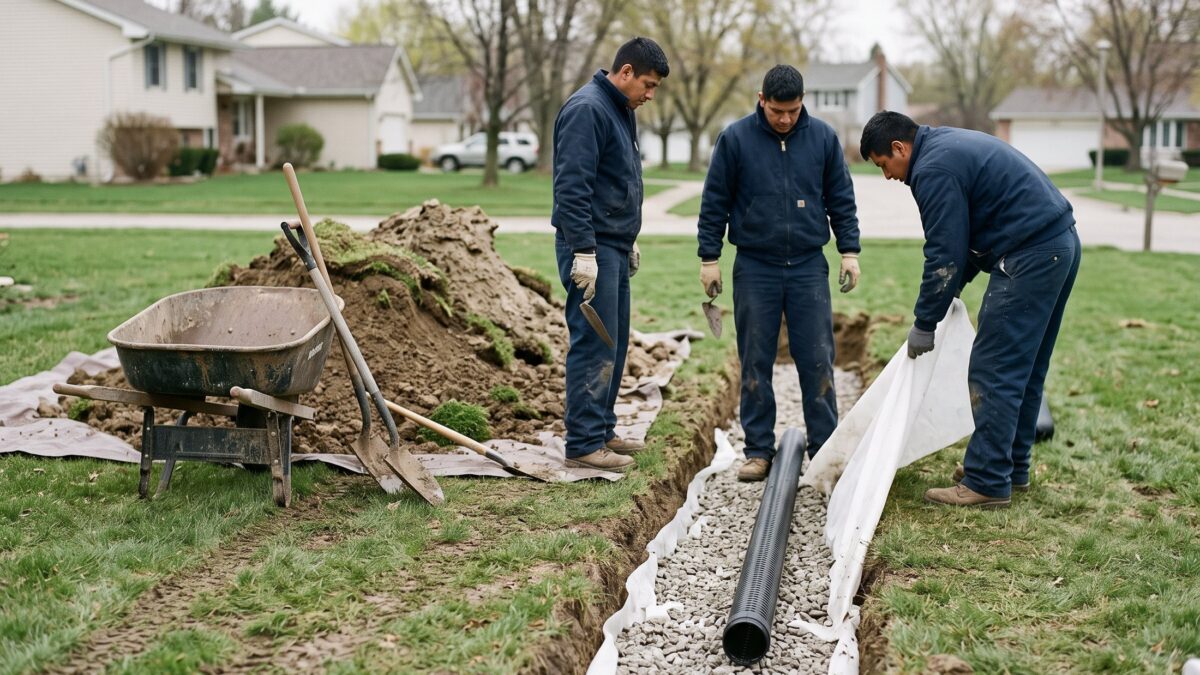 Kendall County scheduled in weekly blocks
Who does basement waterproofing in Yorkville?
ProSeal Basement Waterproofing installs interior drain tile, sump systems and yard drainage throughout Yorkville and the surrounding Kendall County townships. Interior drain tile is $95 to $160 per linear foot, a full perimeter system with a sump and battery backup runs $8,000 to $16,000 on most houses, and the ranges are published before we ever see your address.
Yorkville needs a contractor who can switch playbooks in one afternoon. A poured-wall basement in a 2000s subdivision off Route 34 and a farmhouse basement on acreage in Kendall Township have almost nothing in common: one has a storm sewer at the curb, the other has a run of clay field tile of unknown age somewhere under the beans. We diagnose both without guessing, and nobody on the visit is paid on commission.
See the full basement waterproofing system, wall to discharge
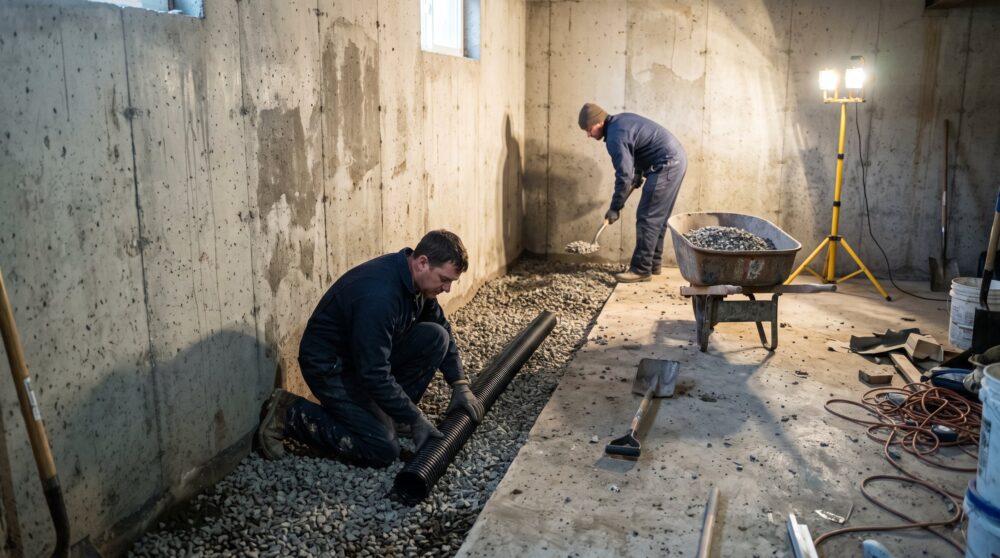 Interior drain tile mid-install: the fix that works with or without a storm sewer.
What does basement waterproofing in Yorkville include?
A Yorkville waterproofing plan pulls from six systems, and on rural properties it often starts outside the house rather than inside it. The free inspection prices only what your property needs, from the published ranges.
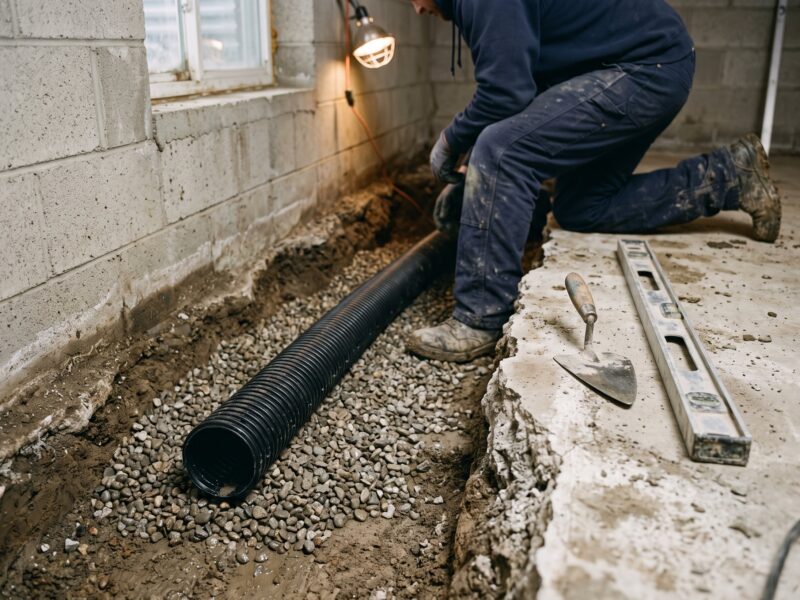 Interior drain tile
Footing-level pipe and gravel for basements the Fox River valley water table keeps wet.
Learn more
Interior drain tile
Footing-level pipe and gravel for basements the Fox River valley water table keeps wet.
Learn more
 Sump pumps & battery backup
Backup power matters more on acreage, where an outage also takes the well pump.
Learn more
Sump pumps & battery backup
Backup power matters more on acreage, where an outage also takes the well pump.
Learn more
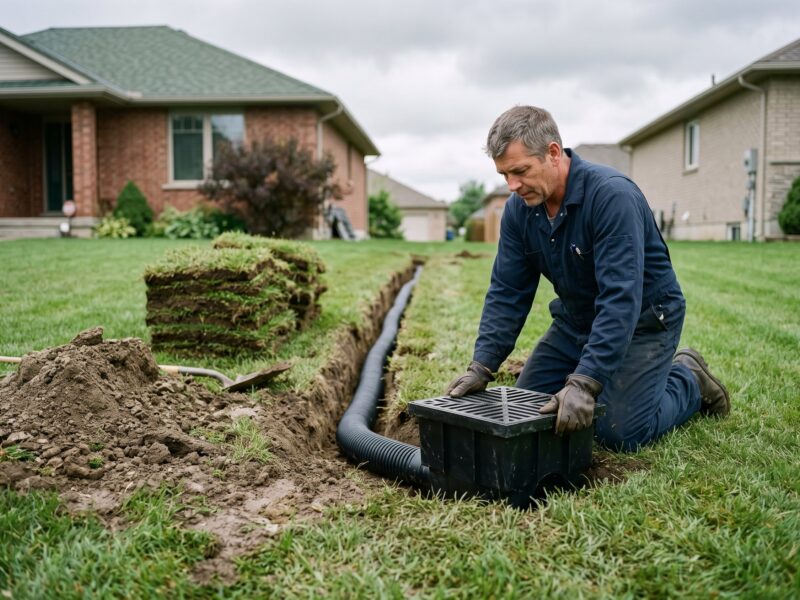 Yard drainage & regrading
Discharge routes designed for properties with no storm sewer to receive them.
Learn more
Yard drainage & regrading
Discharge routes designed for properties with no storm sewer to receive them.
Learn more
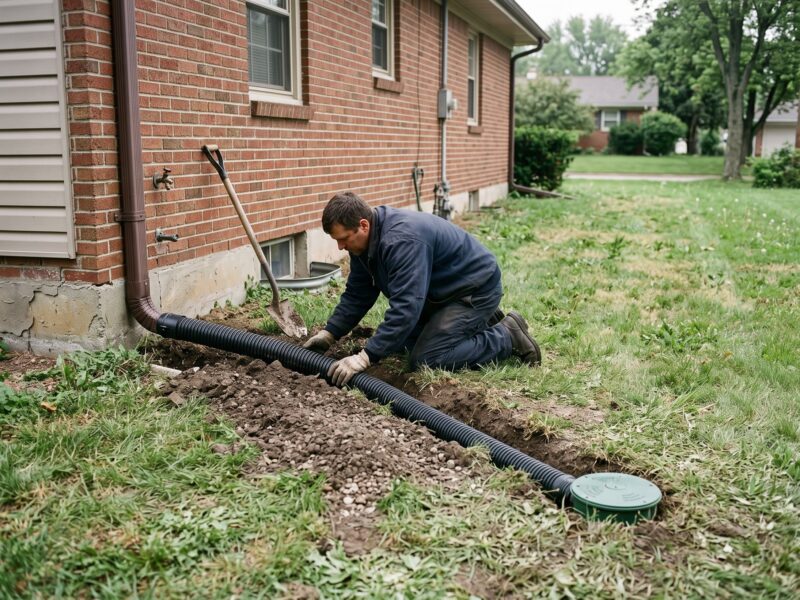 French drains
Long shallow runs that carry water across acreage to a ditch or legal outfall.
Learn more
French drains
Long shallow runs that carry water across acreage to a ditch or legal outfall.
Learn more
 Crawl space encapsulation
Farmhouse crawl spaces and additions sealed against ground moisture.
Learn more
Crawl space encapsulation
Farmhouse crawl spaces and additions sealed against ground moisture.
Learn more
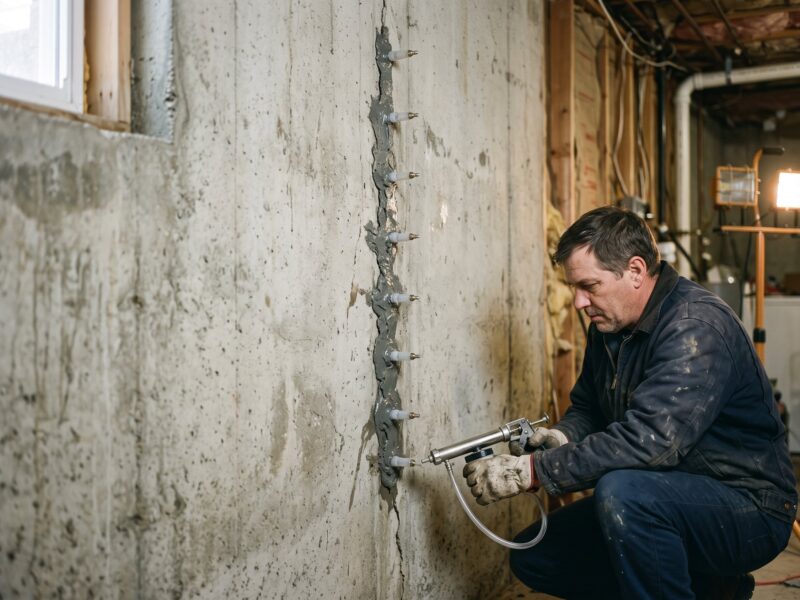 Leaking crack injection
The common subdivision fix: a poured-wall crack sealed from $450.
Learn more
Leaking crack injection
The common subdivision fix: a poured-wall crack sealed from $450.
Learn more
Why do Yorkville basements leak?
Yorkville basements leak for reasons that split cleanly along the village boundary: young poured walls with grading and sump problems inside the subdivisions, and rural basements whose fate hangs on farm drainage older than the house.

The 2000s growth-wave subdivisions
The Route 47 and Route 34 corridors filled with poured-wall houses during the 2000s. These basements mostly stay dry until builder grading settles or the original sump quits, and the honest fix is often yard work and a backup pump, not a full system.

Acreage in Kendall Township
Rural properties sit on well and septic with no municipal storm system anywhere in the equation. Water has to cross the land to a creek or ditch, and when the old field tile carrying it fails, the basement is the first place you find out.

The historic downtown by the Fox River
The older stock near the river predates modern waterproofing entirely. These foundations were built without membranes or footing drains, they sit closest to the valley water table, and they weep in spring by design rather than by accident.
Where is Yorkville water supposed to go?
Yorkville water drains to creeks, not just to sewers, and that shapes every waterproofing decision outside the village core. The Fox River runs through the middle of town and Blackberry Creek comes in from the north, but beyond the subdivisions the land is agricultural, tiled for farming, and it drains to those creeks through buried field tile. On a rural property the tile in the ground around you is frequently older than your house, and its condition is a genuine variable in whether your basement stays dry.
That is why our rural inspections treat discharge as a design question before a product question. A sump pump that dumps into a failed tile run or a low spot with nowhere to drain is just recirculating the problem. We map where the water goes now, where it legally can go, and whether the existing tile is usable, and only then size the system that moves it. Subdivision lots are simpler: the storm sewer is there, and the job is getting water to it faster than it gets to your footing.
See how yard drainage moves water when there is no storm sewer
 Creek-fed lowland: where tiled farm ground has always sent its water.
Signs your Yorkville basement needs waterproofing
Six symptoms drive most Yorkville waterproofing calls, and the same symptom can mean different money on a subdivision lot than on acreage. The free inspection sorts cause from coincidence.

Water at the floor-wall joint
Groundwater under pressure finding the cove joint. Near the Fox River valley this is the classic drain tile call; on higher ground it sometimes traces back to surface water instead.

A sump that runs long after the rain stops
Extended run time means the ground around the house is still feeding the pit. On rural lots that often points at failed field tile holding water in the soil.

Musty smell in a newer house
A 2000s subdivision basement should not smell like a cellar. Persistent damp air usually means slow seepage or a wet crawl area exporting moisture upstairs.

White mineral bloom on the walls
Efflorescence marks water passing through the wall itself. Common on the older downtown foundations, and a sign the wall needs drainage relief, not paint.
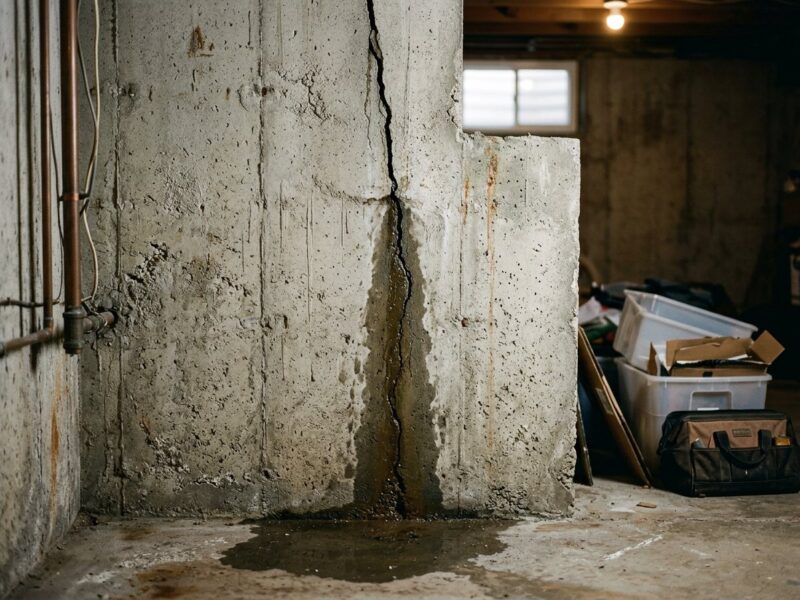
A poured-wall crack that leaks in storms
Growth-wave poured walls crack as they cure and settle. When one starts running, a $450 to $900 injection usually closes it permanently in a morning.

Water standing in the yard for days
On acreage this is the field tile talking. Ground that used to drain and no longer does means the tile serving your parcel has silted, crushed or collapsed.
Yard holding water and the sump never resting? Tell us whether you are on the sewer or on septic; the diagnosis starts there.
How does basement waterproofing work in Yorkville?
A Yorkville waterproofing job runs four steps from call to warranty, and most full systems finish in two to four days once the crew is on site.
Walk the water path
Inside we trace the entry points; outside we walk the grading, the discharge options and, on rural parcels, the field tile question. The inspection is free and lands within 48 hours.
Day 0Design the discharge first
Subdivision lots route to the storm sewer. Acreage gets a written discharge plan to a creek, ditch or legal outfall, sometimes through scoped and verified existing tile.
Day 0, same visitInstall and flood test
Trench, tile, gravel, sump and battery backup, then fresh concrete and a flood test you watch run. Finished basements lose only the bottom drywall course along the work line.
Days 1 to 4Register the warranty
Interior systems carry the lifetime, fully transferable warranty, registered to the address and fully transferable, which matters in a town where the subdivisions are still turning over.
On completionInterior or exterior waterproofing: which fits Yorkville?
Interior drain tile is still the workhorse answer for a wet Yorkville basement, but this is one of the few towns where exterior work earns a fair hearing: acreage lots have the machine access that older tight-lot towns never offer.
| Interior drain tile | Exterior excavation | |
|---|---|---|
| Best for | Cove-joint seepage and valley water tables near the Fox River | Walls deteriorating from the outside face |
| On acreage | Works regardless of lot size; discharge plan still required | Genuinely feasible: open ground means real machine access |
| In the subdivisions | Installs without touching landscaping or neighboring lots | Tighter lots, utilities and mature yards raise the cost |
| Where water exits | Sump discharge routed to sewer, ditch or verified tile | Exterior French drain at $45 to $90 per linear foot needs a fall to daylight |
| Cost | $95 to $160 per linear foot | Higher per wall; priced after inspection |
| Season | Installs year-round, frozen ground irrelevant | Weather-dependent; saturated spring farm clay stops digs |
On some rural properties the honest answer is exterior routing plus a modest interior system rather than either one alone. The written plan shows the reasoning and the math.
When do Yorkville basements get wet?
Yorkville water follows the farm calendar as much as the weather map, because tiled ground and creek drainage set the pace at which the soil empties.
Spring: the saturation test
Snowmelt loads the tiled ground faster than the creeks can take it away, the Fox River and Blackberry Creek run high, and every marginal field tile line shows its age. Sumps run hardest now and the 48 hours promise gets tested.
March to MaySummer: the outage season
Hard storms drop inches in an hour and knock out rural power, taking the sump and the well pump together. This is why battery backup is standard in every system we install out here.
June to AugustFall: the cheap-fix window
Dry ground is the season for regrading, downspout burials and drainage runs across open land, the $600 to $2,500 work that keeps spring water away from the wall entirely.
September to NovemberWinter: the interior season
Interior drain tile installs happily while the ground is frozen, because the whole job happens inside. Kendall County winter slots book fastest and the system is done before the thaw.
December to FebruaryHow much does basement waterproofing cost in Yorkville?
Basement waterproofing in Yorkville costs $95 to $160 per linear foot for interior drain tile, and a complete perimeter system with a sump and battery backup lands between $8,000 and $16,000 on most homes. Yorkville pays the same published ranges as every town we serve; long rural discharge runs are measured and priced at the inspection.
| Work | Range | What moves the number |
|---|---|---|
| Interior drain tileper linear foot | $95–$160 | Length of the run, slab thickness, what has to be moved off the walls |
| Sump pump with battery backupinstalled | $2,800–$4,500 | Pit condition, backup capacity, discharge routing |
| Exterior French drainper linear foot | $45–$90 | Trench depth, where the water can legally go |
| Downspout extensions and regradingtypical job | $600–$2,500 | Feet of grade to rebuild, soil hauling |
Every range lives on the pricing page, and your written Yorkville quote lands inside it.
Where we waterproof in and around Yorkville
Everything in the 60560 ZIP is on the route, and the calls sort by geography. The Route 47 and Route 34 corridors send subdivision work: failed sumps, settled builder grading and the occasional leaking poured-wall crack. The historic downtown and the Fox River corridor send older foundations weeping with the spring water table. Bristol, the Blackberry Creek corridor and the Kendall Township acreage send the drainage design calls, where field tile, ditches and discharge rights decide the plan.
We will be straight about the drive: Yorkville is fifty minutes to an hour and ten from our base in the Joliet and New Lenox corridor, and we make it by scheduling Kendall County in blocks alongside Oswego and the Fox Valley. Inspections still land within 48 hours, standing water still gets a 24/7 response, and the quote carries no trip charge.
 Kendall County day: the western block loads early and runs the full route.
Yorkville basement waterproofing questions, answered straight
I am on acreage with no storm sewer. Where is my water supposed to go?
Across your land to a creek, a ditch or a legal outfall, and on a rural Yorkville property that makes drainage a design question before it is a product question. We map where the water goes now, where it could go, and whether the existing field tile can carry it. Sometimes the whole fix is a few hundred feet of pipe and a proper outlet.
There is old farm tile in my yard. Can my sump or drains tie into it?
Sometimes, and it is worth finding out before installing anything new. Old field tile can be clay, it can be collapsed, and it can be draining someone else's land, which raises questions no contractor can settle for you. We scope the tile and confirm its condition before we plan a single foot of pipe through it.
Is my Yorkville basement at risk from the Fox River?
Check your address against the FEMA flood map before spending money, because the river and Blackberry Creek meet in the middle of town and some low-lying parcels genuinely sit near mapped floodplain. River water and groundwater are different problems: the first is an insurance conversation, the second is drain tile, and the free inspection tells you which one you have.
My sump in a newer subdivision runs constantly. Do I need a full system?
Often not. Growth-wave subdivisions commonly recycle their own roof water: short downspouts and settled builder grading feed the pit the same gallons every storm. The inspection walks the yard first, because $600 to $2,500 of grading and downspout work beats an $8,000 system you did not need.
Why do you push battery backups so hard on rural properties?
Because a rural outage takes everything at once: the sump stops, the well pump stops, and the storm that caused it is still filling the ground. A battery backup keeps the pit moving through the hours that matter. Sump systems with backup run $2,800 to $4,500 installed, and out here they earn it.
How much does basement waterproofing cost in Yorkville?
The same published ranges as everywhere we work: $95 to $160 per linear foot for interior drain tile, $8,000 to $16,000 for a full perimeter system with sump and battery backup, $45 to $90 per linear foot for exterior French drains. Long discharge runs across acreage get measured at the free inspection and priced from those ranges.
Do I need a permit for waterproofing work in Yorkville?
It varies by municipality and by scope, and rural work outside the village can fall under county rather than village rules. Where a permit is required we pull it as part of the job, and the written quote says so. What we never do is route water somewhere it is not allowed to go.
How do I choose a waterproofing company for a rural Kendall County property?
Ask where the discharge goes before you ask what the system costs. A contractor who quotes a sump without a discharge plan on a property with no storm sewer has not understood the job. Then check the paper: our interior systems carry a lifetime, fully transferable warranty registered to the address, and pricing is published before anyone visits.
Is the wet basement also showing cracks?
Water and movement travel together in Yorkville: the same saturated clay feeding a subdivision sump also settles under young footings, and a rural foundation that predates modern standards can weep and shift at once. If the damp wall has a widening crack, a sloping floor above it or a sticking door, one inspection covers both trades.
Foundation Repair in Yorkville
Basement waterproofing near Yorkville

Get the water a real route out
A free inspection within 48 hours, a discharge plan that fits your parcel whether it drains to a sewer or a creek, and a lifetime, fully transferable warranty registered to the address.
Or talk to a human right now
(630) 335-1128
Request your free estimate
Tell us what you're seeing. We'll call back fast and be out within 48 hours.