
The quick answer
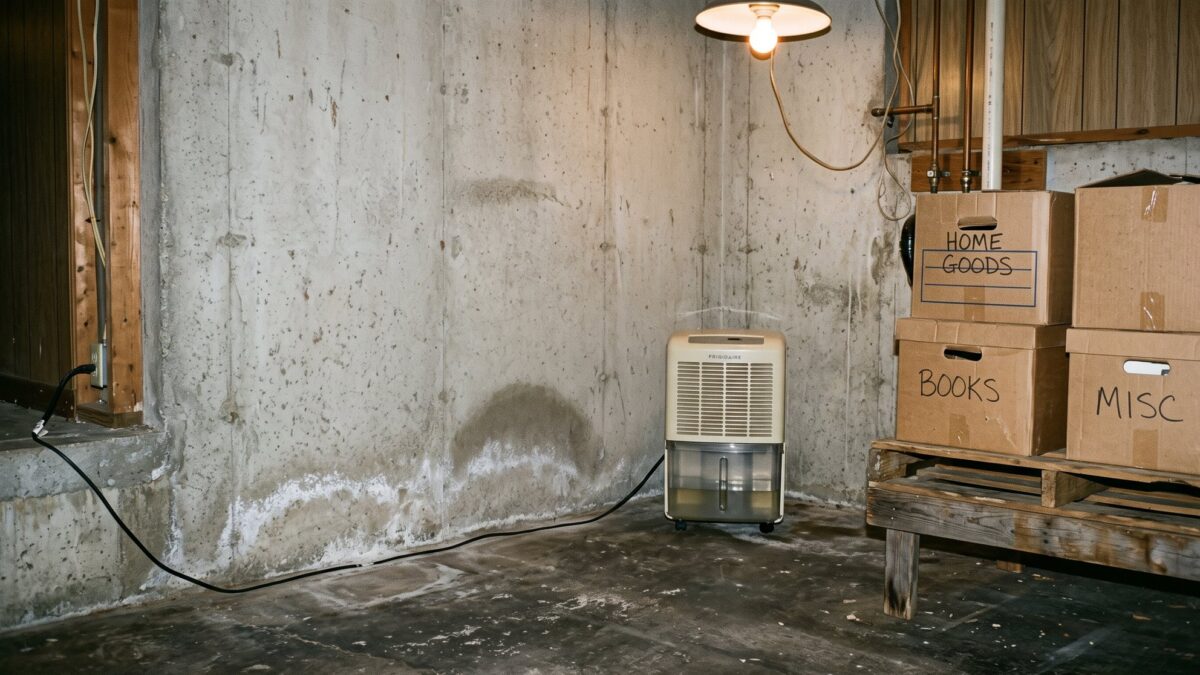
Concrete is porous, so a basement can be wet with no visible leak. Moisture from the clay soil around your foundation passes through walls and floors as vapor, condenses on cool surfaces, or wicks up through the slab, and it evaporates into the room before it ever forms a drip you could point at.
That is the short answer, and the reason it matters is that airborne moisture and soil moisture get opposite fixes. A dehumidifier cannot stop groundwater, and a full basement waterproofing system is the wrong purchase for a condensation problem. Before anyone quotes you anything, you need to know which one you have. This guide walks through where invisible water comes from, the two-dollar tests that trace it, and what each real fix costs in the Chicago area.
Where is the water getting in if nothing is dripping?
Concrete looks solid and behaves like a stiff sponge. Poured walls, block walls and slabs are all threaded with microscopic pores, and when the soil outside is wet, moisture moves through those pores constantly. Most of it arrives as vapor, meaning it enters the room as humid air rather than liquid, so there is never a drip, a puddle or a run mark to catch.
Liquid water can hide too. The cove joint, the seam where the floor meets the wall, is the lowest entry point in the basement, and a slow cove seep behind a workbench or a wall of stored boxes often evaporates about as fast as it arrives. The slab itself wicks water upward by capillary action, which is why a rug or a cardboard box left flat on the floor comes up damp underneath while the exposed concrete around it looks perfectly dry.
The third source is the room’s own air. Warm, humid summer air condenses on anything cool it touches: foundation walls, cold water lines, uninsulated ducts, the slab. That film of condensation reads as a wet basement even though not a drop came through the foundation. Sorting condensation from seepage is the most important step in the whole diagnosis, because every decision after it depends on getting it right.
Why does Chicago clay push moisture through solid concrete?
The soil around Chicago-area foundations is dense glacial clay, and clay is why a basement can stay damp for weeks after the last hard rain. Clay drains slowly, holds water like a reservoir, and keeps the ground against your foundation saturated long after the lawn looks dry. Saturated soil creates hydrostatic pressure, a constant push that drives moisture into every pore and hairline opening the concrete has.
Age stacks on top of geology. Most older homes here drain their footings through clay tile pipes that silt shut over the decades, so water that used to be carried away now sits against the foundation. Winter adds its share: freeze-thaw cycles work hairline cracks a little wider every year, and a crack too fine to see behind paint will still pass vapor. None of this announces itself. A basement can slide from dry to damp so gradually that the first sign is a smell, not water.
How do you find moisture you cannot see?
The foil test settles the biggest question for the price of a strip of aluminum foil. Tape a piece about a foot square to the suspect wall, seal all four edges tight, and leave it for two days. Beads on the room side of the foil mean condensation out of the air. Dampness on the wall side means moisture coming through the concrete. Run it on two or three walls and you have the diagnosis some companies would charge a house call for.
Then read the clues the basement is already leaving out for you.
| The clue | What it usually means | Your first move |
|---|---|---|
| White chalky bloom on the walls | Water is passing through the masonry and leaving minerals behind | Note which walls, then check grading and downspouts outside them |
| Musty smell that never airs out | Ongoing dampness feeding microbial growth somewhere hidden | Run the foil test on the worst wall |
| Damp shadow under rugs or boxes | The slab is wicking ground moisture by capillary action | Lift storage onto pallets and put a gauge on the humidity |
| Sweating pipes and ducts in July | Humid house air condensing on cool metal | Dehumidifier plus a $30 humidity gauge |
| Rusting appliance feet, paint peeling at the floor line | Long-running low-level moisture at the slab | Get an inspection before finishing or storing anything more |
That white bloom deserves a note of its own, because homeowners regularly mistake it for mold. It is efflorescence, dissolved minerals left behind where water evaporated, and it is hard proof that water moves through the wall even if the wall never feels wet. We wrote a full explainer on the white powder on basement walls. Mold behaves differently: it shows up where dampness meets something organic, like drywall paper, wood framing or cardboard.
What does hidden moisture look like at your house?
The hiding places change with the age of the house, because the construction changed. Find your era below.
Pre-war bungalows and two-flats
Brick bungalows and two-flats from the 1910s through the 1940s sit on foundations whose original clay tile drainage retired generations ago, and their basements were built for coal furnaces, not family rooms. Moisture shows up as damp masonry, crumbling mortar and a permanent cellar smell that owners write off as how old basements are. It is not character; it is a moisture reading. In bungalow towns like Berwyn, where the housing stock is nearly all pre-war, much of the basement waterproofing work we do starts with vapor moving through walls that have not seen liquid water in years.
Post-war block ranches and Georgians
Concrete block is hollow, and the cores inside a block wall can hold water like a rain gauge. A 1950s or 60s block foundation can be storing gallons inside the wall while the painted face stays dry to the touch, releasing it slowly into the room as vapor. The telltales are efflorescence tracing the mortar joints and a damp line at the cove after wet weeks. Block walls that stay saturated also bow under clay pressure eventually, which is why we treat a chronically damp block wall as seriously as a visibly wet one.
1980s and 90s poured walls
Poured walls from this era weep through shrinkage cracks and tie rod holes, and a hairline crack behind a finished wall can feed moisture into insulation and drywall for years without one visible drip. If a finished basement smells musty after storms, the leak is very often behind the finish. A moisture meter run along the base of the drywall finds it without demolition, which is exactly how we check finished spaces on inspections.
Newer subdivision homes
Houses from the late 1990s on usually have working perimeter drainage and a sump, so hidden moisture there is more often airborne: humid summer air condensing in a cool basement, sometimes helped along by grading that settled back toward the foundation in the first decade. If your basement turns humid every summer and dries out by October, start with the air, not with excavation.
Whatever the source turns out to be, the fixes carry published prices, and the distance between the cheap end and the complete end is exactly why diagnosis comes first.
What the real fixes cost
- Humidity gauge to confirm the problemabout $30
- Downspout extensions and regrading$600 to $2,500
- Urethane crack injection$450 to $900 per crack
- Interior drain tile$95 to $160 per linear foot
- Full perimeter system with sump$8,000 to $16,000
These are our published ranges, the same numbers we quote from in every county we serve.
When is a damp basement not a waterproofing job?
Some damp basements need a $30 gadget, not a contractor. If the foil test shows room-side condensation, buy a dehumidifier and a humidity gauge, hold the space near 50 percent, and reassess after a month. Insulating cold water lines and keeping basement windows shut on humid days costs almost nothing and can remove the water source entirely.
Some need a plumber. A slow supply line leak inside a wall, a sweating water heater or a failing drain line under the slab can imitate seepage closely. One free check: write down the water meter reading at night, run no water, and read it again in the morning. Movement on the meter means a plumbing leak, and no waterproofing system on earth fixes that.
And anything at the floor drain is a sewer question, not a wall question. In older suburbs on combined sewers, hard storms push water back up the drain line, and the right fix runs through a plumber and possibly a backflow device. We cover that whole situation in why water comes up through the floor drain, and on inspections we say plainly when a problem belongs to a different trade.
What should you do next?
First, run the free tests this week. Foil on the dampest wall, a water meter reading overnight, a $30 gauge on the shelf. Two days of evidence beats an hour of guessing, yours or anyone else’s.
Second, walk the outside during the next hard rain. Watch where the downspouts discharge, where water stands, and whether the ground slopes toward the house. If roof water is landing beside the foundation, downspout extensions and regrading at $600 to $2,500 may be the entire fix.
Third, if the moisture is coming through the concrete, get it diagnosed in writing. We inspect free within 48 hours, trace the source with meters instead of guesswork, and price any fix from published ranges. When you want the entry point found instead of guessed at, book the free inspection or call (630) 335-1128.
Questions homeowners ask about hidden basement moisture
Can water come up through a concrete floor without a crack?
Yes. A slab is porous, and when the soil beneath it is saturated, capillary action pulls moisture up through the concrete itself. The classic sign is a damp shadow under anything left flat on the floor, cardboard, rugs, plywood, while the open concrete around it looks dry because evaporation keeps pace. Persistent slab moisture usually means water is sitting at the footing, which is the problem interior drain tile exists to relieve.
Why do my basement walls feel damp but never drip?
Vapor moves through concrete long before liquid does. Saturated clay presses moisture into the wall’s pores, it migrates through, and it evaporates off the interior face straight into the room air, so the wall feels clammy without a single run mark on it. That constant evaporation is also why chronically damp basements smell musty: the water arrives every day, but it leaves as humidity instead of puddles.
Is a dehumidifier enough to fix a damp basement?
Only when the moisture starts as airborne humidity. A dehumidifier handles summer condensation well and costs little to run, but if water is entering through the walls or the slab, the machine simply processes an endless supply while the source keeps pushing more through. The foil test tells you which side of that line your basement is on before you spend anything bigger than $30.
Can a finished basement hide a leak for years?
Easily. Framing and drywall stand an inch or two off the foundation, so a weeping crack can wet that cavity season after season while the painted surface stays perfect. The giveaways are a musty smell after storms, staining at the baseboard and drywall that feels soft along the floor line. A moisture meter run along the bottom of the wall finds the trouble without tearing anything open.
Hidden moisture never stays hidden; it turns into stains, smells and repair bills on its own schedule. A free inspection within 48 hours puts a meter on the problem and a published price next to the fix, and every interior system we install carries a lifetime, fully transferable warranty. Call (630) 335-1128.


