
The quick answer
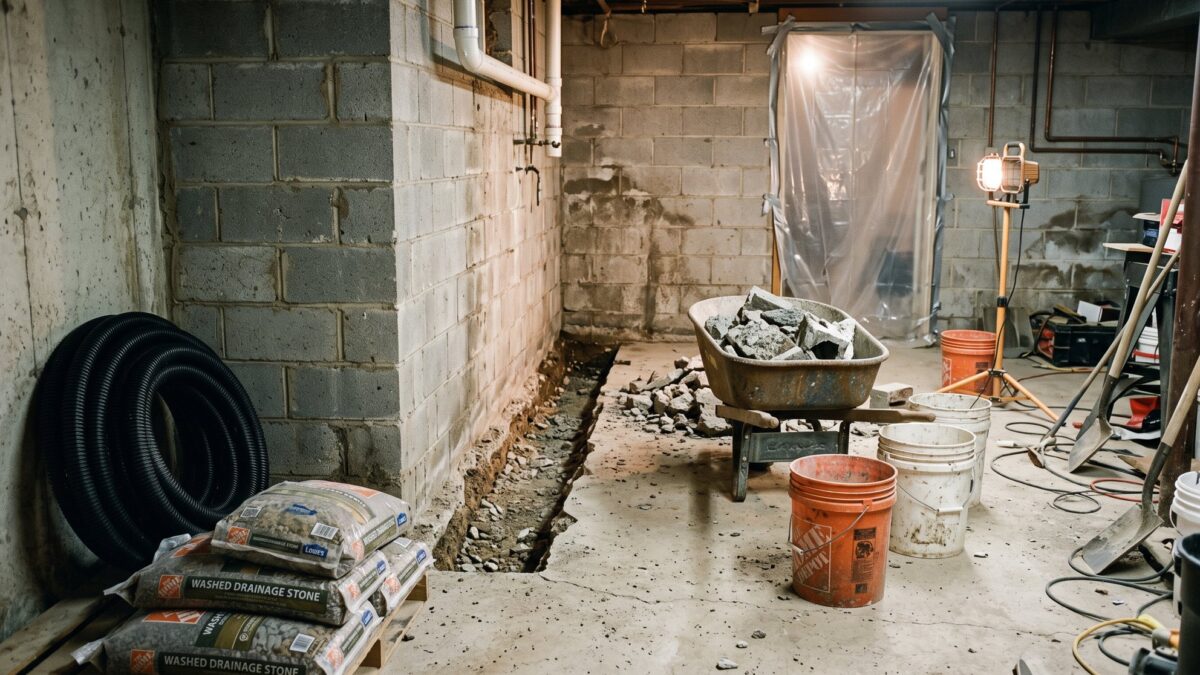
Most basement waterproofing takes one to three working days. Urethane crack injection is a two-hour visit. A sump pump with battery backup is most of one day. A full perimeter interior drain tile system in an average Chicago-area basement runs two to three days, floor cut through concrete restoration, and your house stays livable throughout.
Those are crew days, and crew days are only half of the answer homeowners are actually asking about. The other half is the calendar: how fast someone comes out, how long the schedule is in April, how many hours after the pour before you can stack boxes against the wall again. A basement waterproofing project is closer to a long appliance install than to a remodel, and the reason it stays that short is that almost none of the work happens outside in the weather. This post gives both clocks, the crew clock and the calendar clock, plus the handful of things that genuinely add days.
How long does each waterproofing job take?
Duration tracks how much concrete has to move. A fix that touches no concrete is measured in hours. A fix that opens a channel around an entire basement is measured in days. Nothing in this trade, done correctly on a normal house, is measured in weeks.
Crew time, job by job
- Urethane crack injection, single crackabout 2 hours
- Downspout extensions and regradinghalf a day to a full day
- Sump pump with battery backup4 to 8 hours
- Interior drain tile, one wallusually 1 day
- Full perimeter system with basin and discharge2 to 3 days
- New concrete before heavy use24 to 48 hours after the pour
Times are for an average basement with clear working access. Structural additions such as carbon fiber straps or wall anchors are scheduled and quoted separately.
Read that list next to the price list and the pattern makes sense. Interior drain tile is $95 to $160 per linear foot and a full perimeter lands at $8,000 to $16,000, which sounds like a project measured in weeks until you watch it happen. It is a saw, a trench, pipe, stone, a basin and a pour, repeated around the room. The single most common surprise on our jobs is not that the work took longer than promised. It is that a homeowner cleared their whole week for something that was finished Wednesday afternoon.
The calendar around those crew days is more variable, so here is the whole sequence from the first phone call to the day you put the storage shelves back.
| Stage | What happens | Typical time | What you do |
|---|---|---|---|
| Free inspection | We measure the perimeter, check the pump and grading, write the scope and price | Within 48 hours of your call | Clear a path along the walls |
| Scheduling | Crew date set, permits handled where a village requires them | Days to a few weeks, longest in spring | Pick a date, arrange financing if you are using it |
| Prep | Belongings pulled several feet off the walls, work path protected | One evening | Move boxes, shelving and anything fragile |
| Installation | Cutting, excavation, pipe and stone, basin, discharge, concrete | 1 to 3 days | Stay reachable, keep pets upstairs |
| Cure and walkthrough | New concrete sets, debris hauled out, system tested with you watching | 24 to 48 hours | Wait on flooring, run water in the pit |
Our full sequence, including what the crew does before the first cut, is laid out on our process page. Nothing in it requires you to move out, take a week off, or empty the basement to the studs.
Why does a permanent fix only take a few days here?
Because in this region the work happens indoors, at footing depth, on a fixed length of wall. The Chicago area sits on dense glacial clay that holds storm water against foundations and builds pressure lowest and hardest at the footing. The fix is to intercept water at that elevation, which is reachable from a narrow strip of your basement floor. No excavator, no waiting on a dry week, no lot to restore afterward. That is why an interior system is measured in days while exterior excavation on a landscaped lot turns into a project with a lawn to rebuild at the end.
The second reason is that the failure being corrected is predictable. Most houses here were built with clay tile footing drains that silt shut over decades, so crews are not diagnosing a mystery on site, they are replacing a known dead system with modern pipe and washed stone. The floor gets opened, the old condition gets confirmed, the new run gets pitched to a basin. The day-by-day breakdown of a drain tile installation covers what that looks like hour by hour, and how much of your basement floor actually gets cut answers the question most people ask second.
How long will it take at your kind of house?
Access drives the schedule more than square footage does, and access is mostly a function of when your house was built.
Pre-war bungalows and two-flats
These basements have low ceilings, a maze of mechanicals, an old boiler in the middle of the room and stairs that were never meant to carry a wheelbarrow. The linear footage is modest, but every bucket of spoil travels farther, so budget the upper end of the range: two to three days for a full perimeter, sometimes a fourth on stone foundations where the wall face has to be dealt with. On a tight city lot, that is still faster than any approach involving the gangway.
Post-war block ranches and Georgians
Open rectangular basements with a walk-out stair are the fastest houses we work in. A full perimeter with wall drainage on a 1950s or 60s block foundation is commonly a two-day job. The variable in this era is structural: a wall that has started to bow needs reinforcement scheduled alongside the drainage, and carbon fiber straps at $600 to $1,000 per strap add hours rather than days, while wall anchors add a day and involve the yard.
1980s and 90s poured walls
This is the era with the shortest visits. A single weeping shrinkage crack is injected in about two hours at $450 to $900, with a 10-year warranty, and you are using the room that evening. Three cracks is a half day. What turns this house into a multi-day job is discovering that the cracks were a symptom of drainage failure, in which case you are back in the two to three day perimeter range, which is exactly why we inspect before quoting.
Newer subdivision homes
Houses built since the late 1990s usually need the smallest intervention, and it is usually the fastest one on the list. Swapping a builder-grade pump for a properly sized unit with battery backup at $2,800 to $4,500 is a same-day job, done between breakfast and dinner. Add exterior downspout and grading corrections and you have a one-day project that protects a house whose buried drainage is otherwise fine.
What makes a job take longer than quoted?
Honest scheduling means naming the things that add time before the crew arrives, not after. These are the ones that actually move our numbers.
- A finished basement. Removing and protecting the lower few feet of drywall, trim and flooring along the work path adds most of a day, sometimes more if the framing sits tight to the wall.
- Thick or reinforced slabs. Some older pours and some 1990s slabs are thicker than the norm or carry wire. Cutting is slower and spoil volume goes up.
- Stuff against the walls. The single most common delay we see costs nothing to prevent. A crew that spends the first two hours moving a workshop is a crew that finishes a day later.
- Water arriving during the work. A basement actively taking water gets pumped and managed first. It does not stop the job, but it slows it, and it is one more reason not to schedule your fix for the wettest week of April.
- Structural work stacked on drainage. Beams, anchors or piers are separate operations with their own crews and their own warranties. Piers at $1,600 to $3,000 each involve exterior excavation and add days.
- Winter ground. Interior work runs year round in this region, but any exterior component, a discharge line, a French drain, regrading, waits for workable soil. Timing is covered in the best time of year to waterproof a basement in Illinois.
When should you not be in a hurry at all?
Speed is worth something only when the fix is the right one. Here is when the schedule question is the wrong question.
One wet event with a cause you can point at. A window well full of maple seeds or a downspout that came apart in a windstorm explains itself. Fix the cause for a few dollars, dry the floor, and give it a season of real rain before you book anybody. Watching costs nothing and is sometimes the entire repair.
Water coming up instead of in. If it surfaces at the floor drain during heavy storms, this is a sewer capacity issue, common in older suburbs where storm and sanitary lines share a pipe, and no waterproofing schedule applies. Start with why water comes up through a floor drain and then a plumber. We will tell you the same thing on an inspection.
An estimate with an expiration date on it. A discount that dies when the salesperson pulls out of your driveway is a timing pressure, not a schedule. Real crews have real calendars and a real price that is still real next week. If someone needs your signature tonight, the rush belongs to them.
The exception runs the other way. If water is actively coming in right now, we answer 24/7 for active flooding, because at that point the clock that matters is the one on your furnace and your flooring, not the install schedule.
What should you do next?
First, measure your own perimeter. A tape measure and ten minutes gives you the linear footage of every wall that leaks. That single number turns “how long will this take” into an answer anyone can give you over the phone, and it makes shopping estimates honest.
Second, clear the work zone before you book. Pull storage, shelving and workbenches four to six feet off the walls that need work. It is free, it is a Saturday, and it reliably takes a day off the job.
Third, get a dated schedule alongside the price. We inspect free within 48 hours and hand you both numbers: what it costs from our published ranges, and how many days our crew will be in your basement. Ask for an install window on our free estimate form, or call (630) 335-1128 and we will tell you where the calendar stands this month. If the timing is right but the budget is not, financing at 0% for 12 months keeps the date without the lump sum.
Questions homeowners ask about the install schedule
Do I have to be home while the crew works?
Someone should be there at the start to walk the scope and at the end for the walkthrough, but you do not need to sit downstairs for two days. Most homeowners are at work in the middle of the job. Our crews are our own employees, insured under a $2,000,000 general liability policy, and we set the access arrangement with you in advance rather than assuming you can take the week off.
Is the basement usable while the work is going on?
The rest of the house is normal. The basement itself is a job site during working hours: a concrete saw is loud, dust control runs continuously, and the work strip is off limits. Laundry usually stays available, and your furnace and water heater keep running unless a mechanical sits directly in the trench line, which we flag at the inspection rather than on the morning of day one.
How far ahead do I need to book a spring job?
Spring is the busiest stretch of the year in this region, because everyone discovers their basement during the same three storms. Lead times stretch from days to a few weeks in March through May, and shorten again by late summer. Inspections stay at 48 hours regardless of season, so getting measured early costs nothing and holds your place if you decide to move forward.
When can I put flooring back over the new concrete?
Give the pour 24 to 48 hours before normal traffic and storage. For finished flooring, especially vinyl plank, tile or anything with adhesive, wait longer and let the slab release its moisture; a week is a reasonable minimum and flooring manufacturers publish their own requirements. Painting the lower wall strip can happen sooner. Nobody has ever regretted waiting an extra weekend on this step.
Two or three days is what a permanent dry basement actually costs you in time, and most of that time you are upstairs. A free inspection within 48 hours puts a real date and a published-range price on your job, and the interior system that goes in is backed by a lifetime, fully transferable warranty: call (630) 335-1128 to claim a slot.


